
Month: June 2009
SANJHI VIRASAT (an announcement)
Celebrate South Asia’s Shared Heritage
SANJHI VIRASAT (shared heritage) is an afternoon of South Asians getting together to celebrate a shared heritage of history, ideas, culture and struggle. The attempt is to foster bridges of peace and understanding through discussion, songs, poems, etc.
Date: June 6th
Time 2.30 pm
Venue: Dept of Physics, Room no 1201.
Universtiy of Maryland, College Park Campus
Talks:
Dr. Shamsul Islam, University of Delhi and
Neelima Sharma: “Four decades of cultural activism: Theater as a vehicle for democratization, secularism and justice”
Sameer Dossani: Recent happenings in Pakistan
Nishrin Hussain: tba
Poems:
Begum Nuzaira Azam and Dr. Abdullah: Hum Ek Hain, Hum Ek Hain
Priya Ranjan: Ho Gayee hai pid parvat …
Music:
Khiyali
Shirin
Kundalika group,voices,tabla, sitar
Arpita Gogoi and friend
Dances: tba
At the conclusion of the above we plan to adjourn to Mohan Bhagat’s house for informal get together and snacks (the location is 5011 Tecumseh Street, College Park, some 4 lights north of campus off route 1)
New Warning on Hormone Replacement
By Andrew Pollack (New York Times)
Hormone therapy taken by women to counter the effects of menopause can increase the risk of dying from lung cancer, researchers reported here on Saturday.
The findings represent the latest black mark against a therapy already being used much more sparingly than it once was. But researchers said the new data should serve as a caution to women who did continue to take hormones not to smoke.
“We shouldn’t be using both combined hormone therapy and tobacco at the same time,” said Dr. Rowan Chlebowski of the Harbor-U.C.L.A. Medical Center in California and lead author of the study, which was presented at the annual meeting of the American Society of Clinical Oncology.
Dr. Chlebowski said there was one avoidable lung cancer death over eight years for every 100 women who both smoked and took hormone therapy.
The new analysis used data from the Women’s Health Initiative study, in which women took either Prempro, a drug combining estrogen and progestin, or a placebo. The study was discontinued in 2002 after it was found that the hormone therapy increased the risk of breast cancer.
The new analysis looked specifically at lung cancer for the five and a half years that the women took either the drug or the placebo and for more than two years afterward.
New York Times for more
PAKISTAN: A chilling tale of police torture
A Statement by the Asian Human Rights Commission
Since the Asian Human Rights Commission (AHRC) first reported on the torture of Mr. Fazal Abbas and his family by police earlier this month, details of escalating brutality have continued to become public, particularly in the case of Abbas’ brother-in-law, Mr Shafiq Dogar. The events are horrifying enough on their own, but when one imagines the number of police officers and court members who either carried out the torture or allowed it to go ahead, across the province, Pakistani law enforcement is cast in a particularly bare, ugly light.
Fazal, his young sisters, his mother and his brother in law were all tortured in April at the Airport Police Station Rawalpindi and their ordeal was allegedly arranged and aided by family members of Fazal’s new wife Khulsoom, including MPA Mr. Iftekhar Baloch, in revenge for a marriage that they hadn’t approved. Please see: One victim, a sixteen-year-old girl has yet to be found, even though she was seen being beaten and driven away in a car with Iftekhar Baloch, who remains at large.
Mr. Shafiq Dogar was subjected to which included torment of various imaginative kinds, including his rape, after which red chili powder was put into his anus. Dogar’s wife Riffat Rani and her younger sisters, 12 and 19, were also beaten by policemen and by law maker Iftekhar Baloch and arrested on trumped up charges, and since their release, have been threatened by Iftekhar Baloch.
However it is in the details of relentless abuse which we are able to provide here, that patterns emerge: of impunity and corruption. In the chronology below a disturbing relationship comes to light between Kulsoom’s family–wealthy mill-owners and a provincial assembly member–the lower judiciary and the police, the latter two working under the direction of the former, somewhat like hired thugs. It is particularly unpleasant to note that in each case the lower judiciary has acted as little more than a safe haven for the officers, who at one point had to push Dogar into court in a wheelchair because he could no longer walk.
Asian Human Rights Commission for more
(Submitted by Abdul Hamid Bashani Khan)
Fleischer criticizes Obama’s Cairo speech as being too ‘balanced.’
Today, former Bush press secretary Ari Fleischer told CBS that he disapproved of President Obama’s speech in Cairo about the U.S. relationship with Muslim communities around the world. His problem with the speech? It was too “balanced”:
Fleischer bluntly told [CBS’s Mark] Knoller, “bottom line — the speech was balanced and that was what was wrong with it. American policy should not be balanced. It should side with those who fight terror.” […]
Knoller asked Fleischer if he heard much that is at odds with Bush administration policy.
“In part, it was similar to Bush’s constant message that both sides had obligations to fulfill,” he responded. “But Bush always leaned — privately and publicly — in Israel’s direction because they were being hit with terror attacks. Obama really wants to be in the middle. Bush took sides and was sometimes blunt about it.”
The Obama administration has faced criticism for being too balanced in the past. In January, Abe Foxman of the Anti-Defamation League called George Mitchell, Obama’s top diplomatic envoy to the Middle East, too “fair” and “even-handed.” As Matt Yglesias responded, “[N]obody comes out against fairness. It’d be one thing to complain [about being] biased against Israel in a problematic way, but…complaining that he’s too fair and even-handed” is “absurd.”
(Submitted by reader)
A tragedy of errors and Cover-ups – The IDPs and outcome of military actions in FATA and Malakand Division
By Human Rights commission of Pakistan
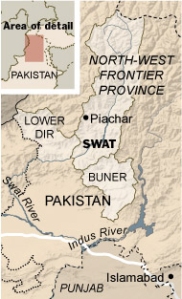
Lahore: The Human Rights Commission of Pakistan (HRCP) is convinced that the cost of the insurgency in the Malakand Division has been increased manifold by the shortsightedness and indecisiveness of the non-representative institutions and their policy of appeasing the militants and cohorting with them. While the ongoing military operation had become unavoidable, it was not adopted as a measure of the last resort. Further, the plight of the internally displaced people has been aggravated by lack of planning and coordination by the agencies concerned, and the methods of evacuation of towns/villages and the arrangements for the stranded people have left much to be desired.
Based on reports by HRCP activists in the Malakand Division and other parts of NWFP/Pakhtunkhwa, visits to IDP camps by its activists and senior board members, and talks with many displaced people and several Nazims and public figures, the commission has released the following statement on the situation, its conclusions and recommendations:
Background:
The Human Rights Commission of Pakistan (HRCP) has reported, time and again over the last many years, on the rising exodus of IDPs from FATA and the Malakand Division, owing to deteriorating security situation, and warned the government of the consequences. IDPs in Balochistan have also been an issue of concern and separate statements on it have been issued by HRCP.
For over two decades the government of Pakistan, in particular the military, tolerated, if it did not collude with them, the religious militants and extended impunity to them as well as to all forms of acts of religious intolerance. It was common knowledge that international as well as national religious militants had safe havens in the country. After September Eleven, militants of all shades were reinforced and given a free hand to organize themselves at the cost of the freedom of the local population in FATA. Other parts of the country also continued to suffer but initially parts of FATA (Federally Administered Tribal Area) became the central hub of all militant groups, local, national, regional and international. The Musharraf government did not simply turn a blind eye but by all accounts, (including those of IDPs), several incidents revealed a policy to protect certain leaders of militant groups. The government has never given a satisfactory explanation on the supply lines of finances, vehicles, arms/ammunition and petrol that the militants have never been short of. This is particularly questionable in the case of Swat, which is a settled area and surrounded by territory in control of the government.
Amongst other reports, a number of credible sources (including official sources) confirmed that in December 2006, a vehicle was impounded by SHO Amir Zaman of police station Kabal, which was full of explosives. The destination of this pick-up was the Dera (house) of Fazallullah, popularly known as Maulana Radio. The SHO who impounded the vehicle was ordered by phone to stop all proceedings till higher police officials instructed him to proceed in the matter. As the DIG of the area was on leave, SP Qudratullah Marwat is said to have personally ordered that the van be released with the explosives as he had instructions from “higher authorities” to release the pick-up. In addition a number of other well placed sources confirmed that groups of militants from Waziristan were officially escorted to Swat in 2007.
Human Rights Commission for Pakistan for more
(Submitted by reader)
Creativity best way to stop plagiarism [China]
By Li Xing (China Daily)
Recently a Chinese blogger discovered two academic theses that had been published online with the same research structure, the same wording, and almost the same title, inciting thousands of Internet users to join in condemning plagiarism.
Of course, there were differences between the two papers. One was published in July 2007, the other not until March 2008. They were written by graduate students in economics at two different universities and cited figures from two different provinces, one in the northeast and the other in the Yangtze River valley.
Before the university in Northeast China announced its decision to strip the author of the second paper of his master’s degree on Monday, China Youth Daily revealed another case of plagiarism, in which a student from Central China copied the thesis of another student. He changed only the dedication of the thesis, prompting critics to label his work “the rankest sort of plagiarism”.
This wave of plagiarism comes hard on the heels of an incident barely three months ago, in which the perpetrator was stripped of his associate professorship, his research team leader sacked, and his academic advisor removed as college dean.
In all the uproar, I also detect a note of resignation. Plagiarism is pretty common these days, with students sharing tales of how they managed to write their theses in a couple of weeks.
Graduate students are not the only culprits. I’ve leafed through several volumes of contemporary history and discovered that few of them have adequate indexes and references, even though many paragraphs or even pages of text clearly come from familiar sources, such as old media articles or published memoirs. Such works set a bad example for today’s students.
Critics place the blame on a number of factors, ranging from professors’ ignorance to universities’ lax supervision to students’ lack of self-discipline.
But I share the view of a few bloggers that the core problem is a lack of emphasis on creative and critical thinking throughout our children’s education. Kindergarten teachers are too quick to correct toddlers who paint the sun or the moon as squares in different colors. In primary schools, teachers favor pupils who do not ask too many questions.
Throughout the middle school years, students are restricted to standard textbooks and a few reference materials that are thought to ensure high scores on the national college entrance examinations.
Throughout a child’s secondary education, teachers encourage uniformity, instead of diversity. By the time they enter college, many students have lost interest in developing their own ideas or exploring their own areas of interest.
China Daily for more
on our honor
By Kelly Zen-Yie Tsai
the old school mc
pours drinks at the bar,
rhymes for the patrons,
teaches the kids in the
kindergarten, waits in
the welfare line.
the promise of hip hop
plated beneath gold teeth,
platinum chains,
spotless rims on the range
rover, that keeps him living at
his grandmother’s house.
the promise of hip hop
recycled in disposable
beats, inedible tracks,
as the original b-boys
and b-girls scramble for traction
on vanishing ground.
out-marketed, out-packaged,
out-industry-ed, out-done —
aging dreams aflame
on the horizon —
we did it for the love,
for the love,
for the love.
Visit Kelly Zen-Yie Tsai’s site Yellow Gurl
How Cells Communicate During the Fight or Flight Response
When our senses perceive an environmental stress such as danger or a threat, cells in the nervous and endocrine systems work closely together to prepare the body for action. Often referred to as the fight or flight or stress response, this remarkable example of cell communication elicits instantaneous and simultaneous responses throughout the body.

Initiating the Response
Sensory nerve cells pass the perception of a threat, or stress, from the environment to the hypothalamus in the brain. Neurosecretory cells in the hypothalamus transmit a signal to the pituitary gland inciting cells there to release a chemical messenger into the bloodstream. Simultaneously, the hypothalamus transmits a nerve signal down the spinal cord. Both the chemical messenger and nerve impulse will travel to the same destination, the adrenal gland.
Keeping the Signal Going
Sitting atop the kidneys, the adrenal glands receive nerve and chemical signals initiated by cells in the hypothalamus. Nerve signals activate the release of epinephrine into the bloodstream.
When chemical messengers arrive via the bloodstream, they dock on to receptors and begin a cell signaling cascade that results in the production of cortisol. Cortisol is released into the blood stream where it begins signaling cascades in several cell types, resulting in an increase in blood pressure, increase in blood sugar levels, and suppression of the immune system.
University of Utah for more
Peter Sellers in Being There (Movie Trailer)
“Peter Sellers in one of his final roles-as a man without friends without family, and without a past.”