Australian singer Sia (Kate Isobelle Furler) sings Healing is difficult


From her Healing Is Difficult CD, the title track. Here are some lyrics:

Healing is difficult
Often results in psychosomatic
I admit to enjoying drugs
They get rid of tension, boredom and static
Hate those adverse side effects
Forcing the people who love me to scatter
Excuse me for being such a hypocrit
The way I see it really doesn’t matter

Why do you cock your head to the side when you look at me
Why are my skills in bed more important than sanity

Why do you cock your head to the side when you look at me
Why are my skills in bed more important than sanity

To tell you the truth
I can’t believe I love you so much
So much in fact that I don’t know whether to weep or wind my watch
I have a sick sense of humour
It amazes me how many points it scores
I’m addicted to vice
My best friends are pushers, my boyfriends are whores

Why do you cock your head to the side when you look at me
Why are my skills in bed more important than sanity

Why do you cock your head to the side when you look at me
Why are my skills in bed more important than sanity

Simple to see why I breathe
No one bothers me completely

Simple to see why I breathe
No one bothers me completely

Why do you cock your head to the side when you look at me
Why are my skills in bed more important than sanity

Why do you cock your head to the side when you look at me
Why are my skills in bed more important than sanity

Waking up next to you
Your morning breath reminds me of Lucy
The flies in the frontroom
Buzz round my head and try to seduce me
If I contract illness
The last thing I want is to pass it to others
Fucking leaves guilt pangs
When I start forgetting the names of my lovers

Why do you cock your head to the side when you look at me
Why are my skills in bed more important than sanity

Why do you cock your head to the side when you look at me
Why are my skills in bed more important than sanity…
(Submitted by Sogul Azad)
Burka speech should not be mistaken for Islam baiting

Published: June 24 2009 18:45

It was a strange throwback to the halcyon days of the early 2000s, before the economic crisis, when European politicians had little more to worry about than what Muslims wear. Nicolas Sarkozy, France’s president, speaking on Monday amidst the very pre-crisis opulence of Louis XIV’s palace of Versailles, attacked an item of clothing that few French people ever see: the burka. “It’s a sign of abasement,” he told parliamentarians. “The burka is not welcome on the territory of the French republic.”

It all sounds like a rerun of Europe’s rhetorical wars of religion that followed September 11 2001. But in fact we are in a new era. It’s true that Mr Sarkozy’s speech signalled a break with French Muslim organisations. However, in this new era, European toughness with Muslims has limits. Mr Sarkozy accepts Islam’s presence in Europe. Few mainstream European politicians still regard the religion as an “enemy within”. The “burka speech”, made in a calmer climate, chiefly intends to draw the boundaries of a European Islam.
FT for more
(Submitted by reader)

China argues to replace US dollar

Friday, 26 June 2009

China’s central bank has reiterated its call for a new reserve currency to replace the US dollar.

The report from the People’s Bank of China (PBOC) said a “super-sovereign” currency should take its place.

Central bank chief Zhou Xiaochuan has loudly led calls for the dollar to be replaced during the financial crisis.

The bank report called for more regulation of the countries that issue currencies that underpin the global financial system.

“An international monetary system dominated by a single sovereign currency has intensified the concentration of risk and the spread of the crisis,” the Chinese central bank said.

The dollar fell after the report was released. The US currency dropped 1% against the euro to $1.4088, and declined 0.8% versus the British pound to $1.6848.

SDRs
Mr Zhou caused a stir earlier this year when he said the dollar could eventually be replaced as the world’s main reserve currency by the Special Drawing Right (SDR), which was created as a unit of account by the IMF in 1969.

BBC for more

Zar Gul

Lahore Film and Literary Club presents screening of film: “Zar Gul “
Written and directed by Salman Peerzada

Reflecting a difficult period of transition in Pakistan’s history Zar Gul’s story is set against the backdrop of Pakistani politics, which lie at the heart of the conflict in so many human stories. The film describes the endemic political turmoil and injustice created by the corrupt, autocratic and vicious politics of the feudal system.

Writer-director Salmaan Peerzada’s Zar Gul took five years from raising the finance to final print. It is the first independent British/Pakistani co-production, shot on location in Pakistan, post-produced in England.

Salman Peerzada will be joining us for discussion after the film

Date: Saturday 27th June 2009
Venue: South Asian Media Centre, 177-A ,Shadman2
Time: 6:30 pm

For information contact: 0300-4591184
Ms Sarah Tareen
Coordinator

South Asian Documentary Festival
Lahore Film and Literary Club
177-A,Shadman-2,Lahore

South Asian Media Centre.
(92-42) 7555621-8

Lonely in the Crowd


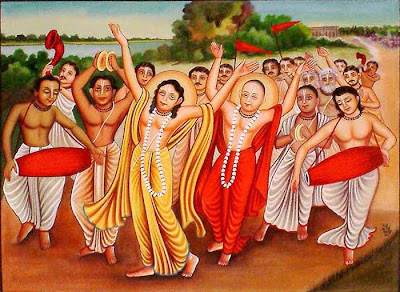
(A Pattachitra painting of Sri Chaitanya Dev)

The Bhakti movement in Indian literature focused on singular devotion, mystical love for God, and had a particular focus on a personal relationship with the Divine. Given their belief in the centrality of personal devotion, poet-saints were highly critical of ritual observances as maintained and fostered by the Brahmin priesthood. Though the Bhakti movement had its genesis in southern India in the 6th century AD, it didn’t gain momentum until the 12th century in the central western regions of India. It then moved northward, coming to an end roughly in the 17th century.

But strangely enough, if we compare the gender basis participation ratio of saint-poets, we find the inclusion of women in this movement was tempered. It is also true that there is little evidence to support any type of revolt against the patriarchal norms of the time. Women bhaktas (disciples) were simply staying largely within the patriarchal ideology that upheld the chaste and dutiful wife as ideal. These women transferred the object of their devotion and their duties as the “lovers” or “wives” to their Divine Lover or Husband. Nonetheless, that their poetry became an integral aspect of the Bhakti movement at large is highly significant and inspirational for many who look to these extraordinary women as ideal examples of lives intoxicated by love for the Divine.

Andal Thiruppavai (a 10th century Tamil poetess), Akka Mahadevi (a 12th century Kannad poetess), Janabai (a 13th century Marathi poetess), Meera Bai of 16th century in Hindi and Madhavi Dasi in that century in Oriya literature were some poetesses who wrote exquisite poetry that has been passed on through bards and singers throughout India. But strangely enough, they had to face the challenge from the patriarchal society, whereas no male poets of their time had to encounter such bitter experiences. These female poets were often blamed by their husbands for acting opposite to marital practices while no evidence was found that the wives of the male poet-saints raised voices against the divine love affairs of their husbands.

Complete Blog
here

(Submitted by Sarojini Sahoo)

Carvings From Cherokee Script’s Dawn


LETTERS Characters in a Kentucky cave that may be the earliest examples of the script

By JOHN NOBLE WILFORD
(NY Times)

The illiterate Cherokee known as Sequoyah watched in awe as white settlers made marks on paper, convinced that these “talking leaves” were the source of white power and success. This inspired the consuming ambition of his life: to create a Cherokee written language.

Born around 1770 near present-day Knoxville, Tenn., he was given the name George Gist (or Guess) by his father, an English fur trader, and his mother, a daughter of a prominent Cherokee family. But it was as Sequoyah that around 1809 he started devising a writing system for the spoken Cherokee language.

Ten years later, despite the ridicule of friends who thought him crazed, he completed the script, in which each of the 85 characters represented a distinct sound in the spoken tongue, and combinations of these syllables spelled words. Within a few years, most Cherokees had adopted this syllabary, and Sequoyah became a folk hero as the inventor of the first Native American script in North America.

It may be, as is often noted, that his achievement is the only known instance of an individual’s single-handedly creating an entirely new system of writing.
NY Times for more

Evolution faster when it’s warmer

By Victoria Gill
Science reporter, BBC News

The results could help explain why the warm tropics are so species-rich

Climate could have a direct effect on the speed of “molecular evolution” in mammals, according to a study.

Researchers have found that, among pairs of mammals of the same species, the DNA of those living in warmer climates changes at a faster rate.

These mutations – where one letter of the DNA code is substituted for another – are a first step in evolution.

The study, reported in Proceedings of the Royal Society B, could help explain why the tropics are so species-rich.

DNA can mutate and change imperceptibly every time a cell divides and makes a copy of itself.

But when one of these mutations causes a change that is advantageous for the animal – for example, rendering it resistant to a particular disease – it is often “selected for”, or passed down to the next few generations of that same species.

Such changes, which create differences within a population but do not give rise to new species, are known as “microevolution”.

BBC for more

El Salvador: Promises, Perils and Reality

By Danny Burridge

On June 1, 2009, Mauricio Funes of the Farabundo Marti National Liberation Front (FMLN) was sworn in as the first leftist president of El Salvador. Funes rode a wave of popular will for change after 20 years of devastating neoliberal policies implemented by successive Nationalist Republican Alliance (ARENA) governments. His victorious candidacy was also helped along by its novelty: Funes is a widely respected former journalist and a progressive political outsider.

Funes overcame both a ruthless smear campaign engineered by the right wing and the institutionalized fraud endemic to the Salvadoran elections that favor ARENA. Massive voter turnout prevailed over both obstacles, handing him a slight majority at the ballot box – though recent opinion polls show he enjoys the support of around 80 percent of the public.

In his inauguration speech, Funes promised the social and economic reconstruction of El Salvador under a “government of national unity.” He twice invoked the legacy of the martyred bishop Óscar Romero, assuring that the only sector privileged by his government would be the poor. Funes promised to fight corruption and tax evasion, to streamline government institutions, and to maintain an independent foreign policy. In fact, one of his first acts as president was to re-establish diplomatic and commercial relations with Cuba, leaving the United States as the only country in the hemisphere with out formal ties to Havana.
ALAI for more

The attacks on Indian students in Australia set off a wave of anxiety

Anguish in Australia

P.S. SURYANARAYANA in Singapore (REUTERS)

Sravan Kumar Theerthala, a student from Andhra Pradesh, in the intensive care unit of a Melbourne hospital. He was attacked in a suburb of the city.

INDIAN students in Australia have made their anguished voice heard as never before. They have also succeeded in placing their plight on the bilateral agenda of the governments of Australia and India.

The crisis, which erupted in the last week of May, centres on a heightened sense of insecurity among the Indians enrolled at Australian campuses. A new wave of anxiety was whipped up by a brutal attack on Sravan Kumar Theerthala in a Melbourne suburb. As this is written, he still remains hospitalised. The hospital itself became a starting point for a rally against alleged racist attacks.

At the other end of the spectrum, it is easy to recognise that multicultural Australia has no state policy of racism. In fact, the very presence of an estimated number of 96,000 Indian students in that country should testify to this. A more conservative estimate is between 70,000 and 80,000. In addition, Indian-origin citizens of Australia number nearly 200,000. And, as some independent observers recount, it is a long time now since Australia gave up its “whites only” policy as an article of political faith.

Within the framework of this indisputable big picture, a number of attacks followed the one on Sravan Kumar. Unofficial estimates placed the total at a minimum of 10 in the course of a month before June 10. According to some long-time observers, the “problem” is nothing new. It has been snowballing during the past few years. Only, the savagery of the assault on Sravan Kumar, whatever the provocation if any at all, outraged Indian students.

Front Line
for more