Leading Reasons of the Global Terrorism: A Turkish Perspective

written by: Assoc. Prof. Dr. Sedat LACINER

I. Terrorism as an Indication of Social Problems

What is Terrorism?
Recently, with the additional effect of popularization, there has been almost countless number of terrorism definitions. The common point of all definitions was their description of terror as “illegal”, “evil” and “an unwanted phenomenon”. Its lawlessness and its merciless attacks without differentiating between innocent-criminal, civil-armed are listed as other characteristics of terrorism. Violence and blood-shedding… Lurid acts… The list of terror’s characteristics may further be extended.

Almost all evils and troubles are attributed to terror and terrorists.

From this point of view, the terror seems as if it is not belonging to our world. As if it has come from far away, from a kind of “world of darkness”… Hence, dark and ugly faces are preferred when portraying terrorists. Most of the time, the terrorist’s face or eyes are not even shown. Terror is described by extremely abstract and contentious concepts like “dark”, “monster”, “devil”, “the origins of all evils”, as if the people prefer to overlook the fact that a terrorist is a human being as well and the terror is an act which belongs to the human beings, if not humane.

To exemplify, the “terror monster” speeches, which depicts terror as a kind of “monster”, are frequently used. In Turkey, where there is the “monster” of everything, the Turks are used to such situations, but reflecting terror as a kind of monster is also common among the peoples of the world.[i] But presentation of a problem as a “monster” is not peculiar to terrorism. Today, as it had been in the ancient times, people tend to generate “monsters” in case they face unclarified, unsolved problems and it can be said that there are monsters in modern times as much as it had been in the ancient times: For instance, it is a common practice in Turkey to characterize inflation, traffic accidents and drugs as “monsters”. However, “monster” is a creature that doesn’t exist and in this regard, the human mind tends to explain the problems that are unresolved and beyond the defined boundaries in this way. Describing the problems like terror and drug as “monster” or “devil” distances, or even alienates us from the problem at first. It makes us think that we are facing a problem that we cannot solve or cope with. We are no more the roots of the problem. Now, there is a “monster” or “devil” in the root of the problem. In other words, there is an unknown, that is, “something that doesn’t belong to us”. By classifying the concepts that we don’t want to include into our world as “monster”, we alienate ourselves from the problem, we, as individuals or the society, oversee – or wish to oversee- the problem. In the case of traffic monster, we construct a “traffic monster” and blame the full responsibility on it as if it was not us who make accidents, who fail to build a good infrastructure, who make mistakes when driving etc. By this way, we acquit our friends, our families, ourselves etc.

Terrorism as a Social Symptom

Terrorism is beyond the perceptions which we tried to summarize earlier. It is not a monster, not a devil. It is not an enemy that you can destroy or overthrow. Terrorism in fact is an indication, a symptom. It is a clue that something is going wrong. Just like the disorders of the body are revealed by “pain”, one of the “pains” of the social problems is terrorism. Especially a terrorist movement which attains a massive scale demonstrates that there are significant problems in the society. There is no one kind of pain in social problems just like the pains in the body. Hence, terrorist activities can not be grasped by a single formula. There are no fixed, unchanged causes for terrorism. As the head ache, stomach ache or tooth ache indicate different problems, kinds of terror similarly point to different problems in the society. In this regard, struggle with the terror itself is meaningless.

Struggle Against Terror – Struggle Against the Terrorist

II. The Global Terror and Terror in the Middle East

III. Leading Reason of Global Terror: Gap In Representation of Greater Middle East


Turkish Weekly
for more

Latin America Asks: Are the Gorillas Back?

After the Honduran Coup
By JOHN ROSS
Mexico City.

The June 28th coup d’etat in Honduras that toppled leftist president Mel Zelaya sends us back to the bad old days of the “gorillas” – generals and strongmen who overthrew each other with reckless abandon and the tacit complicity of Washington.

Perched on a hillside in the Mexican outback, we would tune in to these “golpes de estado”, as they are termed in Latin America, on our Zenith Transoceanic short wave. First, a harried announcer would report rumors of troop movement and the imposition of a “toque de queda” (curfew.) Hours of dead air (and probably dead announcers) would follow and then the martial music would strike up, endless tape loops of military marches and national anthems. Within a few days, the stations would be back up as if nothing had happened. Only the names of the generals who ruled the roost had changed.
Guatemala was the Central American republic par excelencia for such “golpes.” Perhaps the most memorable was the overthrow of General Jacobo Arbenz by Alan Dulles’s CIA in 1954 after Arbenz sought to expropriate and distribute unused United Fruit land. Like Mel Zelaya, the general was shaken rudely awake by soldiers and booted out of the country in his underwear.

Coups in Guatemala continued unabated throughout the 1970s and ’80s. General Efrain Rios Montt, the first Evangelical dictator in Latin America, who had come to power in a coup himself, was overthrown in 1983 by the equally bloodthirsty Romeo Lucas, a much-decorated general. In 1993, the Guatemalan military brought down civilian president Jorge Elias Serrano, the last gasp of the Gorillas until Zelaya was deposed last week. It has been 15 years since the generals had risen in arms in Central America.

Counterpunch
for more

Latin America: Help the Poor or Learn From Them?

Written by Raúl Zibechi
Source: Americas Program
Translated from: ¿Ayudar a los pobres o aprender de ellos?
Translated by: Monica Wooters

The ideology that emanates from the international finance organizations maintains that the poor suffer from a “lack” of resources, that poverty is a scourge to be combated, and that the best method of doing so is to “help” the poor. On the other hand, the priests that live among the poor believe that it is more important to learn from them.

The Church of Our Lady of Caacupé is located in the center of the Villa 21 neighborhood—also known as the “Shantytown” (Villa de Barracas) or “Paraguayan Town”—of Buenos Aires, Argentina. It is a small parish on Osvaldo Cruz Street, the main thoroughfare of the town where few cars pass and dozens of people come and go via the asphalted road. However, the first impressions are deceiving: every few meters narrow streets intersect and weave through the neighborhood where some 40,000 people reside.

To one side of the church lies a small shack whereupon are painted large frescoes of the priests Carlos Mugica and Daniel de la Sierra, with arms opened wide in a sign of hope and welcoming. Mugica is a major icon for all of the villa priests, as he was assassinated in 1974 by the Anticommunist Alliance of Argentina (Alianza Anticomunista Argentina) and Daniel de la Sierra was the founder of the parish where he is now buried. In a small room within the parish resides Father Pepe, José María Di Paola, with long hair, casual clothes, 46 years old, and 10 years in the villa.

The parish was founded in 1987 when it became independent from the traditional Sacred Heart Basilica, found just a few blocks from the villa. “The priest Daniel asked the people what they wanted to call the parish and the majority decided on the patron saint of Paraguay,” says Pepe. The villa is located in a shantytown at the southern edge of the city of Buenos Aires where it borders with Riachuelo, a neighborhood filled with abandoned factories.

The neighborhood is composed of 112 acres, however if one adds nearby Villa 24 and the various squatter sites around, the actual size is closer to 216 acres. While Villa 21 is made up of mainly Paraguayans, Villa 24 has a majority of Argentines from the north of the country such as Santiago del Estero and Tucumán. A census taken by the Buenos Aires city government states that the population of both neighborhoods live in three types of housing: 31% in houses with flooring or running water; 32% in houses with dirt floors or without running water; and another 33% live in shanties which are even more precarious. One in five residents are children or adolescents between the ages of 10 and 19.

The Stigma of Violence
Villa 21 was the subject of news a few months ago when five people were killed in shootings. Almost every month the villas appear in the daily newspapers due to similar occurrences: the media systematically associates violence with crime and drugs, as occurs in all of Latin America. But violence and crime also have a political cost, something that the media tends to hide.

Bernardo Kliksberg, adviser to the United Nations Development Program (UNDP) for the region, states that criminality and violence are perceived as the major problem facing the people of Latin America as shown in the Latin Barometer. In effect, the rate of homicides for every 100,000 inhabitants grew from 12.5 in 1980 to 25.1 in 2006. In comparison, Norway has a rate of 0.9 homicides per 100,000 inhabitants, Denmark 1.1, Canada 1.5, Finland 2.2, and the United States, which holds the highest rate for a developed nation, has reached only 5.5. However Sao Paulo and Rio de Janeiro have rates of 60 homicides for every 100,000 inhabitants, statistics that are higher than those found even in countries undergoing wars.

In 1980 Latin America had some 136 million people living in poverty. Today there are 200 million, or 40% of the population. This makes it the region with the highest level of inequality in the world. Between the incomes of the richest 10% and the poorest 10% there is a difference of one to 50. In Bolivia that difference jumps to one to 168; in Colombia, 1 to 63; Brazil, one to 58; and in Paraguay one to 73. In contrast the ratio between the incomes of the rich and poor in Spain is closer to one to 10, and in Norway one to 6. “The inequality is the principle reason for the poverty in Latin America,” concludes Kliksberg.

Violence and crime grew in the same period that inequality and poverty jumped. If this is not put into context, says Kliksberg, “it gives this impression that there exists within the society a group of crazy individuals who commit crimes.” As a result, the high levels of poverty and inequality make Latin America “a tense continent with a low level of social cohesion. It is not the same being a poor person in a poor society as it is to be a poor person in the society with the highest rates of inequality in the world. The level of tension that is generated is tremendous and it is heightened when one is poor after not having been poor,” says Kliksberg.

Upsidedown World for more

Obama: U.S. has ‘absolutely not’ given OK for Israeli strike on Iran


The president clarifies a statement by Vice President Joe Biden suggesting that the U.S. would stand aside if Israel wanted to launch an attack.

By Paul Richter

Reporting from Washington — President Obama, issuing an unusual clarification of his vice president’s words, said today that his administration has “absolutely not” given its blessing for an Israeli attack on Iran.

Obama said that though Israel has the right to defend itself, U.S. officials have emphasized the need to avoid “major conflict in the Middle East.”

Vice President Joe Biden created a stir Sunday by suggesting that the United States would stand aside if the Israelis wanted to attack.

“Israel can determine for itself — it’s a sovereign nation — what’s in their interest and what they decide to do relative to Iran and anyone else,” Biden said on ABC’s “This Week.”

Biden’s words set off a debate over whether the White House was hardening its line on Iran in the wake of Tehran’s postelection crackdown, or whether Biden had simply committed a gaffe.
Obama said in a CNN interview today that Biden was merely stating “a categorical fact, which is that we can’t dictate to other countries what their security interests are.”

But Biden left out another part of the administration’s usual formulation: that the United States wants to avoid a military strike because it could destabilize the entire Middle East.

LA Times
for more

After the War Was Over

Op-Ed Columnist
By BOB HERBERT

Robert McNamara, Lyndon Johnson’s icy-veined, cold-visaged and rigidly intellectual point man for a war that sent thousands upon thousands of people (most of them young) to their utterly pointless deaths, has died at the ripe old age of 93.

Long after the horror of Vietnam was over, McNamara would concede, in remarks that were like salt in the still festering wounds of the loved ones of those who had died, that he had been “wrong, terribly wrong” about the war. I felt nothing but utter contempt for his concession.
I remember getting my draft notice in the mid-1960s as Johnson’s military buildup for the war was in full swing. I’m not sure what I expected. Probably that the other recruits would be a tough bunch, that they would all look like John Wayne. I was staggered on the first day of basic training at Fort Dix, N.J., to be part of a motley gathering of mostly scared and skinny kids who looked like the guys I’d gone to high school with. Who looked, basically, pun intended, like me.
That’s who was shipped off to Vietnam in droves — youngsters 18, 19, 20 and 21. Many, of course, would die there, and many others would come back forever scarred.

Johnson and McNamara should have been looking out for those kids, who knew nothing about geopolitics, or why they were being turned into trained killers who, we were told, could cold-bloodedly smoke the enemy — “Good shot!” — and then kick back and smoke a Marlboro. Many would end up weeping on the battlefield, crying for their moms with their dying breaths. Or trembling uncontrollably as they watched buddies, covered in filth, bleed to death before their eyes — sometimes in their arms.

NY Times for more

Putin, Union Boss Discuss Opel Bid

By Maria Antonova / The Moscow Times

Prime Minister Vladimir Putin met with Berthold Huber, president of Germany’s IG Metall labor union, in Moscow on Tuesday in an attempt to drum up support for a Sberbank-backed bid to acquire carmaker Opel.

Sberbank joined Canadian car parts maker Magna and GAZ, the carmaker controlled by Oleg Deripaska, to bid for the German unit of General Motors, and the consortium won the backing of the German government in late May.

The bid was hailed as a coup for Russia’s struggling carmakers, which hope that an influx of know-how from Opel could revive the sector. But it has also faced criticism from some German business leaders and politicians, as well as competition from rival bidders.

Huber — whose influential union represents Germany’s metal workers, including in the auto sector — thanked Putin for the invitation and stressed the “important role played by social organizations, including unions. We believe that they must be supported,” according to a translation of his comments on the government web site.

The transcript of their opening remarks did not refer to the Opel bid.

The Moscow Times for more

Indonesian women in Perth perform a ‘uniting’ dance

By Monika Swasti Winarnita

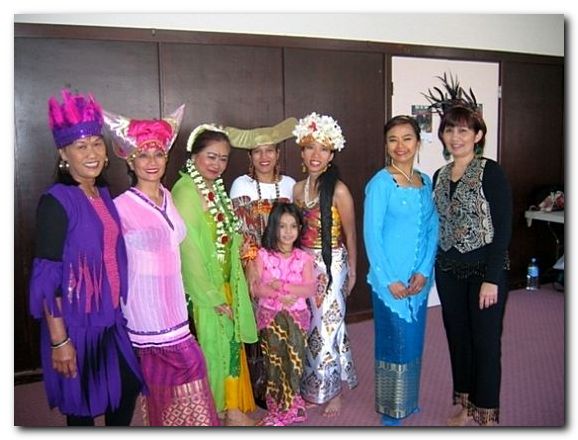
Selendang Sutra dancers in various traditional costumes for the Unity in Diversity dance. Mundaring Shire, Multicultural Festival 2007
Monika Swasti Winarnita

Anna is a dancer from an Indonesian dance group called Selendang Sutra (Silk Veil), based in Perth, Western Australia. Most of the dancers in Selendang Sutra are Indonesian citizens but are permanent residents of Australia with Anglo-Australian partners. Their main occupation is as housewives but some work and study also.
For these women, dancing began as an interesting and challenging pastime but the group developed to the point where they started performing and it is now one of several active Indonesian dance groups in Perth. Multicultural festivals, which occur regularly throughout the city, provide stages for their performances. They also perform at events run by the Indonesian consulate, which caters to the 10,000 strong Indonesian community.

Among the dances the group performs is one that takes Indonesia’s national motto, Unity in Diversity, as its name. When the dancers perform this dance, they feel patriotic. But they no longer perform it at ‘Indonesian only’ events.

Dancing as migrants
Suburbs like Victoria Park and those in the inner south of the Swan River, which have high concentrations of Indonesian migrants, provide a full range of amenities including a supermarket, restaurants, a hairdresser, massage and beautician services and a car rental agency, all owned and run by Indonesians. There are even churches where services are held in Indonesian language. It is not surprising then, that when Anna arrived in Perth in 2002 she found that many Indonesian migrants were involved almost exclusively in their own community. Like her compatriots, Anna lives a very Indonesian lifestyle. Interacting with Indonesians, eating Indonesian food and being involved in Indonesian activities like traditional dancing in her day-to-day life stops her from feeling homesick.

I feel like I am Indonesian when I am doing Indonesian dances
Anna would never have been interested in learning Indonesian traditional dances in Indonesia. To her they were unpopular and old-fashioned. But even in this quite cloistered environment, Anna’s experiences with the broader Perth community brought about some soulsearching. ‘Here in Australia people ask you which country you are from and that’s when I thought about what it meant to be Indonesian. So I decided to really learn about my culture through traditional dancing.’ When she met the women who had formed Selendang Sutra, she decided to join their troupe.

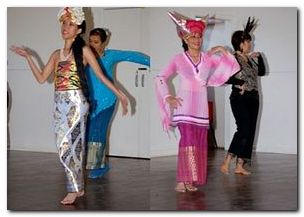
Unity in Diversity was one of the first dances the group learnt and performed. The dance incorporates movements from Aceh (Saman), North Sumatra (Serampang Duabelas), Java (Jaipongan) and Bali (Tabur Bunga), combined with movements from the 1988 National Aerobic Campaign, which were at that time compulsory in schools and government institutions. These movements include military march moves and poses in the shape of the Garuda eagle bird, the national symbol, which is always pictured with the words ’Unity in Diversity’ emblazoned on a ribbon held in its talons.

The Unity in Diversity dance includes movements from diverse ethnic traditions, including the West Java Jaipongan dance (left) and the Sumatran Serampang Duabelas (right)
Hetty Mochtar


Inside Indonesia
for more

Election politics

This edition of Inside Indonesia examines the role of money, religion and much else in this year’s elections

By Edward Aspinall


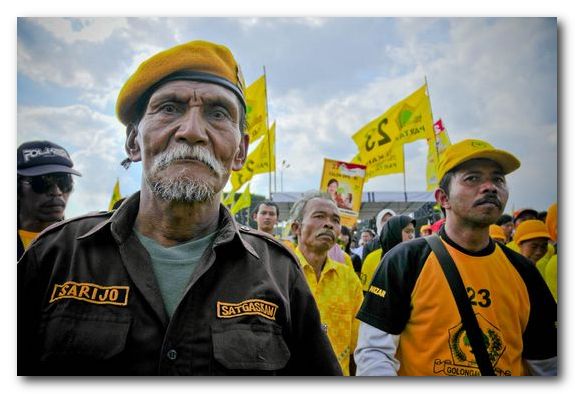
Sarijo, a member of the Golkar party at a campaign event in Yogyakarta. From Tepus, Gunung Kidul, he is a security guard for the party. His job was to take care of the delegation of Golkar supporters from Gunung Kidul who were in town to show their colours for their party.
Danu Primanto Ten years ago, Indonesia held its first democratic elections in the post-Suharto period. The lead article in Inside Indonesia’s pre-election special in 1999 noted that many in the Indonesian press were warning that ‘the coming elections have the potential for national disaster’. But on the day of the polls, the nation heaved a sigh of relief, and outsiders applauded. The elections were generally peaceful, their results were respected, and they ushered in a period of democratic government that has survived, albeit with ups and downs and plenty of shortcomings, until this day.

Ten years on, the atmosphere could hardly be more different. Open elections have become part of Indonesia’s democratic furniture. In April, voters around the country went to the polls to elect thousands of members of legislative assemblies at the national, provincial and district levels. Later this week, citizens will take part in the first of two possible rounds of voting for a president and vice-president. Few people expected either dramatic change or chaos during this year’s elections. In fact, many citizens have lost their initial enthusiasm for voting, but they also take it for granted that this is the way that governments rise and fall.

True to the dampened expectations, the legislative elections last April did not usher in dramatic changes. Some parties – notably President Susilo Bambang Yudhoyono’s Partai Demokrat – did better than in the past, and some did worse. But there were no spectacular breakthroughs or overturnings of established patterns. In the presidential election, the incumbent Yudhoyono is such a strong favourite that some people speculate that he may win in next week’s first round of voting (a second round will only be held if he fails to win an absolute majority and at least twenty per cent in half of the provinces).

But underneath the routine, this year’s elections are still a fascinating moment in Indonesia’s national life. In Indonesia, as in other countries, elections not only determine who controls the government. They can also reveal the social and cultural currents that animate society. Perhaps even more importantly, elections also show much about deeper patterns of power and inequality, about who dominates society and how they do so, and about whose voices are not heard. Elections cement and reflect power even more than they determine it.

Inside Indonesia
for more

Police protest tactics need urgent reform, says Denis O’Connor’s G20 report

Sean O’Neill, Crime Editor
The Chief Inspector of Constabulary has given warning that public confidence in policing will be dangerously eroded unless there is urgent reform of the way officers deal with protests.

Criticising the way that police dealt with the G20 protests, Denis O’Connor said that the national police training manual for public order, published in 2007, was “inadequate for the world police are operating in”.

He said that during the London demonstrations in April police had concentrated on the danger of disorder, rather than realising that their job was to facilitate the “very precious freedom” of peaceful protest.

Some commanders planning for the protest were unaware of the legal situation around the use of “kettling”, or containing protesters, and ill-informed about human rights legislation.

A range of issues crystallised on April 1 when thousands of protesters gathered for a series of demonstrations around the G20 summit: a newspaper vendor, Ian Tomlinson, died as officers tried to clear the streets; communications broke down between between police, protesters and the media; and every aspect of the day was relayed instantly via the media and “citizen journalism”.

Mr O’Connor advocated significant reforms in his report into policing at the G20, Adapting to Protests. “If these recommendations are not adopted, there will be more disruption to our lives, there will be more very problematic incidents, police will be challenged in the courts and the public will be progressively more aware of it,” he said.

“Consent will be withdrawn. It won’t necessarily be a cliff face but another sad erosion of the basis of British policing. We live in an age where public consent of policing cannot be assumed, and policing should be designed to win consent. Future events like the Olympics 2012 make change all the more critical.”

Times online for more

Do sex cells hold the secret to long life?

World Science staff

The secret of long life may lurk within the genetic activity profile of sex cells—such as the sperm and eggs of humans, a paper newly published in the research journal Nature suggests.
Sex cells, and the lineage of cells that develop into them, are “immortal” in the sense that once they are used to create a new organism, they don’t die. Instead they bring about the production of all the new creature’s cells, including more sex cells.

Only the non-sex cells—called somatic cells—are doomed to age and die, typically by accumulating damage, debris and mutations.

Gary Ruvkun, a geneticist at Harvard Medical School, and colleagues found in the new study that the gene activity in somatic cells of long-lived nematode worm mutants resembles that of “germline,” or sex cells. Switching to germline characteristics may therefore confer health benefits and longevity to these mutant worms, according to Ruvkun’s team.

The similarity in the somatic cells’ gene activity profile to that of sex cells largely involved decrease in a pattern of chemical activity known as insulin-like signalling, according to the researchers.

The altered genetic activity also made the non-sex cells more resistant to toxicity, the group reported. This makes sense, they added, because some theories hold that aging evolved as a trade-off in which organisms diverted resources toward maintaining and protecting the reproductive cells at the expense of the others.

World Science for more