Are We Really Cattle?

By: Peter Chamberlin, Countercurrents.org

Have we really become “We the sheeple,” or are we still human beings? The planet is dying under the thrall of a small minority of men who think of the rest of the human race as “cattle,” livestock for them to buy and sell.

The ruling class behaves much like a spoiled child, if they don’t get to have everything their way all of the time, they throw this massive temper tantrum and threaten to upset the whole game. They have gotten their way in everything for so long that they have fallen under the spell of their own propaganda. They believe that we are sub-human animals, who should be herded into the best outcome possible. But, have the rest of us begun to accept this as well?
As members of the human herd, most of us recoil at the “bovinian” suggestion, but consider just how much we do behave like a herd. We willingly accept being treated like a herd, trusting our lives to politicians because we appreciate not having to make hard decisions for ourselves, being contented as cows, as our leaders and their hired hands drive us down a path to destruction, for the sake of them making a few dollars more in profit.

Counter Currents for more

Looking into the Toilet: Potty Politics

by Mandy Van Deven- India –

What do former U.S. Senator Larry Craig, women in Victorian England, and transgender activists have in common?

Toilets!

The first multi-disciplinary book about potty politics to be published, Ladies and Gents: Public Toilets and Gender, explores the ways in which one of our most private public spaces is laden with cultural, social, and ideological meaning. From ablism (discrimination in favor of the able-bodied) to ethnocentric hygiene, this collection of essays encourages us to consider what toilets—their design and functionality—say about societies around the globe. I spoke with editors Olga Gershenson and Barbara Penner, who spearheaded the project, about how they came to write about the water closet, why the loo is still taboo, and what about their work struck a nerve among conservatives.

Since it’s not the most obvious subject matter, how did you come to edit a book about toilets?

Olga Gershenson: I am a cultural studies scholar, and I specialize in Jewish Studies. So Ladies and Gents is a bit of professional detour. In fact, the subject of toilets was a complete accident – no pun intended (laughs). I was teaching a course on gender, and bumped into a totally unexpected subject: toilet accessibility for folks who are transgender, gender-variant, or just plainly don’t look their sex. I was stunned that for all these people something I took for granted was a hurdle and a risk. I tried to do more research on the subject, couldn’t find much material, and realized there was a need for a book about toilets and gender. Five years later—here we are.

The WIP for more

Tribe of spies

By A.G. NOORANI

Alger Hiss was a spy after all, these books show. And Ernest Hemingway had meetings with KGB agents.

AFTER 9/11, the second oldest profession has had a rebirth. No invention of man can be a substitute for the spy in the field.

Varied are the motives that drive a person to espionage and treason. One is ideological – an alienation from the state and society so deep that the spy readily undertakes the risks to spy for another country.

The Cambridge Apostles, of which Anthony Blunt was a leading figure, is an outstanding example. Heretics became traitors. There is the mercenary spy who is liable to become a double agent. Personal reasons also drive persons to seek refuge in espionage. Some operate as mere couriers.

These two books are written by scholars, not propagandists, who draw on the archives of the Soviet Union. The scholar-journalist Susan Jacoby’s book is a work of reflection on the impact of smear campaigns and spy scares and the fragility of safeguards in such times when, as has happened recently in India, judges become super patriots and violate their oath of office.

John Earl Haynes, a historian in the Library of Congress and Professor Andrew Mellon of Emory University co-authored Venona. Alexander Vassiliev, a former KGB officer, joins Haynes and Harvey Klehr to produce a tome on the KGB’s work in the United States.

Frontline for more

Methane Seeps From Arctic Sea-Bed

By Judith Burns, Science and environment reporter, BBC News


Methane bubbles observed by sonar, escape from sea-bed as temperatures rise

Scientists say they have evidence that the powerful greenhouse gas methane is escaping from the Arctic sea-bed.

BBC News
Researchers say this could be evidence of a predicted positive feedback effect of climate change.

As temperatures rise, the sea-bed grows warmer and frozen water crystals in the sediment break down, allowing methane trapped inside them to escape.

The research team found that more than 250 plumes of methane bubbles are rising from the sea-bed off Norway.

The joint British and German research team detected the bubbles using a type of sonar normally used to search for shoals of fish. Once detected, the bubbles were sampled and tested for methane at a range of depths.

Writing in Geophysical Research Letters, the team says the methane was rising from an area of sea-bed off West Spitsbergen, from depths between 150m and 400m.

The gas is normally trapped as “methane hydrate” in sediment under the ocean floor.

“Methane hydrate” is an ice-like substance composed of water and methane which is stable under conditions of high pressure and low temperature.

As temperatures rise, the hydrate breaks down. So this new evidence shows that methane is stable at water depths greater than 400m off Spitsbergen.

However, data collected over 30 years shows it was then stable at water depths as shallow as 360m.

BBC for more

Stop playing political dice with lives

By PHILIP OCHIENG

Apparently, the professor of politics was learned only in the “techniques” of achieving immediate power interests.

Since he lost all power possibilities in 2002, he has exposed an astonishing absence of not only social education but also self-protective wisdom.

Concerning Mau, who “dished out” such huge swathes of land to individuals? The reports are cagey about it. But any glance at the list of recipients reveals that they could have benefited only during Daniel arap Moi’s political stewardship.

Thus, were I he, I would maintain a tight lip on that controversy. Why? Because it is a list of Who Was Who in the Nyayo system.

Nay, more. It is a list of overwhelmingly Kalenjin individuals. No, I have no problem with my people of “Onjelo”. I accuse only certain individuals among them.

Ravenous and ruthless in the extreme, they danced around the president like moths around a glowglobe, grabbing everything they could lay their hands on. But, as long as it was the community’s name that suffered nationally, they could get away with it as individuals.

They had learned well from the preceding regime. A certain very tightly knit clique of Kikuyu individuals had hidden behind the tribe’s name and completely ruined its reputation by grabbing both power and wealth under the banner of “Kikuyu”, rather than merely as individuals.

That is the same game that the culprits in the destruction of Mau are still trying to play. Just as the ordinary Kikuyu never benefited from Mzee Kenyatta’s Home Guard regime, so the ordinary Kalenjin never benefited from the Nyayo regime – in particular, from the Mau allotments.

Nation for more

VIETNAM: Sex Selection Skews Sex Ratio

By Helen Clark

HO CHI MINH CITY, Aug 21 (IPS) – Vietnam is something of a regional leader when it comes to gender equality. There are laws against domestic violence and discrimination, and very high female literacy.

Yet its sex ratio is skewed. For every 100 girls born, there are 112 boys. People prefer sons.

“If you have sons and they have children, they will carry on the family name,” says Ngo Thi Thanh Nhan, 32. “People want boys so when they are pregnant with girls – abortion. This thinking must change,” she adds, cradling her second daughter who is less than a month old.

In keeping with Vietnamese tradition, mother and child will remain confined to their home in District 10, Ho Chi Minh city, for the next two months.

Nhan watches as female relatives coo over her daughter, Dang Nghi. “I prefer girls but my husband likes boys. Boys and girls are the same, I think,” she says. Will she have a third child? No, she has been sterilised.

The Population Ordinance, restricting families to two children, was reinstated in November 2008, after being rescinded in 2003. It was originally brought in during the mid-1980s thanks to government fears of a population boom and corresponding strains on resources.

Vietnam’s sex ratio at birth (SRB) has been rising steadily for the past few years, from the “average” 105 boys to 100 girls in 1999 to 110:100 in 2006. This year it topped at an average of 112:100.

IPS News for more

Palestine: the view from South Africa

Gaza, One More Bantustan

By Alain Gresh

During the Gaza war, South Africa expressed strong solidarity with the Palestinians. No one here has forgotten the collaboration between Pretoria and Israel under apartheid, and many see parallels between the Palestinian situation today and that of black and coloured South Africans back in the days of white rule.

Ronald “Ronnie” Kasrils looks just like the caricature of him drawn by the cartoonist Zapiro in November 2001. It showed him at the head of a line of Jews, including the Nobel Laureate Nadine Gordimer and Zapiro himself, escaping from a fortress. Kasrils has a big smile on his face. The fortress is emblazoned with the words “unconditional support for Israel”. The jailers are shouting “Catch them! Catch them!”

Kasril’s smile is the same today, as is his determination; his is a life that’s been devoted to moving mountains. He was born in South Africa in 1938, the son of Jewish immigrants from the Baltic states. It was not long before he encountered racism, notably in the Sharpeville Massacre on 21 March 1960, when the police fired on unarmed black demonstrators, killing dozens of people. The international reverberations of the massacre – the prelude to South Africa’s drift towards dictatorship, were all the greater as 1960 was the year in which the majority of African nations gained their independence.

Z Mag for more

“Astroturf Activism”: Leaked Memo Reveals Oil Industry Effort to Stage Rallies Against Climate Legislation

Guest:
Kert Davies, Research Director for Greenpeace USA.
A leaked memo reveals the American Petroleum Institute is asking oil companies to recruit employees, retirees and contractors to take part in rallies against climate change legislation. We speak with Greenpeace USA research director Kert Davies. [includes rush transcript]

JUAN GONZALEZ: The oil industry appears to be turning to the tactics of right-wing opponents to healthcare reform in order to derail federal climate change legislation. In a leaked memo obtained by Greenpeace, the American Petroleum Institute asked member oil companies to help recruit employees, retirees and contractors to participate in anti-climate bill rallies being held in twenty-two cities across the country this month.

The leaked internal email from American Petroleum Institute President Jack Gerard says it’s organizing the so-called Energy Citizens rallies to, quote, “put a human face on the impacts of unsound energy policy” and calls on member companies to achieve a, quote, “participation level Senators cannot ignore.” It lists venues in states with, quote, “significant industry presence” and “assets on the ground.”

Democracy Now for more

Back to the Natural State of Stagnation

by Dan Glazebrook


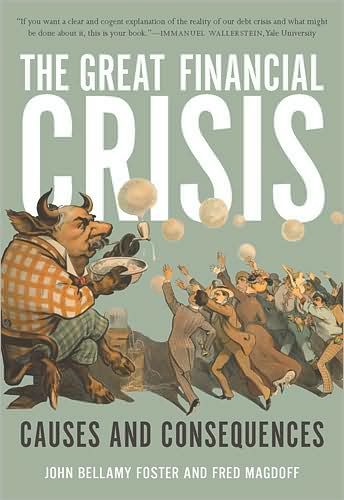
John Bellamy Foster and Fred Magdoff, The Great Financial Crisis (Monthly Review Press, 2009).

One of the few boom industries in times of slump, it seems — aside from private security firms, debt collection agencies and porn — is the publication of books about slumps.

Everyone from Vince Cable to Newsnight economics editor Paul Mason is touring the country, touting their own take on recent economic events. Copies of Das Kapital are reportedly flying off the shelves faster than they can be printed.

The Great Financial CrisisWhat makes this short book by the editors of the long-standing US left journal Monthly Review stand out is that it looks beyond the shenanigans of high finance to the deeper, structural causes of capitalism’s current malaise.

Fifty years ago, Paul Baran and Paul Sweezy published their classic work Monopoly Capital.

In it, they argued that mainstream economic thinking on recession was topsy-turvy from the outset.

Instead of asking why the Great Depression occurred — and thus accepting that it was some kind of freak occurrence — they argued it was capitalism’s growth periods that needed explaining.

Capitalism in its monopoly phase — the age of the giant corporation — is characterised by stagnation and only experiences anything different due to historically specific — and temporary — “fixes.”

At the root of this stagnation lies the classic contradiction of capitalism — that productive capacity tends to outstrip effective demand.

In other words, we are not paid enough to buy all the crap we produce. Goods pile up unsold, productive activity freezes up and capital is unable to find avenues for profitable reinvestment.

Mr Zine for more

Jaswant, Jinnah and the South Asian Monroe Doctrine

C. Raja Mohan Indian Express

C. Raja Mohan is a Professor at the S. Rajaratnam School of South Asian Studies at the Nanyang Technological University, Singapore

Bhartiya Janata Party leader Jaswant Singh’s bold reinterpretation of Mohammed Ali Jinnah–his book on the founder of Pakistan is being launched on Monday–is bound to create controversy in both India and Pakistan.

On the face of it, it would seem futile to reapportion the political blame for the Great Partition of 1947. Yet, the renewed controversy over Jinnah could help us rethink the future of Indo-Pak relations.

No amount of blood-letting and political quibbling will alter our past. But we owe it to ourselves to overcome the many bitter consequences of the Partition. It is in this context that Jinnah’s frequent invocation of the ‘Monroe Doctrine’ is of some interest.

The ‘Monroe Doctrine’, of course, is about the US foreign policy aspirations in the 19th century, when it sought to minimize the influence of European powers in the Western hemisphere. Jinnah visualized that after Partition, India and Pakistan could declare some kind of a Monroe Doctrine that would prevent the great powers from intervening in post-colonial Subcontinent.

In an interview to a European newspaper in early 1948, Jinnah discussed broadly his idea of how he wanted India and Pakistan to relate to each other and the world. “Our own paramount interests demand that the Dominion of Pakistan and the Dominion of India should co-ordinate for the purpose of playing their part in international affairs. It is of vital importance to Pakistan and India as independent sovereign states to collaborate in a friendly way to jointly defend their frontiers both on land and sea against any aggression. But this depends entirely on whether Pakistan and India can resolve their own differences,” Jinnah said.

That India and Pakistan have not been able to resolve their differences or cooperate during the last six decades does not, in any way, detract from the essence of Jinnah’s logic. If India and Pakistan reflect on their relationship with each other and the world purely in terms of power, they will confront two broad political conclusions.

One is that–hard as it may try–India can’t shake off Pakistan. Put it another way, India will rise in the international system only if it takes Pakistan along with it. The other is that Islamabad can trip up Delhi at will but it can’t force India to pay up what Pakistan considers are its dues from the Partition and then some.

Pakistan’s determination to balance India with the help of other great powers turned Jinnah’s logic of a South Asian Monroe Doctrine on its head. While Pakistan’s foreign policy has certainly helped other powers, it has produced few enduring strategic gains for itself.

One does not have to be a rocket scientist to figure out that global weight of India and Pakistan would be a lot heavier if they stopped fighting with each other. If the two countries can embark on political cooperation, Delhi and Islamabad could easily become arbiters of the regional security order in the Indian Ocean and the Southern Asia.

It should not be impossible for Delhi and Islamabad to see that the absolute gains they could harvest from mutual cooperation are much larger than the compromises they need to make to resolve their differences. The reaction in India and Pakistan to Jaswant Singh’s book on Jinnah might tell us whether the Sub-continent is ready to redo the Partition sums with a power calculus that is not cluttered with anger and tears.

Indian Express for more
(Submitted by reader)