Outsource It! Privatize It! LA School Reform in the Age of Obama

Acting on the ideological position that teachers are the root of all evil, and with the full support of the city’s Latino mayor, the LA school board has voted to transfer one-third of its schools to private, charter management – including 50 brand new campuses. Corporate outsourcing now passes as education policy.

A Black Agenda Radio commentary by Glen Ford

“The LA schools handover may represent the biggest one-shot giveaway of public school property in history.”

The Los Angeles Board of Education has voted overwhelmingly to outsource the operations of about one-third of the district’s schools, a huge blow to the very concept of public education in the nation’s second largest city. The scheme would allow private charter operators to take control of over 250 schools, including 50 brand new, multi-million dollar campuses. The great giveaway to private contractors was approved by a six-to-one vote, with the enthusiastic support of Los Angeles Mayor Antonio Villaraigosa.

Two hundred of the schools to be placed on the auction block are classified as “underperforming.” The 50 new school campuses that are up for grabs were paid for by the public through construction bonds. The purpose was to relieve overcrowding, but now the spanking new buildings are to be put up for bids by private charter companies. That’s an illegal giveaway of public resources, say opponents of the turnover. The teachers union agrees, and is exploring legal strategies to block the outsourcing. Under California state law, charter schools don’t have to hire union workers.

If it goes through, the LA schools handover may represent the biggest one-shot giveaway of public school property in history. The 50 recently constructed schools alone are the equivalent of a big city school district, all brand new and just out of the box, giving the charter operators a huge, built-in physical plant advantage over the city’s traditional public schools.

The transfer of one-third of LA’s public schools to charter operation means the city will no longer be able to claim to have a truly city-wide public school system. In this, LA will come to resemble New Orleans, where charter privateers now dominate the school infrastructure, and accountability for the system as a whole is non-existent. Veteran teachers have been replaced, wholesale, by young, non-union novices.

“LA will come to resemble New Orleans, where charter privateers now dominate the school infrastructure.”

In New Orleans, Hurricane Katrina blew in the charter school takeover. In Chicago, the driving force was corporate elements of the Democratic Party. Massive imposition of charter schools has led to grossly disproportionate terminations of Chicago’s Black teachers, replaced mostly by white youngsters from outside the city.

The corporate world, which cares a great deal about the salaries of its executives and consultants, blames unionized teachers for the decline in big city public schools – an ideological position with no basis in measurable reality. Suburban teachers are just as likely to be unionized as inner city teachers, but we don’t see suburban communities describing teachers as the root of all evil. And we can’t even imagine a white, suburban district hundreds millions of dollars to build a whole generation of brand new schools – and then turning the buildings over to private contractors to do with as they please. That’s inconceivable.

Outsourcing of public education only occurs in overwhelmingly Black and brown school districts, places where, like in Los Angeles, public property and public responsibility to students is put on the private auction block.

For Black Agenda Radio, I’m Glen Ford. On the web, go to www.BlackAgendaReport.com.
BAR executive editor Glen Ford can be contacted at Glen.Ford@BlackAgendaReport.com.

BAR for more
Unemployment Rises Everywhere. El Centro, Calif., Hits 30.2 Percent

By Laura Conaway

Unemployment has kept on growing in every one of the nation’s 372 metropolitan areas, the Bureau of Labor Statistics reports. Unemployment was higher in July 2009 in each metro than at this time last year.

Of the 19 metros where joblessness tops 15 percent, California lays claim to eight. God bless El Centro, Calif., which has the highest unemployment at 30.2 percent. Another five of the most miserable metros are in Michigan.

At the other end of the scale are Washington, D.C., at 6.2 percent, and Oklahoma City at 5.9 percent.

The jump from this year to last year happened in Greater Detroit, with 8.4 percent. Next up were Bend, Ore., with 7.1 percent and Elkhart County, Ind., at 7 points. The only places where joblessness grew by less than a point were Bismarck and Grand Forks, N.D.

The national unemployment rate dipped by 0.1 percent to 9.4 percent in July. The Bureau of Labor Statistics is set to release the August figure on Friday.

OWLY
for more

No questions, please

A.G. NOORANI

Jaswant Singh’s expulsion from the BJP is an illegality of a piece with the entire sordid drama to humiliate him.

[Members of the Parakram Janchetna Manch, affiliated to the RSS, burnt copies of Jaswant Singh’s new book, in Bhopal on August 20.]

Woh baat sare fasane mein jis ka zikr na tha/ Woh baat unko bohat nagawar guzri hai (What was never mentioned in the entire story/ Is the very thing that offended most).

FAIZ AHMED FAIZ’S immortal conflict explains the otherwise inexplicable savagery of the Bharatiya Janata Party’s (BJP) expulsion of one of its most respected founder members from the primary membership of the party. It was not the book (Jinnah – India, Partition, Independence; Rupa; pages 669, Rs. 695), which none of them could have read. It was his position that Hindutva was a hurdle to the BJP’s growth, and his independent questioning stance in the party’s councils.

The brazen illegality of the expulsion is of a piece with the entire sordid drama to humiliate him. The Rashtriya Swayamsewak Sangh (RSS) asked the leaders to bend; they decided to crawl. It will not appease the RSS. The action not only marks the end of the Vajpayee era but puts an inglorious end to the Advani phase, with Rajnath Singh not far behind. Narendra Modi has ensured Arun Jaitley’s promotion. He had saved Modi after the Gujarat pogrom.

But the soft pro-BJP secularists, who wistfully hoped for the emergence of the BJP as a “secular” conservative party after their own heart – not quite secular, nor quite Hindutva – are disillusioned.

Jaswant Singh’s prestige has soared. The BJP’s has plummeted, thanks to L.K. Advani’s intrigues, Rajnath Singh’s bigotry and the ambitions of the Modi-Jaitely combine.

A Chintan Baithak was abruptly converted into a Parliamentary Board meeting with a non-member – Modi, who else? – participating. No notice of the meeting, no show-cause notice and no grounds were provided when Rajnath Singh phoned their quarry at Shimla. That Jaswant Singh will not contest the action in a court of law is no reason why the outrage should pass muster. In law, a political party is an “unincorporated association”, like a club. The law is part of the law of torts (a “tort” is a civil wrong actionable in damages). Formerly castes were governed by this law. It permits internal autonomy but insists on observance of the rules of natural justice. An authoritative work sums up the law in three propositions: First, “the power of expulsion must be exercised with meticulous attention to the rules which create it, and if any formality is omitted the purported expulsion is of no effect; for instance, where under the rules a certain number of days’ notice should be given to consider the question of expulsion and the notice is a day late the expulsion is a nullity”.

Secondly, “expulsion must be bona fide and in the interests” of the organisation and not from any “improper motives” or extraneous considerations. That is an abuse of power.

Lastly, where the rules provide for expulsion for conduct injurious to the organisation, “the power must be exercised not only bona fide but judiciously”. The test is “reasonable and probable cause”. The rules of natural justice must be followed. The member “must have every reasonable opportunity of defending himself”. The notice must not be a recital of comments but a list of precise charges with particulars specific enough to enable the member to reply.

The phrase “anti-party activities” is of Stalinist provenance. It was adopted in the high-noon of Indira Gandhi’s era. It means anyone who is disliked.

The charges must be laid before the expulsion, a subsequent volley of charges will not do.

Gujarat’s ban on the book is as illegal. Section 95 of the Criminal Procedure Code, 1973, empowers the State government to order forfeiture of any newspaper, book or document if it contains matter that is seditious, promotes disharmony between groups or disturbs public tranquillity, questions the loyalty of any group, is obscene or outrages the “religious feelings” of any class of citizens , thereby violating Sections 124-A, 153-A, 153-B, 292, 293 or 295-A of the Indian Penal Code.

How many publications attacking Muslims has Modi banned? Section 95 does not exempt political or historical figures from criticism. The order must state “the grounds” for the ban. That is done by the Law Department. Had Modi prepared the order before arriving in Shimla?

In 1968, the Governments of India and Maharashtra banned a book by Gopal Godse, brother of Gandhi’s assassin Nathuram, entitled Gandhi’s Murder and I. The ground was promotion of communal hatred. It was set aside by the Bombay High Court (Gopal Godse vs The Union of India (1970) 72 Bombay Law Reporter 871).

Justice Y.V. Chandrachud, later the Chief Justice of India, said that “its accent is not” on the relationship between the communities but on the past, namely, Gandhi’s policies. It was a Bench of three judges, as is required by Section 96 of the Code.

“Any person having any interest” in the book can move the High Court to set it aside. The Code advisedly does not confine it to the writer, printer or publisher. It covers the citizen for he has a right to know, which is part of the fundamental right to the freedom of speech and expression.

If Jaswant Singh does not move the courts, concerned citizens can or should. Where the fundamental rights are involved, an alternative remedy is no bar to a petition to the Supreme Court, rather than the High Court.

Jaswant Singh at a function to release his book in New Delhi on August 17. He invited a group of discussants for the event, knowing that they might not agree with his analyses or with one another.

Jaswant Singh did not challenge “the ideology” of the BJP. Hindutva is a recent arrival. When it was founded in 1980, it disowned a revival of the Jan Sangh but claimed to be the “real” Janata Party, a true heir of the JP – the Bharatiya Janata Party. Advani proposed that their commitment to “the concepts of Gandhian socialism and securalism has been total and unequivocal” (Letter of February 26, 1980, to Janata Party president Chandra Shekhar).

At the first plenary convention on December 28, 1980, “Gandhian socialism” was affirmed as one of the five commitments along with nationalism and national integration, democracy, “positive secularism” and value-based politics.

The hoax did not work. In March 1985, a working group was set up to review the policies. Its 47-page report opted for the Jan Sangh leader Deen Dayal Upadhyaya’s “Integral Humanism”. On January 31, 1986, the locks on the gates of the Babri Masjid were opened. On May 9, Advani replaced Vajpayee as president of the BJP. It was he who in 1990 made V.D. Savarkar’s Hindutva a battle cry in his rath yatra. There is not a word on Hindutva in the BJP’s definitive Palampur resolution of June 11, 1989, on Ayodhya.

In power, the BJP could not fulfil its pledges to the RSS and the Vishwa Hindu Parishad (VHP). In 2004 and 2009, the nation showed its disgust. Jaswant Singh did no more than urge that the worn-out garment be discarded. It had begun to stink.

Frontline for more

What Kind of Space Is Cyberspace?

by Jeff Strabone

What kind of space is cyberspace? Of all the things we take for granted, cyberspace is near the top of the list. The promise of the internet in the twenty-first century is to make everything always available to everyone everywhere. All of human culture and achievement, the great and the not so great, may, one day soon, be a click away.

When one is online, cyberspace can seem a lot like outer space or, to use the latest jargon, ‘the cloud’. It appears infinite and ethereal. The information is simply out there. If, instead, we thought more about the real-world energy and the real estate that the internet uses, we would start to realize that things are not so simple. Cyberspace is in fact physical space. And the longer it takes us to change our concept of the internet—to see quite clearly its physical there-ness—the closer we’ll get to blogging our way to oblivion.

When I was in college in the 1990s, I resided near the campus computing center for two years and made friends with some of the staff. Seeing the physical space where everything happened did not make me want to be a computer science major, but it did de-mystify the internet. I knew they had machines that stored everything we did online. For all I know, they still have all our old e-mail stored away somewhere in case anyone ever runs for high office.

But permanent storage is not the same thing as what we have today. Now, everything that we upload—all the Facebook photos, all the Youtube videos—is always available on demand to everyone. What does it take to keep up that commitment? Tom Vanderbilt recently asked that question in the New York Times Magazine for June 14, 2009. It takes many huge buildings, with square footage in the hundreds of thousands of feet, called data centers or, more appropriately given the internet’s relentless growth, server farms.

In order to maintain total, ubiquitous availability, as today’s internet users have come to expect, a lot of things have to be happening simultaneously. The millions of hard disc drives that store the internet’s contents have to be powered up and spinning at thousands of revolutions per minute, not just in one place but at backup mirror sites elsewhere. The drives’ read-write arms are constantly racing over the surfaces of the discs. Other servers have to be available to handle spikes in demand, as when everyone searches for Michael Jackson or Teddy Kennedy at the same time. Electrons run at light speed through miles of transmission wires and power cables. Air conditioning keeps the whirring servers cool. Real estate has to be acquired and developed to house it all. Electrical grids have to be extended to the sites. And lots of electricity has to be generated, which means lots of carbon dioxide gets produced.

3QD for more

Taliban’s bombs came from US, not Iran

By Gareth Porter

WASHINGTON – In support of the official United States assertion that Iran is arming its sworn enemy, the Taliban, the head of the Office of the Director of National Intelligence (ODNI), Dennis Blair, has cited a statement by a Taliban commander last year attributing military success against North Atlantic Treaty Organization (NATO) forces to Iranian military assistance.

But the Taliban commander’s claim is contradicted by evidence from the US Defense Department, Canadian forces in Afghanistan and the Taliban themselves that the increased damage to NATO tanks by Taliban forces has come from anti-tank mines provided by the United States to the jihadi movement against the Soviets in Afghanistan in the 1980s.

The Taliban claim was cited by the ODNI in written responses to questions for the record from the Senate Select Committee on Intelligence following testimony by Blair before the committee on February 12, 2009. The responses were released to the Federation of American Scientists under the Freedom of Information Act on July 30.

ODNI wrote that Iran was “covertly supplying arms to Afghan insurgents while publicly posing as supportive of the Afghan government”. As evidence of such covert Iranian arms supply, the ODNI said, “Taliban commanders have publicly credited Iranian support for their successful operations against coalition forces.”

That statement was taken almost word-for-word from the subtitle of an article published on the website of London’s DailyTelegraph and Sunday Telegraph on September 14 last year. “A Taliban commander has credited Iranian-supplied weapons with successful operations against coalition forces in Afghanistan,” read the sub-heading of the article “Taliban claim weapons supplied by Iran”.

The single Taliban commander quoted became plural in the ODNI version.

ATimes for more

China’s top 500 perform better than US’

(China Daily)

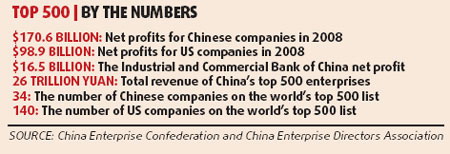
HANGZHOU: The money-earning capability of China’s top 500 enterprises has exceeded that of their United States counterparts for the first time, as the sweeping financial crisis pummeled many US firms while China is already entering an economic recovery.

Net profits for the Chinese companies stood at $170.6 billion in 2008, well above the $98.9 billion for US companies in the same period, according to the latest report released on Saturday by the China Enterprise Confederation (CEC) and China Enterprise Directors Association.

Although the financial crisis decreased net profits for the Chinese heavyweights by 12.4 percent from a year ago, it is far less than the 84.6-percent fall experienced by US companies, which saw the worst decline in 55 years, as recorded by Fortune magazine.

Wang Jiming, vice-president of CEC, said although the numbers show Chinese companies were less vulnerable to the global financial crisis than their US counterparts, it did not mean they have made substantial improvements in overall competitive power.

“Chinese enterprises enjoy relatively better policies and domestic market environment,” Wang said. “But Chinese companies still lag behind the world’s leading enterprises in resource allocation, innovation, international presence, business models and corporate culture.”

The Industrial and Commercial Bank of China, the country’s biggest lender, was the top Chinese money-earner with a net profit of 111 billion yuan ($16.4 billion) in 2008.

Half of the top 10 profit makers on the CEC list are financial companies, including banks and insurance companies.

“Compared with the US, where many IT companies have the strongest earning potential, the best money earners in China are still banks,” said Xiong Xiaoge, vice-president of US venture capital IDG. “This means Chinese technology still has a lot of room to improve.”

China Petrochemical Corp, Asia’s leading refinery, topped the revenue list for the fourth consecutive year with 1.46 trillion yuan in 2008. Its net profit was 13.6 billion yuan.

According to CEC, the total revenue of China’s top 500 enterprises amounted to 26 trillion yuan, an increase of 19.7 percent over last year.

China Daily for more

Why Obama Needed Single Payer on the Table Obama’s Mistakes in Health Care Reform

By VICENTE NAVARRO

Vicente Navarro, M.D., Ph.D., professor of Health Policy at The Johns Hopkins University and editor-in-chief of the International Journal of Health Services. The opinions expressed here are those of the author and do not necessarily reflect the views of the institutions with which he is affiliated. Dr Navarro can be reached at vnavarro@jhsph.edu

Let me start by saying that I have never been a fan of Barack Obama. Early on, I warned many on the left that his slogan, “Yes, we can,” could not be read as a commitment to the major change this country needs (see “Yes, We Can. Can We? The Next Failure of Health Reform”). Still, I actively supported him against John McCain and was very pleased when he became president – for many reasons, encompassing a broad range of feelings. One reason was that Obama is African-American, and the country needed to have a black president. Another was that his election seemed to signal the end of the Bush era. But, the most important reason was that I saw him as a decent man, surrounded by some good people who could promote change from the center and open up some possibilities for progress, giving the left a chance to influence the administration’s policies. Well, after just over seven months of the Obama White House, I have no reason to doubt that he is a decent man, but I am dismayed by the bad judgment he has shown in the choice of some of his staff and advisors. I really doubt that he is going to be able to make the changes we need. As I said, I never had great expectations about him and his policies, but even the lowest of my expectations have not been met.

Some among the many skeptics on the left might add, “What did you expect?” Well, at least I expected Obama to show the same degree of astuteness that he and his team had shown during the campaign. He seemed to be a brilliant strategist, and his election proves this. But my greatest disappointment is the strategies he is now following in his proposals for health care reform – they could not be worse. I am really concerned that the fiasco of this reform may make Obama a one-term president.

Error number One
One of the two major objectives for health care reform, as emphasized by Obama, is the need to reduce medical care costs. The notion that “the economy cannot afford a medical care system so costly, with the annual increases of medical care running wild” has been repeated over and over – only the tone varies, depending on the audience. An element of this argument is Obama’s emphasis on eliminating the federal deficit. He stresses that most of the government deficit is due to the outrageous growth in costs in federal health programs. Thus, a crucial part of the message he is transmitting is the health care reform objective of reducing costs.
This message, as it reaches the average citizen, seems like a threat to achieve cost reductions by cutting existing benefits. This perception is particularly accentuated among elderly people – which is not unreasonable, given that the president indicates that the funds needed to provide health benefits coverage to the 48 million currently uncovered will come partially from existing programs, such as Medicare, with savings supposedly achieved by increasing efficiency.

To the average citizen (who has developed an enormous skepticism about the political process), this call for savings by increasing efficiency sounds like a code for cutting benefits. Not surprisingly, then, one sector of the population most skeptical about health care reform is seniors – the beneficiaries of Medicare. The comment that “government should keep its hands off my Medicare,” as heard at some of the town hall meetings, is not as paradoxical or ridiculous as the liberal media paint it. It makes a lot of sense. An increasing number of elderly people feel that the uninsured are going to be insured at the expense of seniors’ benefits.

Error Number Two

The second major objective of health care reform as presented by Obama is to provide health benefits coverage for the uncovered: the 48 million people who don’t have any form of health benefits coverage. This is an important and urgently needed intervention. The U.S. cannot claim to be a civilized nation and a defender of human rights around the world unless this major human and moral problem at home is resolved once and for all. But, however important, this is not the largest problem we have in the health care sector. The most widespread problem is not being uninsured but underinsured: the majority of people in the U.S. – 168 million, to be precise – are underinsured. And many (32 per cent) are not even aware of this until they need their health insurance coverage. This undercoverage is an enormous human, social, and economic problem. Among people who are terminally ill, 42 per cent worry about how they or their family will pay for medical care. And most of these people are insured – but their insurance does not cover all of their conditions and necessary interventions. Co-payments, deductibles, and other extra expenses – besides the insurance premiums – can amount to 10 per cent or even higher proportion of disposable income.

Counterpunch for more

The “Golden Voice of the Great Southwest”: Legendary Folk Musician, Activist Utah Phillips, 1935-2008

Utah Phillips, the legendary folk musician and peace and labor activist, died earlier this year at the age of seventy-three. Over the span of nearly four decades, Utah Phillips worked in what he referred to as “the Trade,” performing tirelessly throughout the United States, Canada and Europe. The son of labor organizers, Phillips was a lifelong member of the Industrial Workers of the World, known as the Wobblies. As a teenager, he ran away from home and started living as a hobo who rode the rails and wrote songs about his experiences. In 1956, he joined the Army and served in the Korean War, an experience he would later refer to as the turning point of his life. In 1968, he ran for the US Senate on the Peace and Freedom Party ticket. For the past twenty-one years he lived in Nevada City, where he started a nationally syndicated folk music radio show. He also helped found the Hospitality House homeless shelter and the Peace and Justice Center. We spend the hour with an interview with Phillips from January 2004. [includes rush transcript]

Utah Phillips, legendary folk musician and peace and labor activist, interviewed in January 2004. He passed away in his sleep in his Nevada City home on May 23, 2008 of congestive heart failure. He was 73 years old.

AMY GOODMAN: Over the span of nearly four decades, Utah Phillips worked in what he referred to as “the Trade,” performing tirelessly for audiences in large and small cities throughout the United States, Canada and Europe. His songs were performed by Emmylou Harris, Waylon Jennings, Joan Baez and Arlo Guthrie. He earned a Grammy nomination for an album he recorded with Ani DiFranco and was awarded a Lifetime Achievement Award by the Folk Alliance.
The legendary folk musician, peace and labor activist died on May 23rd of this year. He passed away in his sleep in Nevada City. He was seventy-three years old.
Born Bruce Duncan Phillips in 1935, he later adopted the name “Utah,” from where he grew up. The son of labor organizers, Utah Phillips was a lifelong member of the Industrial Workers of the World, known as the Wobblies. As a teenager, he ran away from home and started living as a hobo who rode the rails and wrote songs about his experiences. In 1956, Utah Phillips joined the Army and served in the Korean War, an experience he would later refer to as the turning point of his life. In 1968, he ran for the US Senate on the Peace and Freedom Party ticket.
In Nevada City, California, he started a nationally syndicated folk music radio show called Loafer’s Glory, produced at community radio station KVMR. He also helped found the Hospitality House homeless shelter and the Peace and Justice Center there.
In January 2004, I had a chance to sit down with Utah for an extensive interview. We met at the pirate radio station, Freak Radio Santa Cruz. I began by asking Utah Phillips why he arrived at least a day early to any city or town where he performed.

UTAH PHILLIPS: When you have an engagement, at least in my world, the world that I create for myself, an engagement doesn’t begin when you hit the stage and end when you leave the stage. It begins when you hit the city limits, and it ends when you leave the city limits.
There’s a whole lot going on in that town. My trade is like being paid to go to schools, and every town is its own teacher. Every town, that’s my university. And there are marvels and wonders. There’s Hobos from Hell, are from Santa Cruz. They’re young people riding on the freight trains, and they’re better at it than I ever thought I would be. You’ve got the Homeless Garden Project. You’ve got just an enormous rich community here.
I was involved some years ago in helping to organize a street singers’ guild in this town, and it—you got to beat the streets and learn from the people, and then you’ve got to get on their stage and, having done that and been with those people, let that audience know that you’re not just doing the show you did in the town the night before, you know. You’re no—you’ve got to know who you’re with and where you are. That’s very important to me. And they’ve got to know that I understand that, that I’m really there for them.

AMY GOODMAN: Let’s start out where you started out. Where were you born? When were you born?

UTAH PHILLIPS: I was born in Cleveland, Ohio in 1935.

AMY GOODMAN: And how did you start on this journey? When did you begin singing, storytelling?

UTAH PHILLIPS: Oh, mercy, I think we’re all storytellers, you know. You think of the excuses you told your parents for why you got home late. I just never gave it up.
I got—I left home. I went up to work in Yellowstone National Park during high school. I was going to make some summer money. I went up on the freight trains, and for the first time I rode the freight trains. And I worked on a road rating crew. And at that time, I was playing the ukulele and singing ersatz Hawaiian music—Johnny Noble, things like that, “Lovely Hula Hands,” “Malihini Melee.”

Democracy Now for more

Let the elderly push their own shopping trolley

(DPA)

Insisting on carrying a shopping bag or pushing a luggage trolley for an older person is not really doing them a favour.

Better to let them do the work and compliment them on their heroic efforts to stave off osteoporosis and the other perils of ageing.

“The old saying ‘If you don’t use it, you’ll lose it,’ applies,” said Australian researcher Robert Newton. “As we get older what we’re seeing with a lot of the people, particularly over 65, is a really marked decline in their physical function and their quality of life.”

Newton, professor of exercise and sports science at Perth’s Edith Cowan University, said resisting the onset of diabetes, Alzheimer’s, osteoporosis and cardiovascular disease requires continuing physical activity.

A minimum of 150 minutes of aerobic exercise each week and two sessions of lifting weights is what’s required.

“We need to get our older folk to build up their muscles and build up their bones,” he said.

Newton would be pleased with Susan Smith, 70 this year, who took up weekly aquarobics sessions in her local swimming pool after being diagnosed as a border-line diabetic.

And he’d be delighted with 70-year-old Vlastik Skvaril, who is currently making the 3,000-kilometre north-south transcontinental journey from Darwin to Adelaide on a scooter that doesn’t have a motor. He expects the trip to take 40 days.

Last year Skvaril ran the 6,000-kilometre west-east route from Shark Bay to Byron Bay.

“A lot of people these days do walking and running, so I thought I would do something I haven’t seen many people doing,” Skvaril explained about his latest massive aerobics session.

Khaleej for more

Out of Work, and Too Down to Search On


“You send out so much, and you don’t get responses. Then when you get called in, you’re treated like you’re too old.” RAY RUCKER, a 62-year-old former facilities manager from Overland Park, Kan.

By MICHAEL LUO

They were left out of the latest unemployment rate, as they are every month: millions of hidden casualties of the Great Recession who are not counted in the rate because they have stopped looking for work.

But that does not mean these discouraged Americans do not want to be employed. As interviews with several of them demonstrate, many desperately long for a job, but their inability to find one has made them perhaps the ultimate embodiment of pessimism as this recession wears on.

Some have halted their job searches out of sheer frustration. Others have decided it makes more sense to become stay-at-home fathers or mothers, or to go back to school, until the job market improves. Still others have chosen to retire for now and have begun collecting Social Security or disability benefits, for which claims have surged.

Rick Alexander, a master carpenter in Florida who has given up searching after months of effort, said the disappointment eventually became unbearable.

“When you were in high school and kept asking the head cheerleader out for a date and she kept saying no, at some point you stopped asking her,” he said. “It becomes a ‘why bother?’ scenario.”

The official jobless rate, which garners the bulk of attention from politicians and the public, was reported on Friday to have risen to 9.7 percent in August. But to be included in that measure, which is calculated by the Bureau of Labor Statistics from a monthly nationwide survey, a worker must have actively looked for a job at some point in the preceding four weeks.

For an increasing number of people in this country who would prefer to be working, that is not the case.

It is difficult to assign an exact figure, because of limitations in the data collected by the bureau, but various measures that capture discouragement have swelled in this recession.

In the most direct measure of job market hopelessness, the bureau has a narrow definition of a group it classifies as “discouraged workers.” These are people who have looked for work at some point in the past year but have not looked in the last four weeks because they believe that no jobs are available or that they would not qualify, among other reasons. In August, there were roughly 758,000 discouraged workers nationally, compared with 349,000 in November 2007, the month before the recession officially began.

The bureau also has a broader category of jobless it calls “marginally attached to the labor force,” which includes discouraged workers as well as those who have stopped looking because of other reasons, like school, family responsibilities or health issues. But economists agree that many of these workers probably would have found a way to work in a good economy.

There were roughly 2.3 million people in this group in August, up from 1.4 million in November 2007. If the unemployment rate were expanded to include all marginally attached workers, it would have been 11 percent in August.

But even this figure is probably an undercount of the extent of the jobless problem in this country. There are about 1.4 million more people who are not in the labor force than when the recession began. Some of these are retirees, stay-at-home parents, people on disability and students. But it is also rather likely that many of these people have given up looking for work at least partly because of economic reasons as well.

Here are four people’s stories:

NYT for more