The Next New Plan for Bananastan

by Jeff Huber

We’re going through Bananastan* war strategies like they’re Pez candies. As Jason Ditz of Antiwar.com has noted, General Stanley McChrystal’s new report on Afghanistan “admitted that the current strategy, which was itself a new strategy presented only five months ago to replace the previous new strategy, isn’t working and that yet another new strategy is needed.” It seems certain that Stan the Man will ask for more troops, though, so we’re at least being consistent in our policy of sending more American soldiers to war without knowing why.

When you slice out the wimp words and platitudes, the current new strategy is the same as the old new strategy: clear, hold and build. Any new strategy the war wonks come up with will look pretty much the same, and will require even further escalation in terms of troops and national treasure. Clear, hold and build hasn’t worked in Afghanistan just as it didn’t work in Iraq. It didn’t work in Vietnam either, even though at one point we committed over a half-million troops there. It will never work.

Any cogent strategy must be built around realistic, achievable goals that involve U.S. national security. Our goals, as presently stated, involve turning Pakistan and Afghanistan into real countries with real security forces that civilian authorities are in control of and disrupting terrorist networks. We’ll never achieve those things. The Bananastans will always be warlord-ruled thuggeries, and it is impossible to disrupt terrorist networks when the only “sanctuaries” those networks need in order to operate are pockets large enough to carry an iPod.

Our top military officer, Joint Chiefs of Staff chairman Admiral Mike Mullen, still insists that Afghan civilians are the “center of gravity.” Civilian populations are never a center of gravity. They may be a critical factor — a strength, weakness or critical vulnerability — but only to the extent that they affect political leadership, and that affect is almost always overstated. America supposedly has the most representative form of government of any modern nation, yet even though the population has voted against war in two straight national elections, we’re still embroiled in two wars. Afghanistan’s voting process makes the electoral systems of Florida and Ohio look honest, and it’s difficult to say where Afghan political leadership lies: with the official government or with the warlords or with whatever the loose collection of hooligans is that we refer to as the Taliban.

Original antiwar
(Submitted by Ingrid B. Mork)

Overcoming American Military Base Pollution in Asia: Japan, Okinawa, Philippines

By Hayashi Kiminori, Oshima Ken’ichi and Yokemoto Masafumi

Translated by Christopher Nelson

I. Military Activity and Environmental Problems

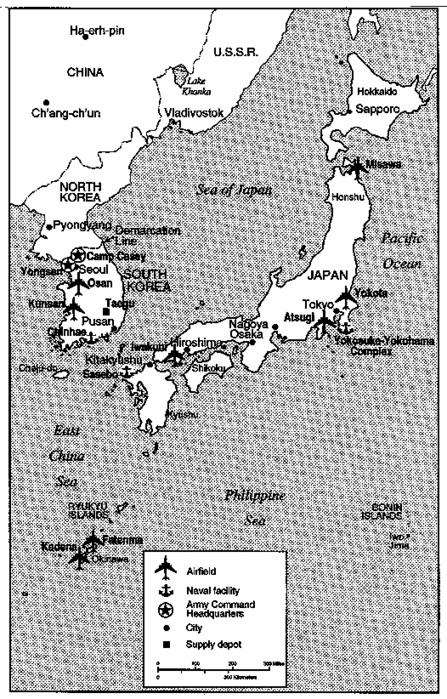
War is said to be the ultimate cause of environmental destruction. The absolute devastation of the environment in combat has been proven by examples such as World War II, the Vietnam War, the Gulf War, and the Iraq War. However, even in peacetime, military activity causes environmental destruction through the construction of facilities, everyday activities on base, and the preparation for war such as military training and maneuvers. Particularly in the case of the United States, the enormous military power that accounts for half of the world’s military expenditures, the destruction of the environment is appalling. For example, in Japan, the damage to nature that would accompany the construction of an alternative facility to Futenma Marine Corps Air Station in Okinawa will be accelerated and aircraft noise will damage the areas surrounding the bases. In the Korean community of Mehyang-ri, aerial bombing practice has caused severe environmental pollution. This essay will focus on the pollution of US bases in Asia in order to come to grips with the environmental problems caused by military activity. After investigating the pollution of US bases in Yokota (Japan), Okinawa and the Philippines, we will examine the principal conclusions that can be draw from those examples. Our purpose is to locate ways to resolve these military environmental problems.

US military bases in Japan, Okinawa and Korea

Why did we choose the problem of pollution associated with American bases in Asia? One reason is the particular importance to the US of Asian bases, especially those in Japan. In 2002, 44.3% of all American soldiers stationed overseas and 26.7% of US bases were concentrated in Asia. Since US bases in the Philippines were closed in 1992, most are now in Japan and Korea. The majority of US Marines stationed abroad are also located in Japan. What’s more, Japan provides 62% of the budget for basing American soldiers in Japan. In 2001, it was about 4.6 billion dollars. In addition to the so-called “Sympathy Budget” that Japan offers in order to support US bases, Japan provides additional funds such as indemnities for noise and various kinds of financial support for base activities. From the prospective of the American military, this has made it easy to pay for their overseas presence. Only in Japan (Yokota) has such an extensive complex of foreign military air force and navy bases, including port facilities for an aircraft carrier, been placed in such close proximity to the capital of an independent state. From a global perspective, this is an exceptional situation.

A US plane approaches Yokota

A second reason is that, even among US overseas bases, Asian base pollution is unusually severe. In accordance with 1993 Bonn supplemental agreements, base pollution became the first military environmental problem to be attended to by the American military. However, as can be seen from the example of damage in the Philippines, while we have entered a new century, pollution has been left as it is without being adequately addressed. It is a matter of great urgency to decide how to rectify these conditions.

II. The Problem of Pollution in US Bases in Asia

The Philippines

JF for more

Viacom’s Political Messaging Encourages Kids to be Celebrities, Service Celebrities, or Join the Army

The furor around President Obama’s Back-to-School speech among some Republicans and conservatives was mostly neutralized after it was apparent that motivation to stay in school was the primary message. It stayed firmly in the tradition set by Presidents Reagan and George H. W. Bush who also addressed students with the message of responsibility and academic achievement. But the real controversies around the messaging that school-age students are exposed to is rarely a flash point for conservative parents. Airing on TV stations the same day as President Obama’s speech was a documentary called Get Schooled funded by the Bill and Melinda Gates Foundation and sponsored by Viacom. The troubling aspects of the program, according to education researcher Kenneth Libby, are “disturbing subtle messages about gender, power, celebrity, and the role of education in a democratic society [which] should give the public pause for concern.” It also upholds mayor-controlled school districts in Chicago and New York as models, despite their poor performance, and encourages students to join the US Army.

GUEST: Kenneth Libby, education researcher, teacher, and blogger from Portland, Oregon.

Read Kenneth Libby’s blog
Listen here:
from
URR

Hey Ram, the Things the Financial Times Group Does!

By VIJAY PRASHAD

A city, burning
Smoke billowing through the holes
Spreading into every eye
Every dream.
Adil Mansuri (1936-2008).

Things are at a bad pass for the Indian far right. Its political party, the BJP, is in disarray. At their last “chintan baithak,” (introspection meeting) in Simla, the leadership went at each other for their poor showing in the general election earlier this year. Expulsion followed expulsion, as formerly revered men and women were found guilty of one kind of infraction or another. A book by a former head-man of the party, Jaswant Singh (one time foreign minister and close confidant of Strobe Talbott), on Pakistan’s “father of the nation” Mohammed Ali Jinnah provided the opportunity for more blood letting. Singh gave credence to what the history profession already knew (from Ayesha Jalal’s useful biography of Jinnah), which is that Jinnah was hardly the clownish bigot so carefully portrayed in Richard Attenborough’s Greatest Hits of Gandhi (1983). Singh was shown the door. The Hindu right cut its teeth singing songs against Jinnah. He was always the “bad Muslim.” There are not many “good Muslims” in the Hindu Right’s cosmos.

With Jaswant Singh went Sudheendra Kulkarni, onetime Leftist and journalist turned intellectual bagman for the Hindu Right’s leader, L. K. Advani. A few days later, another former journalist who had done so much to burnish the credentials of the Hindu Right, Arun Shourie, went apoplectic on a television show. He accused the rump leadership of ineffectiveness, and went so far as to quote Mao, asking the cadre to “bombard the headquarters.” In the party of the far right, a call to arms is not made lightly. The fellows often take the thinkers seriously. Fortunately, Shourie’s writ runs in the chattering classes alone, and they were too busy locking up the silver to rush out and throw candelabra at the BJP’s citadel. Shourie is the former Minister for Disinvestment, a surreal post whose portfolio was blocked by massive protests. He was discomforted by the current boss, Rajnath Singh, whom he called Alice in Blunderland. Nothing in the ideology of the far right came under criticism from him, or from others who were on the way out.

The RSS, which operates as a sort of Reichsleitung (party directorate) of the Hindu Right, hastily tried to take charge of the collapse of its parliamentary arm. Mohan Bhagwat, the Sarsangchalak or headman of the RSS, told a press conference that the BJP would “rise from the ashes,” an indication of how bad things had become for the movement. BJP leaders rushed to the RSS headquarters to get the blessings of Bhagwat and to prove their Saffron bonafides. Gujarat’s Chief Minister Narendra Modi played a crucial role at the Simla introspection meeting. Some accused his prime ministerial ambitions of scuttling the BJP’s electoral chances in this go-around. Modi has a terrible reputation as an extremist of the far right, which gives pause to a population that was fortunately distracted by matters of the stomach to concentrate on jingoism. The murmurs of the BJP dissidents were not taken lightly. Modi is ambitious and has built a strong following among both the RSS and the party’s base. They like his clarity: no wavering from the hard right’s aversion to Muslims. Few contemporary politicians in India have their face on t-shirts. Modi is the far right’s Obama.

As all this transpired before the television cameras, the investigative moles of the Indian State gathered up their paperwork and went before various high and supreme courts, seeking permission to open an investigation against Modi. In April, Mrs. Zakia Jafri, whose husband Congress Member of Parliament Ahsan Jafri was killed in cold blood during the pogrom of 2002, and human rights activist Teesta Setalvad moved the Supreme Court to investigate the Modi government. In June, the Court ordered the Special Investigation Team (SIT) to “take steps as required by Law.” The wheels of justice had finally been wiped of their rust. The BJP tried to stop the process in the Gujarat High Court, but the state court declined and moved the SIT to continue its work (which would include the registration of a First Information Report against those whom it would accuse, including, perhaps the Chief Minister, Narendra Modi). There is ample evidence of Modi’s role in that pogrom, engineered as it was by his state apparatus and party (Human Rights Watch has a very clear report on this, chillingly called We Have No Orders to Save You, 2002). Two thousand people were killed in this state-engineered campaign. A virtuous police officer, Rahul Sharma, at the Ahmedabad police control room taped the calls coming from local Hindu right leaders to the Chief Ministers’ office during the heat of the riot. Modi is said to have egged them on. Now the government has finally taken notice. The boiling oil of legality was set to pour on Modi.

To divert attention from all this, Modi went ahead and banned the book on Jinnah written by his erstwhile comrade-in-arms (or put together by him; my teacher, C. M. Naim wrote a piece in the Indian Express showing several instances of plagiarism). Once expelled from the BJP, Jaswant Singh has let loose. He revealed that after the Gujarat pogrom some in the BJP leadership wanted to remove Modi. They were overruled at that time. Modi had too much support in the party, and besides his views had been given credence by the BJP’s then leader, Atal Bihari Vajpayee (on April 12, 2002, when the pogroms fires had only just begun to simmer, Vajpayee told a gathering in Goa, that Muslims, all Muslims, “tend not to live in co-existence with others, not to mingle with others, and instead of propagating their ideas in a peaceful manner, they want to spread their faith by resorting to terror and threats” – this is the sort of rude ideology of the far right, shared by its most eloquent and well-regarded leader, Vajpayee). Singh tried to hide behind Vajpayee in this, saying that the grand old leader had been distressed by the Gujarat massacres. No such evidence was given in public. At any rate, Singh’s breach of faith could not be tolerated. Modi struck back by banning the book in his state. The Supreme Court stepped in to prevent the banning, just as the RSS chief Bhagwat is to be in Gujarat to discuss the book and the fallout with Modi. The nadir for Modi is on the horizon.

Personality of the Year
Then comes FDI magazine, a five year old publication devoted to foreign direct investment and owned by the Financial Times’s parent company, the Pearson Group. Its editor, Courtney Fingar points out that her magazine investigates “issues that concern foreign investors,” talks to “leading corporate executives and government leaders” and highlights “the many opportunities and risks that await investors around the world.” It is a classic corporate magazine, little of interest to the general reader, a pretence of real journalism when it is actually filled with corporate and governmental press releases transcribed into better English. For that, FDI provides a real service.

As part of the press release culture, FDI picked Narendra Modi as the Asian Personality of 2009, citing in particular that he had attracted $2.8 billion in foreign direct investment to Gujarat (10.3% of the total FDI coming into India). This was in late August, just as the proverbial you-know-what hit the fan in the chief minister’s Gandhinagar residence. The FDI tribute was a boon to Modi. It was a nice way to take the spotlight off the 2002 investigations. The magazine is either ignorant of Modi’s checkered career, or else some mischief is afoot. It is probably the former. After all, in a manner of speaking, Modi makes the trains run on time.

What is remarkable about this award is that the Financial Times, the flagship of the Group, itself took Modi to pieces after the pogrom. Edward Luce, who was then the FT’s man in India and later wrote a very thoughtful book about India (In Spite of the Gods: the strange rise of India, 2007), put his case in a long piece on July 4, 2003 called “Faith, Caste and Poverty.” Luce didn’t hold back. When the BJP began its ascent in 1990, its leader L. K. Advani went on a national tour to garner support. Modi was his Gujarat man, and when Advani sailed through the state, Modi ran the organization, which included “a trail of anti-Muslim violence wherever [Advani’s cavalcade] went.” Calling Modi “India’s most hardline Hindu nationalist,” Luce described the 2002 pogrom which took the lives of 2000 Muslims and which cleansed Ahmedabad of 800,000 Muslim residents. “The riots followed a ruthlessly well-organized pattern,” Luce continued, “Armed with electoral rolls, mobs moved from one Muslim locality to another.” He quoted from Dr. Hanif Lakdawala, “They raped the women and the children. Then they poured kerosene down their throats and set them on fire. Their male relatives were forced to watch. Afterwards they were killed as well.” The police stood down. So did the other arms of the State. Luce went and interviewed Modi. When asked about the riots and the refugees, he prevaricated: “Your question is very loaded,” or “That is a myth peddled by vested interests,” or indeed, “Your question is factually incorrect.”

CP for more

Lockerbie: Megrahi was framed

In his latest column for the New Statesman, John Pilger describes the suppression of facts behind the furore over the “compassionate” release of the so-called Lockerbie bomber, Libyan Abdelbaset Ali Mohmed al-Megrahi. He writes that Megrahi was “in effect blackmailed by the governments of Scotland and England” so that it would not be revealed in his appeal that he had been framed for a crime he did not commit.

The hysteria over the release of the so-called Lockerbie bomber reveals much about the political and media class on both sides of the Atlantic, especially Britain. From Gordon Brown’s “repulsion” to Barack Obama’s “outrage”, the theatre of lies and hypocrisy is dutifully attended by those who call themselves journalists. “But what if Megrahi lives longer than three months?” whined a BBC reporter to the Scottish First Minister, Alex Salmond. “What will you say to your constituents, then?”

Horror of horrors that a dying man should live longer than prescribed before he “pays” for his “heinous crime”: the description of the Scottish justice minister, Kenny MacAskill, whose “compassion” allowed Abdelbaset Ali Mohmed al-Megrahi to go home to Libya to “face justice from a higher power”. Amen.

The American satirist Larry David once addressed a voluble crony as “a babbling brook of bullshit”. Such eloquence summarises the circus of Megrahi’s release.

No one in authority has had the guts to state the truth about the bombing of Pan Am Flight 103 above the Scottish village of Lockerbie on 21 December 1988 in which 270 people were killed. The governments in England and Scotland in effect blackmailed Megrahi into dropping his appeal as a condition of his immediate release. Of course there were oil and arms deals under way with Libya; but had Megrahi proceeded with his appeal, some 600 pages of new and deliberately suppressed evidence would have set the seal on his innocence and given us more than a glimpse of how and why he was stitched up for the benefit of “strategic interests”.

“The endgame came down to damage limitation,” said the former CIA officer Robert Baer, who took part in the original investigation, “because the evidence amassed by [Megrahi’s] appeal is explosive and extremely damning to the system of justice.” New witnesses would show that it was impossible for Megrahi to have bought clothes that were found in the wreckage of the Pan Am aircraft – he was convicted on the word of a Maltese shopowner who claimed to have sold him the clothes, then gave a false description of him in 19 separate statements and even failed to recognise him in the courtroom.

The new evidence would have shown that a fragment of a circuit board and bomb timer, “discovered” in the Scottish countryside and said to have been in Megrahi’s suitcase, was probably a plant. A forensic scientist found no trace of an explosion on it. The new evidence would demonstrate the impossibility of the bomb beginning its journey in Malta before it was “transferred” through two airports undetected to Flight 103.

A “key secret witness” at the original trial, who claimed to have seen Megrahi and his co-accused al-Alim Khalifa Fahimah (who was acquitted) loading the bomb on to the plane at Frankfurt, was bribed by the US authorities holding him as a “protected witness”. The defence exposed him as a CIA informer who stood to collect, on the Libyans’ conviction, up to $4m as a reward.

Megrahi was convicted by three Scottish judges sitting in a courtroom in “neutral” Holland. There was no jury. One of the few reporters to sit through the long and often farcical proceedings was the late Paul Foot, whose landmark investigation in Private Eye exposed it as a cacophony of blunders, deceptions and lies: a whitewash. The Scottish judges, while admitting a “mass of conflicting evidence” and rejecting the fantasies of the CIA informer, found Megrahi guilty on hearsay and unproven circumstance. Their 90-page “opinion”, wrote Foot, “is a remarkable document that claims an honoured place in the history of British miscarriages of justice”. (Lockerbie – the Flight from Justice by Paul Foot can be downloaded from the Private Eye website for £5).

Foot reported that most of the staff of the US embassy in Moscow who had reserved seats on Pan Am flights from Frankfurt cancelled their bookings when they were alerted by US intelligence that a terrorist attack was planned. He named Margaret Thatcher the “architect” of the cover-up after revealing that she killed the independent inquiry her transport secretary Cecil Parkinson had promised the Lockerbie families; and in a phone call to President George Bush Sr on 11 January 1990, she agreed to “low-key” the disaster after their intelligence services had reported “beyond doubt” that the Lockerbie bomb had been placed by a Palestinian group contracted by Tehran as a reprisal for the shooting down of an Iranian airliner by a US warship in Iranian territorial waters. Among the 290 dead were 66 children. In 1990, the ship’s captain was awarded the Legion of Merit by Bush Sr “for exceptionally meritorious conduct in the performance of outstanding service as commanding officer”.

Peversely, when Saddam Hussein invaded Kuwait in 1991, Bush needed Iran’s support as he built a “coalition” to expel his wayward client from an American oil colony. The only country that defied Bush and backed Iraq was Libya. “Like lazy and overfed fish,” wrote Foot, “the British media jumped to the bait. In almost unanimous chorus, they engaged in furious vilification and op en warmongering against Libya.” The framing of Libya for the Lockerbie crime was inevitable. Since then, a US defence intelligence agency report, obtained under Freedom of Information, has confirmed these truths and identified the likely bomber; it was to be centrepiece of Megrahi’s defence.

In 2007, the Scottish Criminal Cases Review Commission referred Megrahi’s case for appeal. “The commission is of the view,” said its chairman, Dr Graham Forbes, “that based upon our lengthy investigations, the new evidence we have found and other evidence which was not before the trial court, that the applicant may have suffered a miscarriage of justice.”

The words “miscarriage of justice” are missing entirely from the current furore, with Kenny MacAskill reassuring the baying mob that the scapegoat will soon face justice from that “higher power”. What a disgrace.
JP for more

The Unnecessary Death of My Aunt, Hazel

by Cynthia McKinney

The author is a former U.S. Representative from Georgia and 2008 Green Party candidate for President of the United States.


“My aunt, while still in intensive care, was forced to be transferred to the hospital that had, in my opinion, committed a capital crime.”

“Over 83,000 blacks die unnecessary and premature deaths each year due to their treatment after they arrive in a doctor’s office.” This week, Ms. McKinney’s aunt became one of them.

I never want you to take the journey that I’m currently on. So, I want to tell you about it.

It starts on the front of the refrigerator. “The Healthiest Foods on Earth.” A two-page primer from apple to watermelon, touting immunity to male fertility support. Inside the refrigerator, natural and organic foods only. On the countertop is the Jack LaLanne juicer, the Magic Bullet, the handy food chopper plus, the food saver vacuum sealer–all items familiar to us because they are constantly hawked on the midnight cable channels. Hanging from the kitchen cabinet door are plastic bags for recycling: one for plastics, the other for aluminum cans. The house and car are filled with reusable shopping bags made of recycled materials. By the way, a new car was in the works, and not because of the cash for clunkers program of the Federal Government. An American-made hybrid was preferred–keeping U.S. workers working. In the back seat of her Ford Focus is a booklet, “Living in a Healthy Body: A New Look at Health & Weight.” What I’m trying to describe is someone working very hard at changing a typically indulgent “American” lifestyle into one more respectful and healthy for the body, healthy for our earth.

So, in an act of preventive medical care, my aunt Hazel went to the doctor to have a colonoscopy. We are all bombarded with television commercials advising us to have a colonoscopy. I know in the black media, those ads abound. And so, dutifully, my aunt abided by those suggestions for healthy choices and had her first colonoscopy. What the family knows is that her colon was perforated. That’s when our journey took us on a wrong turn.

“My aunt abided by suggestions for healthy choices and had her first colonoscopy.”

Unfortunately, the facility that performed the colonoscopy had told my aunt not to call before the results were published and that would take up to two weeks!!! When my aunt called them because she was feeling so bad, they told her that she’d be ok overnight and that they would call her in the morning. The hospital told my aunt to go to sleep overnight and they’d call her back in the morning. But my aunt-tee continued to deteriorate so badly that her daughter called 9-1-1 and by the morning, my aunt-tee was already in surgery at another hospital that was not too busy to care for her. This is when the perforation was discovered and repaired.

While my aunt was recovering in the second hospital, in intensive care, a letter was sent from the hospital where the colonoscopy was performed stating that they were the insured’s provider and that the hospital performing the emergency surgery would not get paid. The hospital performing the colonoscopy demanded my aunt-tee back. So, against the desires of the hospital providing the emergency surgery, my aunt, while still in intensive care, was forced to be transferred to the hospital that had, in my opinion, committed a capital crime.

My aunt-tee deteriorated after the transfer, but fought like heck to live. Unfortunately, her body had been so poisoned by the doctor’s failure to recognize that he had perforated her colon that her body became toxic. The third affront to my aunt-tee’s health and life occurred when morphine was administered, ostensibly for pain and gave her such a blow to her vital statistics that the family objected to a second administration of morphine. But guess what!!! She was given morphine again, despite her children’s complaints!!!! My aunt never recovered from that.

BAR for more

Geoengineering: do we intervene?

By Tan Copsey

A major study published today in the United Kingdom asks what role proposed geoengineering technologies could play in regulating the climate. Tan Copsey spoke to one of its contributors, Ken Caldeira.

As part of a series for chinadialogue that examines the environmental and political arguments around geoengineering, Tan Copsey spoke to Ken Caldeira, senior scientist at the Department of Global Ecology at the Carnegie Institution and a leading expert in “climate emergency response research”. Caldeira is a contributor to the study published today by the Royal Society, Geoengineering the Climate: Science, Governance and Uncertainty, which asks whether planetary-scale geoengineering schemes could play a role in preventing the worst effects of climate change.

Tan Copsey (TC): What geoengineering ideas do you think are being considered seriously by scientists?

Ken Caldeira (KC)
: I think it is useful to approach this question by asking what problems are we trying to solve. If we are trying to solve the problem of increasing climate risk and climate damage, then we need to consider transforming our energy system first. If we are concerned with catastrophic climate change, then that pushes us towards other techniques.

If we look at the IPCC [Intergovernmental Panel on Climate Change] predictions for global temperature over the century, in every scenario the world continues to warm. So the question is: if rainfall patterns shift such that we are no longer able to grow food properly for the world, or Greenland starts sliding into the sea, raising sea levels rapidly, or if methane starts catastrophically re-gassing from the Siberian frozen grounds, what would we do? This leads us to think about options that could be deployed very rapidly to cool the earth.

I think the leading candidate is to emulate what major volcanoes do, which is to put huge amounts of small particles into the stratosphere, where they can deflect sunlight back into space. We know this works, because after Mount Pinatubo erupted in 1991, the earth cooled about half a degree Celsius. It would have probably cooled three, four, or maybe five degrees had that amount of material been maintained in the stratosphere. While these are very risky types of things to do, I think that in a climate emergency situation we might have to deal with those risks.

There are other options that make some sense: one of them is the idea of whitening clouds by spraying sea water through the air. This forms tiny little salt particles that increase the whiteness of marine clouds [reflecting light back into space].

I think these are really the two options that have the most plausibility. Most other options are either too difficult or expensive – like the idea of putting satellites into space between the earth and the sun, which would be a huge and difficult engineering undertaking.

TC: Do you think that someone will need to deploy forms of geoengineering in our lifetime?

KC: I am uncertain about how bad climate change is going to be for humans. I think it is pretty clear that if you are a polar bear or a coral reef, your days are numbered unless we radically change our emission patterns very soon.

Climate change is clearly an issue for some ecosystems and it is probably an existential issue for some people who are already at the margins, where climate change could push them over the edge.

CD for more
via
OD

The Virtues of Deglobalization

Walden Bello, Editor: John Feffer, Foreign Policy In Focus

The current global downturn, the worst since the Great Depression 70 years ago, pounded the last nail into the coffin of globalization. Already beleaguered by evidence that showed global poverty and inequality increasing, even as most poor countries experienced little or no economic growth, globalization has been terminally discredited in the last two years. As the much-heralded process of financial and trade interdependence went into reverse, it became the transmission belt not of prosperity but of economic crisis and collapse.

End of an Era
In their responses to the current economic crisis, governments paid lip service to global coordination but propelled separate stimulus programs meant to rev up national markets. In so doing, governments quietly shelved export-oriented growth, long the driver of many economies, though paid the usual nostrums to advancing trade liberalization as a means of countering the global downturn by completing the Doha Round of trade negotiations under the World Trade Organization. There is increasing acknowledgment that there will be no returning to a world centrally dependent on free-spending American consumers, since many are bankrupt and nobody has taken their place.

Moreover, whether agreed on internationally or unilaterally set up by national governments, a whole raft of restrictions will almost certainly be imposed on finance capital, the untrammeled mobility of which has been the cutting edge of the current crisis.

Intellectual discourse, however, hasn’t yet shown many signs of this break with orthodoxy. Neoliberalism, with its emphasis on free trade, the primacy of private enterprise, and a minimalist role for the state, continues to be the default language among policymakers.
Establishment critics of market fundamentalism, including Joseph Stiglitz and Paul Krugman, have become entangled in endless debates over how large stimulus programs should be, and whether or not the state should retain an interventionist presence or, once stabilized, return the companies and banks to the private sector. Moreover some, such as Stiglitz, continue to believe in what they perceive to be the economic benefits of globalization while bemoaning its social costs.

But trends are fast outpacing both ideologues and critics of neoliberal globalization, and developments thought impossible a few years ago are gaining steam. “The integration of the world economy is in retreat on almost every front,” writes the Economist. While the magazine says that corporations continue to believe in the efficiency of global supply chains, “like any chain, these are only as strong as their weakest link. A danger point will come if firms decide that this way of organizing production has had its day.”

“Deglobalization,” a term that the Economist attributes to me, is a development that the magazine, the world’s prime avatar of free market ideology, views as negative. I believe, however, that deglobalization is an opportunity. Indeed, my colleagues and I at Focus on the Global South first forwarded deglobalization as a comprehensive paradigm to replace neoliberal globalization almost a decade ago, when the stresses, strains, and contradictions brought about by the latter had become painfully evident. Elaborated as an alternative mainly for developing countries, the deglobalization paradigm is not without relevance to the central capitalist economies.
11 Pillars of the Alternative

There are 11 key prongs of the deglobalization paradigm:

1. Production for the domestic market must again become the center of gravity of the economy rather than production for export markets.
2. The principle of subsidiarity should be enshrined in economic life by encouraging production of goods at the level of the community and at the national level if this can be done at reasonable cost in order to preserve community.
3. Trade policy — that is, quotas and tariffs — should be used to protect the local economy from destruction by corporate-subsidized commodities with artificially low prices.
4. Industrial policy — including subsidies, tariffs, and trade — should be used to revitalize and strengthen the manufacturing sector.
5. Long-postponed measures of equitable income redistribution and land redistribution (including urban land reform) can create a vibrant internal market that would serve as the anchor of the economy and produce local financial resources for investment.
6. Deemphasizing growth, emphasizing upgrading the quality of life, and maximizing equity will reduce environmental disequilibrium.
7. The development and diffusion of environmentally congenial technology in both agriculture and industry should be encouraged.
8. Strategic economic decisions cannot be left to the market or to technocrats. Instead, the scope of democratic decision-making in the economy should be expanded so that all vital questions — such as which industries to develop or phase out, what proportion of the government budget to devote to agriculture, etc. — become subject to democratic discussion and choice.
9. Civil society must constantly monitor and supervise the private sector and the state, a process that should be institutionalized.
10. The property complex should be transformed into a “mixed economy” that includes community cooperatives, private enterprises, and state enterprises, and excludes transnational corporations.
11. Centralized global institutions like the IMF and the World Bank should be replaced with regional institutions built not on free trade and capital mobility but on principles of cooperation that, to use the words of Hugo Chavez in describing the Bolivarian Alternative for the Americas (ALBA), “transcend the logic of capitalism.”

From the Cult of Efficiency to Effective Economics
The aim of the deglobalization paradigm is to move beyond the economics of narrow efficiency, in which the key criterion is the reduction of unit cost, never mind the social and ecological destabilization this process brings about. It is to move beyond a system of economic calculation that, in the words of John Maynard Keynes, made “the whole conduct of life…into a paradox of an accountant’s nightmare.” An effective economics, rather, strengthens social solidarity by subordinating the operations of the market to the values of equity, justice, and community by enlarging the sphere of democratic decision making. To use the language of the great Hungarian thinker Karl Polanyi in his book The Great Transformation, deglobalization is about “re-embedding” the economy in society, instead of having society driven by the economy.

The deglobalization paradigm also asserts that a “one size fits all” model like neoliberalism or centralized bureaucratic socialism is dysfunctional and destabilizing. Instead, diversity should be expected and encouraged, as it is in nature. Shared principles of alternative economics do exist, and they have already substantially emerged in the struggle against and critical reflection over the failure of centralized socialism and capitalism. However, how these principles — the most important of which have been sketched out above — are concretely articulated will depend on the values, rhythms, and strategic choices of each society.

Deglobalization’s Pedigree

FPIF for more

Moving Beyond Representation: Participatory Democracy and Communal Councils in Venezuela

Written by Katie Bowen and Caitlin McNulty

Introduction:
As two college students living and studying in the United States, we have long been frustrated and discouraged by the limiting representative democracy seen by the U.S. government and media as the only viable form of democracy. We traveled to Venezuela to learn about a more substantive form of democracy based on the values of inclusion and participation that has emerged during the last decade. This new model, referred to as participatory democracy, utilizes local entities of self-governance to allocate decision-making power and resources to the people themselves. While the U.S. system of representative democracy works to undermine true democratic values through excluding those without capital, participatory democracy goes beyond elections to place the power of the government and the country’s resources directly in the hands of the people. We drew upon research and our personal experiences in Venezuela to make this exciting new form of democracy accessible to the people of the United States.

The United States prides itself on being a democracy, but what does that mean? Democracy is a term that can be used to describe a form of political representation or used as a justification for military intervention abroad. It is a term with countless definitions and understandings worldwide that that can mean anything from checking a box every four years to widespread participation in societal change and self-governance. The United States subscribes to a liberal, representative form of democracy, one that was created with numerous “safeguards” meant to prevent true popular control over the government. This allowed the elite governing class to maintain power and control while pacifying an entire electorate (at the time of the ratification of the constitution this meant white male landowners). These “safeguards,” though some have been modified, were never removed, and continue to prevent true citizen participation in their own government.1

UDW for more

World Suicide Prevention Day: 10 September 2009

World Suicide Prevention Day on 10 September promotes worldwide commitment and action to prevent suicides. On average, almost 3000 people commit suicide daily. For every person who completes a suicide, 20 or more may attempt to end their lives.

With the sponsoring International Association for Suicide Prevention, WHO and other partners advocate for the prevention of suicidal behaviour, provision of adequate treatment and follow-up care for people who attempted suicide, as well as responsible reporting of suicides in the media.

At the global level, awareness needs to be raised that suicide is a major preventable cause of premature death. Governments need to develop policy frameworks for national suicide prevention strategies. At the local level, policy statements and research outcomes need to be translated into prevention programmes and activities in communities.

WHO for more