
Month: November 2009
Thus He Spoke
 Itar-Tass / Landov
Pink writing appears on the leg of 9-month-old Ali Yakubov. His parents say verses from the Quran appear and fade on the baby’s body.
By B. R. Gowani
The Supreme Being
Loves and wants people to
Remember, worship, and obey Him
So He performs miracles
But always on the wrong people
People of Dagestan
Part of Russian Federation
Are depressed and disheartened
With the Russian government
And the Islamist separatists
The Most Beneficent, the Most Merciful
Decided to uplift people’s spirit,
But also to warn
He chose Ali Yakubov’s right leg
To convey His message:
“Be thankful or grateful to Allah”
Like the United States
Allah is unilingual
So the message is in Arabic
The only language He knows
(What a pity!
He won’t survive
In today’s multicultural world)
One wonders why:
I am a thief
I am a CIA agent
I am a womanizer
I am a blood sucker
I am an unjust ruler
I am a murderer of my own people
Never appears on foreheads of
Karzais, Shahs, Sultans, Zardaris, Emirs, Mubaraks, …
B. R. Gowani can be reached at brgowani@hotmail.com
‘Miracle’ Baby Gives Hope to Russian Muslims
KIZLYAR, Dagestan — A “miracle” baby has brought a kind of mystical hope to people in Dagestan who are increasingly desperate in the face of Islamist violence.
From hunchbacked grandmas to schoolboys, hundreds of pilgrims lined up this week in blazing sunshine to get a glimpse of 9-month-old baby Ali Yakubov, on whose body they say verses from the Quran appear and fade every few days.
Pinkish in color and several centimeters high, the Quranic verse “Be thankful or grateful to Allah” was printed on the infant’s right leg in clearly legible Arabic script this week, religious leaders said. Visiting foreign journalists later saw a single letter after the rest had vanished.
“The fact that this miracle happened here is a signal to us to take the lead and help our brothers and sisters find peace,” said Sagid Murtazaliyev, head of the Kizlyar district about 150 kilometers north of Makhachkala, the Dagestani capital.
“We must not forget there is a war going on here,” he told Muslim leaders who had invited journalists to witness what they unequivocally claim is a sign from God.
Islam in Russia is widely believed to have originated in ethnically rich Dagestan, where 3 million people speak more than 30 languages and whose ancient walled city of Derbent claims to be the country’s oldest city.
Up to 2,000 pilgrims from Russia’s 20 million Muslim population come daily to see the docile, blue-eyed baby, whose pink brick house has become a shrine.
Vladimir Zakharov, deputy director of the Caucasus Research Center at the Moscow State University of International Relations, said he was not in a position to judge the veracity of the claims, but that it was clear that they were born out of desperation.
“Islam and fear of terrorism now totally dominate the North Caucasus, and they are perhaps using this to escape from a certain reality,” he said by telephone.
A spate of recent suicide bombings and armed attacks on police and security services in Dagestan, Ingushetia and Chechnya has shattered a few years of relative calm in the North Caucasus.
Local leaders have told President Dmitry Medvedev that they are struggling to contain an Islamist insurgency pervading all spheres of society in the North Caucasus.
Moscow Times for more
Pakistani pop music and Taliban
Genocide and demographic transformation in Papua
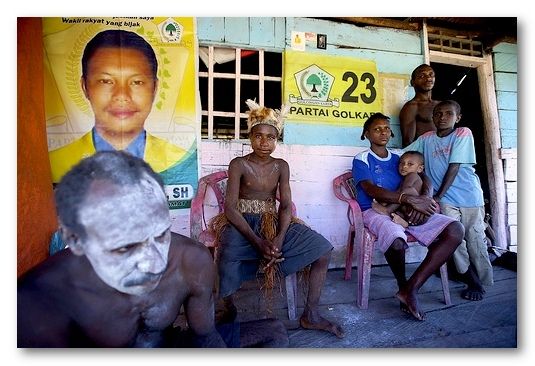
Non-indigenous Papuans now hold relatively few elected positions
Grenville Charles
A response to Jim Elmslie and Stuart Upton
By Richard Chauvel
Stripped of the obvious differences in rhetorical tone and values, the articles by Jim Elmslie and Stuart Upton have much in common. They both agree that:
• Papua has experienced a large scale demographic transformation since 1963
• the modern economy is dominated by Indonesian settlers and Papuans are marginalised
• Papuans suffer disadvantage in education, employment and health
• there have been significant human rights abuses by the Indonesian security forces
One of the useful contributions that both articles make is that they place Papua in a broader regional context. In comparing the markedly different rates of population growth in Indonesian Papua and Papua New Guinea, Jim Elmslie asserts that the two are ‘comparable Melanesian societies’. Looking west to the rest of the archipelago, Stuart Upton argues that population change in Papua looks like ‘the normal pattern of inter-island migration rather than genocide’.
Comparing Papua and PNG
Had Jim Elmslie’s comparison been related to New Guinea prior to intensive Dutch, British/Australian and German intervention in the last decades of the nineteenth century, it would have been more convincing than it is today. However, over the last one hundred years, the heterogeneous Melanesian societies in the two halves of the island of New Guinea have come into contact and interacted with the world beyond New Guinea through very different colonial and post-colonial governance structures. This has made them very different places.
In the case of PNG, Australian colonial rule and, since 1975, an indigenous Papuan political elite have been the mediating agencies. PNG was the sole Australian colony. The western half of the island was colonised by the Dutch as part of the Netherlands East Indies. Prior to the Pacific War, it was ruled through various administrative structures based in the neighbouring Maluku Islands. In the Australian territories, Australian administrators interacted directly with all levels and regions of PNG society. On the other side of the island, particularly before the Pacific War, there were more east Indonesian officials, police, teachers and missionaries than there were Dutch. The missionary education, the Christianity and the dialects of Malay that developed in Papua were those of the east Indonesian teachers and missionaries. Papuan contact with Indonesians in Papua and with Indonesian society outside Papua has intensified greatly since 1963.
I am not suggesting, however, that the different patterns of change in the two halves of the island over the past century or so explain the difference in population growth rates. The poorer levels of health care in Indonesian Papua, especially in the highlands and remote and still predominantly Papuan regions compared to the ‘failed state’ the other side of the border is one factor that helps explain the differences in population growth. The most obvious difference generated by the divergent patterns of change is that PNG has remained a predominantly Melanesian society, while the western half of the island has become more ‘Indonesian’ through education, language and religious change as well as a demographic transformation. With these great changes, Indonesian Papua and PNG now have much less in common than before colonisation.
Comparing Papua and East Indonesia
Inside Indonesia for more
“This is Jenna Bush Reporting … ”
By Walter Brasch

(AP Photo/Jeff Christensen)
NBC news correspondent Jenna Bush Hager had a news exclusive. And, like news exclusives in the Era of Infotainment TV, this one was broadcast by the entertainment division. Specifically, Jenna Bush interviewed her mother, Laura Bush, on 38th episode of “The Jay Leno Show.”
It makes no difference what the questions or answers were. Journalism hasn’t been a priority of television for a long time. What matters is that a network hired someone with no background into a job with an income substantially above what most journalists earn. Jenna Bush isn’t the only one to parlay dubious credentials onto network television. Beauty pageants—it makes no difference if it’s the Miss Rutabaga or Miss America contests—are full of contestants who say their ambition is to be a TV anchor—or an actress, whichever comes first.
Now, Jenna Bush, in her mid-20s, had also become a best-selling author, something that rarely happens even to the best writers. HarperCollins, owned by Rupert Murdoch of Fox News fame, printed an initial 500,000 copies of Ana’s Story in 2007. The press run was about 100 times greater than the average run of a first book by even a good writer. A year later, HarperCollins published a children’s book co-written by Jenna Bush and Laura Bush, who promoted their books on the major talk shows, including “The Tonight Show, with Jay Leno.” Thousands of publicists and authors literally beg to get network exposure. Most books that do get published can be found in the remainder bins—or recycling bins – within a year of publication—if the author is fortunate enough to even secure a contract.
The Bushes aren’t the only celebrities who have written children’s books. Among dozens of celebrities who easily found publishers for their children’s books were Julie Andrews, Bill Cosby, Katie Couric, Jamie Lee Curtis, LL Cool J, Jay Leno, Will Smith, Jerry Seinfeld, and even Shaquille O’Neal.
Superstar pro athletes can often get book deals in the six- and seven-figure range. Among them are 7-foot-5 NBA star Yao-Minh, whose command of English is minimal, but who scored a $1.5 million advance for his autobiography; and Dennis Rodman, aided by a fluorescent-hued hair, multi-body tattoos, and a seven-figure advance, who wore a dress and feather boa in Detroit and a wedding dress in Manhattan to promote his own in-your-face autobiography. O.J. Simpson was a cross-over—a superstar pro athlete and a criminal. Criminals whose stories make the front pages, and who while in prison “find” religion and do a great job of feigning repentance, can often secure book deals.
Thousands of 20-something students and recent graduates have worked extremely hard, usually in anonymity, to earn internships, many of them unpaid, in the media or in government. However, unlike most interns, Monica Lewinsky, Bill Clinton’s presidential playmate, became a best-selling author. And, like other celebrity-authors, she was able to parlay her notoriety into numerous talk show appearances, all of which helped promote Monica’s Story and more than $2 million in income.
Add Paris Hilton to the list. In 2004, she secured a book contract for an autobiography, reflecting her entire 23 year life of entitlement and near uselessness. Of course, the book became a New York Times best-seller.
Counterpunch for more
My Father, the Terrorist
A son of Osama bin Laden paints an intimate portrait of the man who would become the world’s most infamous terrorist.

By Omar bin Laden
Excerpted from Growing Up bin Laden: Osama’s Wife and Son Take Us Inside Their Secret World, by Najwa bin Laden, Omar bin Laden, and Jean Sasson, published this month by St. Martin’s Press; © 2009 by the author.
Since the time I could observe and reason, I have mainly known my father to be composed, no matter what might be happening. That’s because he believes that everything of earthly life is in the hands of God. It is difficult, therefore, for me to imagine that he became so excited when my mother told him I was about to be born that he momentarily misplaced his keys.
After a frantic search, I’m told he settled my mother hastily in the car before spinning off at a reckless speed. Luckily he had recently purchased a new automobile, the latest Mercedes, because on that day he tested all its working parts. I’ve been told it was golden in color, something so beautiful that I imagine the vehicle as a golden carriage tearing through the wide palm-tree-lined boulevards of Jeddah, Saudia Arabia.
Within a short while after that chaotic journey, I made my appearance, becoming the fourth child born to my parents.
I was only one of many in a chain of strong personalities in our bin Laden family. My father, although quiet-natured in many ways, has always been a man that no other man can control. My paternal grandfather, Mohammed Awad bin Laden, was also quite famous for his strength of character. After the premature death of his father, who left behind a grieving widow and four young children, Grandfather bin Laden sought his fortune without a clue as to where he would end up. He was the eldest at 11 years.
Since Yemen offered few possibilities in those days, my grandfather bravely turned his back on the only land and the only people he had ever known, taking his younger brother, Abdullah, with him to join one of the many camel caravans trekking through the area.
Vanity Fair for more
Setting Sail Into Space, Propelled by Sunshine

Rick Stembach/Planetary Society
DEEP-SPACE TRAVEL If the launching of LightSail-1 goes off according to plan next year, humans may soon be solar-sailing, as shown in this illustration.
By Dennis Overbye
Peter Pan would be so happy.
About a year from now, if all goes well, a box about the size of a loaf of bread will pop out of a rocket some 500 miles above the Earth. There in the vacuum it will unfurl four triangular sails as shiny as moonlight and only barely more substantial. Then it will slowly rise on a sunbeam and move across the stars.
LightSail-1, as it is dubbed, will not make it to Neverland. At best the device will sail a few hours and gain a few miles in altitude. But those hours will mark a milestone for a dream that is almost as old as the rocket age itself, and as romantic: to navigate the cosmos on winds of starlight the way sailors for thousands of years have navigated the ocean on the winds of the Earth.
“Sailing on light is the only technology that can someday take us to the stars,” said Louis Friedman, director of the Planetary Society, the worldwide organization of space enthusiasts.
Even as the National Aeronautics and Space Administration continues to flounder in a search for its future, Dr. Friedman announced Monday that the Planetary Society, with help from an anonymous donor, would be taking baby steps toward a future worthy of science fiction. Over the next three years, the society will build and fly a series of solar-sail spacecraft dubbed LightSails, first in orbit around the Earth and eventually into deeper space.
The voyages are an outgrowth of a long collaboration between the society and Cosmos Studios of Ithaca, N.Y., headed by Ann Druyan, a film producer and widow of the late astronomer and author Carl Sagan.
Sagan was a founder of the Planetary Society, in 1980, with Dr. Friedman and Bruce Murray, then director of the Jet Propulsion Laboratory. The announcement was made at the Hart Senate Office Building in Washington at a celebration of what would have been Sagan’s 75th birthday. He died in 1996.
Ms. Druyan, who has been chief fund-raiser for the society’s sailing projects, called the space sail “a Taj Mahal” for Sagan, who loved the notion and had embraced it as a symbol for the wise use of technology.
There is a long line of visionaries, stretching back to the Russian rocket pioneers Konstantin Tsiolkovsky and Fridrich Tsander and the author Arthur C. Clarke, who have supported this idea. “Sails are just a marvelous way of getting around the universe,” said Freeman Dyson, of the Institute for Advanced Study in Princeton, N.J., and a longtime student of the future, “but it takes a long time to imagine them becoming practical.”
New York Times for more
The day the bulldozers came…

Vegetable crops and irrigation network being uprooted by an Israeli army bulldozer in Jiftlik, Jordan Valley, 11 March 2008.
© Amnesty International
West Bank farmer Mahmoud al-‘Alam won’t forget the day Israeli army bulldozers cut off his water supply… and destroyed his livelihood.
The village of Beit Ula, where Mahmoud lives, is not connected to the Palestinian water network. Instead the community, located north-west of Hebron, relies on rainwater, which it collects and stores in pots dug in the ground, known as cisterns.
The nine new cisterns built in 2006 as part of a European Union-funded project to improve food security became the pride of the village. The cisterns were vital to the survival of the nine families that used them… until the bulldozers arrived.
“[The Israeli army] destroyed everything; they went up and down several times with the bulldozer and uprooted everything,” recalls Mahmoud al-‘Alam.
In a few hours, years of hard work had been undone. The cisterns had been built with the help of two local nongovernmental organizations, the Palestinian Agricultural Relief Committees and the Palestinian Hydrology Group.
The cisterns provided water for 3,200 newly planted trees including olive, almond, lemon and fig trees. The farmers had also contributed a significant portion of the overall cost of the project.
“We invested a lot of money and worked very hard,” said Mahmoud al-‘Alam. “This is good land and it was a very good project. We put a lot of thought into how to shape the terraces and build the cisterns in the best way, to make the best use of the land, and we planted trees which need little water… the saplings were growing well…”
The story of Beit Ula is one of many cases where Israeli forces have targeted Palestinian communities in the region.
On 4 June 2009, the Israeli army destroyed the homes and livestock pens of 18 Palestinian families in Ras al-Ahmar, a hamlet in the Jordan Valley area of the West Bank.
More than 130 people were affected, many of them children. Crucially, the soldiers confiscated the water tank, tractor and trailer used by the villagers to bring in water. They were left without shelter or a water supply at the hottest time of the year.
Amnesty International for more
A Lesson Brazil Is Learning: We Are the Wealth
By Cristovam Buarque
Recently, the United Nations Development Program (UNDP) held a meeting in Cairo, Egypt, to discuss the importance of Income-Transfer Policies – initiated in 1995 in Brasília with the Bolsa-Escola and transformed into the Bolsa Família in 2004 – in the reduction of world poverty.
Participating in the meeting were UNDP representatives from 56 countries. During this meeting, former New Zealand Prime Minister and current UNDP Administrator Helen Clark said something surprising: “Africa is a rich continent.” Although surprising, this statement is correct since it affirms that a people’s wealth lies in its population.
For Ms. Clark, the challenge of abolishing poverty involves a mobilization of the population to produce the goods needed by the poor. Income transfer is the road for this mobilization so that the poor come together to produce that which they need, thus creating the surplus that traditionally characterizes wealth.
Called “Productive Post-Keynesianism,” this logic’s best-known instrument is the Bolsa-Escola, the program through which a mother receives payment for participating in her children’s production of education.
When poverty is treated as if it were a lack of income, the poor population is seen as reducing per-capita income and not as inducing production. With her observation, Ms. Clark presented a new vision: first, because, if the poor person is producing, he or she has become wealth; second, because she affirmed that poverty is not a question of income, but, rather, of the offer of goods and services.
In the traditional Keynesianism of the rich countries, the government transfers income to the unemployed population merely to create demand and, therefore, dynamize the economy, with no need for producing the public goods needed by the population. On the other hand, Conditional Income Transfers generate a product that increases the offer of the goods and services the poor need. These programs transform an idle workforce into an active one; they increase the offer and transform necessity into demand.
Translated from the Portuguese by Linda Jerome LinJerome@cs.com
Brazzil for more