How American awfulness stacks up

Americans may be some of the least healthy people in the rich part of this world, but we sure do feel good about ourselves!
That’s one of the more interesting revelations in the 2009 edition of the OECD’s Social Indicators. Americans lead the world in obesity, lag the world in life expectancy and infant mortality—yet 89% of us report ourselves to be in excellent health, just behind the world’s biggest health-boasters, New Zealanders, who beat us by a point in self-reported health, but who outlive us by more than two years.

This report got some coverage in our surviving newspapers, but most of the stories focused on the not-uninteresting news that the French spend more time than Americans sleeping and eating. But, of course, that shows what layabouts and sensualists they are. What the stories didn’t disclose is that we look like an overworked people with a dim future—aside from being some of the least healthy people in the richer neighborhoods of planet earth.

The general picture of the social and physical health of the U.S. isn’t pretty. In a summary table at the beginning of the volume, countries are rated with a red, yellow, or green symbol, depending on whether they fall in the bottom, middle, or top of the rankings on eight crucial indicators. The U.S. scores a yellow on six (among them employment, reading skills, the gender wage gap, and life expectancy), and a red on two (inequality and infant mortality). But we are near the top in income. Far poorer countries, like Hungary and the Czech Republic, do a lot better than this imperial colossus. Maybe it’s not so bad to have a Commie past.

And not only does the U.S. turn in an awful performance—we’ve been getting worse on six of the eight.

Slaving for pennies

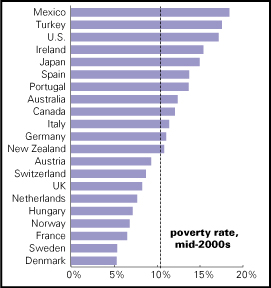
The U.S. always turns in a spectacular performance on poverty indicators, and this version is no exception: not only do we have one of the highest poverty rates in the OECD (as the graph shows), our poor also tend to be quite poor. The average poor household in the U.S. has an income 38% below the poverty line (and poverty is defined here, as it often is in international comparisons, as an income less than half the national household median, with appropriate adjustments made for household size). The average for the OECD is 10 points lower, 28%. It’s in the low 20s in the Scandinavian countries, and in the mid-20s in France and Canada.

New Left Observer for more

War in Yemen Means Business

While 30,000 IDPs remain inaccessible to relief, US Powered scores nuclear reactor

by Isaac Oommen


Once one of the most sophisticated centres of learning in Arabia, Yemen has recently become one of the poorest and most troubled countries in the Middle East. [cc 2.0] Photo: Ahron de Leeuw

VANCOUVER—Yemen has been rocked by a series of violent clashes between government and rebel forces from the northern tribes since August, and plans to build a new nuclear reactor has sparked fears of increased tensions.

When the internal conflict in Yemen intensified in August from periodic clashes to full-scale military engagement, President Ali Abdullah Saleh was adamant that his forces would crush the rebel tribes.

“We are determined to destroy this sedition,” he said in an address to military school graduates. “We will nip this cancer wherever it exists, in [the province of] Sa’ada or elsewhere.”

The northern al-Houthi rebels immediately accused the armed forces of using weapons supplied by the US. A series of videos released by the Houthis displayed weapons they had confiscated from the army during skirmishes over the last year.
Yemen’s government has since denounced the northern rebels for wanting to set up an independent Shia state in the country that mimics the pre-1962 theocracy.

In press releases, the government has also accused Iran of backing the Houthis with weapons and training.

On his website, the rebels’ leader Abdul-Malik al-Houthi has denied both accusations. He countered that his people have been fighting for their rights against a government that has become too cozy with Saudi Arabia, whose fundamentalist Wahhabi Sunni rulers see the 10 million Zaydi Yemeni Shi’ites as heretics. He also stressed the difference between Zaydi and Iranian Shi’ism.

Saudi Arabia has a noted interest in the conflict, and has been accused by Houthis of disallowing internally displaced people (IDPs) from entering its borders. Saudi interests in Yemen are like those of the US—primarily related to the threat of terrorism.
US and Pakistani officials are looking at the Arabian peninsula as the new breeding ground for terrorist activities, alleging a movement out of Afghanistan towards countries such as Somalia and Yemen.

Early in the year, deputy chief of Al Qaeda Ayman al-Zawahiri merged the Saudi Arabian and Yemeni wings of the group. This made enough waves for US President Barack Obama to send Yemen’s President a letter in September asking for more cooperation in fighting Al Qaeda in the region.

During US Senator John McCain’s August visit to Yemen, he mentioned that the US wholly supports efforts to enhance Yemen’s security.

Yemen also gained attention in Canada as an alleged training ground for Canadian Islamic extremists.

“There’s a great, and I think growing, fear among policy makers in Washington, in London, in Canada and in Europe about what instability in Yemen will mean for the future of a group like al-Qaeda in the Arabian Peninsula,” Canadian Minister of Public Safety Peter Van Loan told the National Post on September 4.
Canadian firms were among those meeting with the Yemeni government in September over talks to build a nuclear reactor there. The deal eventually went to US-based Powered Corporation. Greenpeace was one of the first groups to note that the plant would likely increase instability in Middle East.

Energy shortfalls in Yemen are becoming worse, with rolling blackouts and water shortages affecting multiple provinces, particularly in the south of the country. Protests in that area are becoming increasingly violent, as more people become angry about marginalization by the federal government.

Reports regarding the war in the north are few and sporadic. By the end of September the Yemeni government was alleging that Operation Scorched Earth had killed hundreds of Houthi fighters and pushed the remainder out of their stronghold in Sa’ada.
In an October 14 address commemorating the Yemeni uprising against the British in 1963, President Saleh said that he expected to completely crush the rebels over the next few days.
The rebels have been reporting the opposite, claiming to have captured further cities and killed several government troops in Sa’ada province in September. Houthi sources said the rebels had even seized an army camp in early October.

Dominion for more

The Berlin Wall of the Desert

On the 20th anniversary of the fall of the Berlin Wall, Stefan Simanowitz reports from Western Sahara on the wall that has separated a nation for 29 years.

Whilst the world is commemorating the fall of the Berlin Wall, another less well-known wall that separates a nation and its people still stands tall. At 1,553 miles long, the wall that divides Western Sahara is 12 times longer than the Berlin Wall and, having stood for 29 years, is now a year older than the Berlin Wall was when it was toppled.

Known as ‘the Berm’, the wall was constructed by the Moroccans from sand and stone to keep the Polisario Front, the Western Sahara liberation movement, out of the territory and prevent the 165,000 Saharawi refugees from returning to their land. Standing at around 3 metres in height, the wall runs through the desert and is fortified with barbed-wire fencing, artillery posts and one of the highest densities of land mines in the world.

Like the wall that separates the Israeli and Palestinian populations in the West Bank, the Berm has become a potent symbol of the occupation and focus for protests. Last April 19-year-old Ibrahim Hussein Leibeit was taking part in one of the frequent marches to the wall organized by Saharawis living in the refugee camps. In a symbolic gesture, Ibrahim was attempting to get close enough to the wall to throw a pebble to the other side when he trod on a land mine. He lost his right leg below the knee and in the following months has become something of a hero to the Saharawi cause.

Unlike the Berlin Wall or the wall in Palestine, few people have heard either of the Berm or the conflict in Western Sahara – which remains one of the longest-running conflicts in the world. About the size of Britain, Western Sahara lies along Africa’s Atlantic coast. It was colonized by Spain but in 1976, in a breach of international law, the Spanish colonizers divided Western Sahara between Morocco and Mauritania in exchange for continued fishing rights and partial ownership of mining interests. A 15-year war ensued between the Moroccans and the Polisario Front, with the Mauritanians withdrawing in 1979. The fighting was brutal, with Morocco using her well-equipped army and air-force to full effect, but the Saharawis conducted an effective counter insurgency. In 1980 the Moroccans began construction of the Berm to try and contain the Polisario, but with little success. In 1991 a ceasefire was declared and under the terms of a UN agreement a referendum for self-determination was promised. Seventeen years later the Saharawi are still awaiting that referendum.

New Internationalist for more

Whose Team Is It, Anyway?

By Katha Pollitt

Katha Pollitt’s new book of poems, The Mind-Body Problem, has just been published by Random House.

You know what I don’t want to hear right now about the Stupak-Pitts amendment banning abortion coverage from federally subsidized health insurance policies? That it’s the price of reform, and prochoice women should shut up and take one for the team. “If you want to rebuild the American welfare state,” Peter Beinart writes in the Daily Beast, “there is no alternative” than for Democrats to abandon “cultural” issues like gender and racial equality. Hey, Peter, Representative Stupak and your sixty-four Democratic supporters, Jim Wallis and other antichoice “progressive” Christians, men: why don’t you take one for the team for a change and see how you like it?

For example, budget hawks in Congress say they’ll vote against the bill because it’s too expensive. Maybe you could win them over if you volunteered to cut out funding for male-exclusive stuff, like prostate cancer, Viagra, male infertility, vasectomies, growth-hormone shots for short little boys, long-term care for macho guys who won’t wear motorcycle helmets and, I dunno, psychotherapy for pedophile priests. Men could always pay in advance for an insurance policy rider, as women are blithely told they can do if Stupak becomes part of the final bill.

President Obama, too, worries about the deficit. Maybe you could help him out by sacrificing your denomination’s tax exemption. The Catholic Church would be a good place to start, and it wouldn’t even be unfair, since the blatant politicking of the US Conference of Catholic Bishops on abortion violates the spirit of the ban on electoral meddling by tax-exempt religious institutions. Why should antichoicers be the only people who get to refuse to let their taxes support something they dislike? You don’t want your tax dollars to pay, even in the most notional way, for women’s abortion care, a legal medical procedure that one in three American women will have in her lifetime? I don’t want to pay for your misogynist fairy tales and sour-old-man hierarchies.

Women Democrats have taken an awful lot of hits for the team lately. Many of us didn’t vote for Hillary Clinton in the primary because the goal of electing a woman seemed less important than the goal of electing the best possible president. Only a self-hater or a featherhead didn’t feel some pain about that. And although women are hardly alone in this, we’ve seen some pretty big hopes set aside in the first year of the Obama administration. The Paycheck Fairness Act, which would expand women’s protections against sexism in the workplace, is on the back burner. Meanwhile, the Office of Faith-Based and Neighborhood Partnerships is not only alive and well; it’s newly staffed with antichoicers like Alexia Kelley of Catholics in Alliance for the Common Good, who, as Frances Kissling notes in Salon, has compared abortion to torture.

The Nation for more

In The Service of Historical Falsification

A Review of Robert Service’s Trotsky: A Biography

By David North
Trotsky: A Biography
Robert Service
Harvard University Press
Cambridge, Massachusetts, 2009


The Specter of Leon Trotsky

In 1955 James Burnham, the intellectual godfather of modern American neo-conservatism, reviewed The Prophet Armed, the first volume of Isaac Deutscher’s monumental biography of Leon [Lev Davidovich] Trotsky. Fifteen years had passed since Burnham had resigned from the Fourth International at the climax of a political struggle in which he had crossed polemical swords with Leon Trotsky. It had been a difficult experience for Burnham, who felt somewhat overmatched in this political and literary contest. “I must stop awhile in wonder,” Burnham had written in a document addressed to Trotsky, “at the technical perfection of the verbal structure you have created, the dynamic sweep of your rhetoric, the burning expression of your unconquerable devotion to the socialist ideal, the sudden, witty, flashing metaphors that sparkle through your pages.” (1)

In the aftermath of his repudiation of socialism, Burnham moved rapidly to the extreme right (as Trotsky had predicted). By the mid-1950s he viewed Trotsky’s life and work through the prism of his own ideological commitment to a global struggle against Marxism. Deutscher’s work filled Burnham with alarm. The problem was not literary in character. Burnham readily acknowledged the author’s masterful reconstruction of Trotsky’s revolutionary persona.

“Mr. Deutscher has cast his story of Trotsky in the Greek mould, and with sufficient justification,” Burnham wrote. “His Trotsky is a protagonist of the most dazzling brilliance, who rises in 1905, 1917 and in the Civil War to successive heights where he fuses with History and becomes her voice.” Burnham allowed that the author had succeeded in conveying to his readers Trotsky’s extraordinary qualities: “the flaming oratory, which many who heard him believe to have been the greatest of our century; the linguistic facility; the witty and vibrant prose; the quickness with which Trotsky mastered every new subject; the breadth of interest, so rare among the dedicated revolutionaries.”
Burnham noted that Deutscher’s portrait of Trotsky was not one-sided; that he “conscientiously displays, also, Trotsky’s weaknesses…” But despite the many literary virtues of the biography, Burnham denounced it as an “intellectual disaster.” Burnham’s reason for his condemnation was that “Mr. Deutscher writes from a point of view that accepts and legitimizes the Bolshevik revolution.” The biography was “organically warped” and unacceptable. “Not all the scholarly references from all the libraries are enough to wash out the Bolshevik stain.”

Burnham confessed his horror that Deutscher had received “all the courtesies of our leading research institutions, the aid of our foundations, the pages of our magazines, publication and promotion by the great Anglo-Saxon Oxford Press.” Did the establishment not recognize the danger in allowing, and even encouraging, the details of Trotsky’s heroic life and revolutionary ideas to reach the broader public, and especially the youth?

Burnham concluded his review with a cry of despair: “The minds of many of our university students and opinion-makers are being deeply formed, on the supremely important issues with which he [Deutscher] deals, by his ideas. It is surely one more among the many indications of the suicidal mania of the western world.” (2) The conclusion that implicitly flowed from this review was that Deutscher’s book and others like it, which portrayed the October Revolution and its leaders sympathetically, should not be published.

World Socialist Web Site for more

Manu Over Ambedkar


We have a voice: Balmiki children at the public hearing at Sabarmati ashram. Photograph Courtesy: Navsarjan Trust

Gujarat’s Balmiki kids face daily humiliations in school and village

By Mari Marcel Thekaekar

Our Kids, Their Kids

• Children of safai karmacharis in Gujarat are forced by teachers to clean toilets and mop floors in school
• They are abused and beaten if they refuse to do the menial tasks
• Treated as untouchables and kept at arm’s length by upper caste students
• In some areas, they are not even allowed to drink from a common source of water
• Reports of their notebooks never being corrected since teachers don’t like to handle their books
***
They had, it seems, come from all corners of Gujarat. From Gandhinagar to tribal Panchmahals, from Porbandar on the western coast to the Dangs at its southern tip. The children arrived at the Mahatma’s Sabarmati ashram, lining up solemnly in their new Gandhi caps. At the gates, they were welcomed with handwoven cotton thread malas by elderly Gandhian leaders.

They were children of safai karamcharis, Balmiki kids used to watching their parents sweep public streets and private homes and clean filthy toilets. The children were at the ashram to share their ‘experiences’ with a fact-finding panel, tales of being forced to clean toilets and mop floors in school, of horrific discrimination by their upper-caste schoolmates and teachers. They came to the podium in line, district by district, took the mike to tell their stories. Matter of fact, stating the facts somewhat baldly. There was no wallowing in pity, in ‘vibrant Gujarat’ this was how life was for them.

Pooja, a fifth standard student, says they are not even allowed to take water from the drinking water matka: “The kids from the ‘upper’ castes blow air and do ‘phoo phoo’ to cleanse themselves if we touch them by mistake. Or they sprinkle water on the spot we touch…. The teachers don’t want to touch our homework books. So they are never corrected. I clean the toilets. I have to. Because the teacher tells us to do it. We are Bhangis. No one in school would like to be friends with us. They say ‘Hey Bhangi door bes, (sit far away)’.”

Prakash, from Mohua taluka of Kheda district, is in the seventh standard. “I clean toilets in school.” “Why do you do this?” the panel asks him. He looks puzzled, it’s obviously a stupid question. “Because the teacher tells me to….” “Why do you obey him?” Wasn’t it obvious? “Because I’ll get a beating if I don’t obey.” What do you want to be when you grow up?” the panel asks. “A teacher.” “Why a teacher?” “Because I want a life of dignity,” Prakash replies shyly.

Aarti, in the seventh standard and studies in a Girls High School in Patan district. “I clean the classroom and the toilets three times a week.” “Why do you do this?” “Because the principal asks us to do it,” she replies. “How does he know you are a Balmiki?” “From my name. If we say we don’t want to clean toilets, they beat us. Three Balmiki girls, Sangeeta, Raksha and Daksha, were beaten because they didn’t want to clean the toilets.”

In the schools, the pattern is almost always the same. The teacher or principal asks “all the Bhangi children to stand up”. Then they are allotted the toilet cleaning duties.

Rahul is an unusual name for a Balmiki kid. He disposes of dead animals for Rs 10. He also cleans the toilets and urinals at school. Have you heard of Rahul Gandhi, someone inevitably asks. “No,” he replies. “Didn’t you see him on TV during the elections?” “I don’t think so.”

Jayesh, in the 10th, is sharply turned out. Maroon shirt, cream trousers, hair smartly cut. A mobile peeps out of his pocket. It’s hard to believe that the lad regularly mucks about in manholes to earn some extra money. But he dreams of doing a BBA, getting a job in an office. “If I pass my BBA and get a job, I will never do this work again,” he declares.

Outlook for more

Vegetarianism in a Nutshell

By Bruce Friedrich (of PETA)

There are very few choices in our day-to-day lives that make a significant impact on the world around us, but what we choose to eat does. Eating meat supports global poverty and worker abuse, harms the environment, supports cruelty to animals, and is bad for our health. Socrates said that “[t]he unexamined life is not worth living.” Basically, veganism and vegetarianism are about leading an examined life—really considering the health, environmental, human, and animal consequences of our food choices, and then opting to make choices
that are in keeping with our basic values.

So vegetarianism is the self-empowerment diet; at every meal, we have the opportunity to live our values—to cast our vote against cruelty to animals, environmental degradation, and global poverty—and we do this all while eating a diet that is better for us than one that includes meat.

Health

Meat, eggs, and dairy products contain absolutely no fiber or complex carbohydrates, and they are packed with saturated fat and cholesterol. In the short term, eating meat, dairy products, and eggs is likely to make a person fat and lethargic. In the long term, eating these products can cause heart disease, high blood pressure, several types of cancer, and an array of other problems. I’d like to make a couple of points about human physiology, and then I’ll talk about the link between animal products and a few of the worst health scourges
plaguing North Americans.

It’s amazing how many seemingly intelligent people, to justify their meat-eating, open their mouths, point at their teeth, and say something about “canines” as a means of defending a habit that is ecologically devastating, cruel to animals, and likely to kill them. Putting aside how different human “canines” are from the canine teeth of carnivores (I really wonder if these people have ever even looked at the long, dagger-like canines of a dog or a tiger), every natural carnivore has an array of other physiological properties that do not mirror ours. For example, unlike humans, all natural meat-eaters manufacture their own vitamin C, whereas we need to consume vitamin C in fruits and vegetables. True carnivores perspire through their tongues rather than through their skin. Natural meat-eaters have sharp, pointy front teeth, sharp and jagged molars, and a toothbone density that’s many times greater than that of humans, which enables them to crunch through the bones of their prey. Carnivores have no digestive enzymes in their saliva at all, and their digestive acids are many times more acidic than those of humans, so the bacteria from rotting flesh won’t kill them. Natural meat-eaters have jaws that move only vertically, instead of in a grinding motion as ours do, and they don’t chew their food—they just rip and swallow. Carnivores have claws to rip their prey apart instead of sensitive fingers for plucking.

They have intestinal tracts that are only three times their body length, which enables them to eject rotting flesh quickly. No matter how much saturated fat and cholesterol they consume, natural meat-eaters never develop atherosclerosis, the heart disease that consistently kills more human beings in the industrialized world than any other cause of death. And the list of physiological differences between humans and natural meat-eaters goes on and on. And let’s also think about this intuitively. How many of us salivate at the idea of chasing small animals, ripping them limb from limb, and then devouring them, blood and all? I hope that no one listening has that reaction, but every carnivore does. How many of us, if we’re walking down the street and see a recently run-over animal carcass on the road, think, “Mmmmmm … I’d like to eat that”? No. We think, “Oh, how sad” or “Blech.” A real carnivore, if hungry, digs in.

Yes, human beings learned, “Hey, if we kill all the bacteria and viruses with fire, this stuff probably won’t kill us.” And a long time ago, at times when there was little vegetation for us, we started eating meat. But it’s still not good for us, and in fact, it’s so bad for us that it kills many of us.

Go Veg for more

(Submitted by reader)

Bangladeshis rush to learn English by mobile

By Maija Palmer in London and Amy Kazmin in New Delhi

More than 300,000 people in Bangladesh, one of Asia’s poorest but fastest-growing economies, have rushed to sign up to learn English over their mobile phones, threatening to swamp the service even before its official launch on Friday.

“We were not expecting that kind of response; 25,000 people would have been a good response on the first day,” said Sara Chamberlain, the manager of the discount service. “Instead, we got hundreds of thousands of people.”

The project, which costs users less than the price of a cup of tea for each three-minute lesson, is being run by the BBC World Service Trust, the international charity arm of the broadcaster. Part of a UK government initiative to help develop English skills in Bangladesh, it marks the first time that mobile phones have been used as an educational tool on this scale.

Since mobile-phone services began in Bangladesh just over a decade ago, more than 50.4m Bangladeshis have acquired phone connections, including many in remote rural areas. This far outnumbers the 4m who have internet access.

English is increasingly seen as a key to economic mobility. An estimated 6.2m Bangladeshis work overseas and hundreds of thousands of others want to follow in their steps. However, English is also important for securing jobs at home, where about 71 per cent of employers look for workers with “communicative English”.

Through its Janala service, the BBC offers 250 audio and SMS lessons at different levels. Each lesson is a three-minute phone call, costing about 3 taka (2.6p).

One basic lesson involves listening to and repeating simple dialogue like: “What do you do?” “I work in IT, what about you?” “I’m a student.” “That’s nice.” Another is devoted to differentiating vowel sounds like those in ship and sheep or leaf and live.

Financial Times for more

New DNA Law in Argentina Will Help Find the Missing Grandchildren

By Joel Richards

“The second I saw Martín, I knew he was my brother,” recalls Mauricio Amarilla-Molfino. “I didn’t need to see the DNA results. Just like me and my brothers, he has the same ears!”

Smiles broke out amidst the emotionally charged atmosphere in the offices of the Abuelas de la Plaza de Mayo (Grandmothers of the Plaza de Mayo) in Buenos Aires last week.

The three Amarilla-Molfino brothers did not know their mother had given birth to a fourth son. The three older brothers had grieved the “disappearance” of their parents, Guillermo and Marcela, by the military dictatorship that ruled Argentina from1976 to 1983. Yet evidence that came to light just three months ago revealed that Marcela had given birth to a fourth son – Martín – in 1979, while she was held prisoner at the clandestine detention center, Campo de Mayo.

Twenty-nine years later, Martín Amarilla-Molfino was united with his three elder brothers, along with aunts and uncles, and saw a photo of his parents for the very first time.

It was Abuelas who made this emotional meeting possible. They have worked tirelessly for over 32 years, searching for the “missing grandchildren” – the children of the disappeared, children whose identity was falsified by the military. The Abuelas estimate there are approximately 500 cases.

Along with the Madres (Mothers) de la Plaza de Mayo, the Abuelas are continuing symbols of resistance to the legacy of the dictatorship. Every Thursday, with white handkerchiefs over their heads, the Abuelas and Madres march in front on the Presidential Palace, and have done so since before the dictatorship fell.

The case of Martín, the 98th to be solved by Abuelas, was all the more poignant coming in the week that Congress approved a DNA law that will aid the Abuelas in their search for the missing grandchildren.
“We were handed over like puppies to different families,” said congressional deputy Victoria Donda in her speech to Congress during the DNA law debate. Donda was born at the infamous detention center used during the dictatorship, the Navy School of Mechanics (ESMA), and handed over to another family when her parents were disappeared.

She also touched on a particularly sensitive issue surrounding the Abuelas’ search. “It took me eight months to decide to take a DNA test. It is torture waiting for the parents that raised you – who you love – to die, so that you can meet your family and find out about your real parents.”

In some cases investigated by Abuelas, the children involved – now adults in their 30s – do not want to take a DNA test for fear they would be betraying the parents who raised them.

Yet one aspect about the debate remains incontrovertible – the falsification of a child’s identity is a crime. In 83 of the 98 cases of missing grandchildren found by the Abuelas, the families that raised the children were in part responsible for, or at least knew about, the disappearance of the child’s real parents.

Speaking of the decision to give DNA or not, one deputy during the debate in Congress spoke of Argentine society’s need to redress the issue. “The truth is a collective obligation, not an individual decision.”
Now awaiting the Senate’s approval to become law, once the DNA law is ratified, the courts can order a DNA sample – from hair or skin – be taken from those who refuse to have a blood test.

North American Congress on Latin America for more

On The Wrong Side Of Geography?


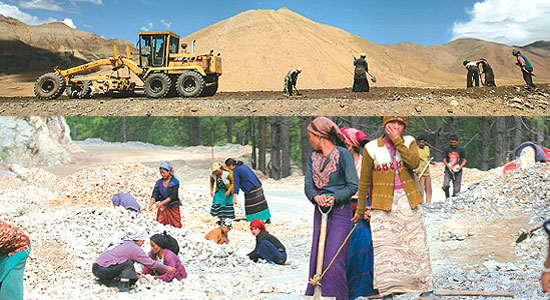
Stark contrast: A road being constructed in the China-administered Tibet Autonomous Region; and below, one being laid on the Indian side, in Arunachal Pradesh’s Tawang region

With India having given them nothing but neglect, the Arunachalis wonder if they’d have been better off with China

By Saikat Datta

• Flashpoint 1 Appalling infrastructure makes Arunachalis wonder how New Delhi can ignore such a sensitive border state
• Flashpoint 2 It’s particularly shameful when you look at all the development just across the border, on the Chinese side
• Flashpoint 3 There is resentment over dilution of tribal identity, especially on account of the imposition of Hindi
• Flashpoint 4 A corrupt electoral system is helping elect people who have the money but don’t necessarily represent people
• Flashpoint 5 Hydel projects will lead to influx of migrants and hasty environmental
clearances will wreak havoc
***
Travelling through the plains of upper Assam one late October afternoon, wending our way from picturesque Tawang to Arunachal’s capital Itanagar, an irony keeps hitting us at every turn. To access one part of Arunachal from another, we must suffer this tedious journey through Assam. It’s here that we run into Ritesh (name changed), an indigenous Arunachali who’s a journalist with a government media agency based in Itanagar. He recalls the day he went across the McMahon Line, which divides India from China, for the first time in his life—and saw what China was all about. Actually, Ritesh didn’t really see mainstream China but the region euphemistically called the Tibet Autonomous Region (TAR).

Ritesh could cross the McMahon Line because of a tradition that the Indian and Chinese military follow diligently every year. On August 15, a Chinese delegation crosses over to Tawang at Bum La; on October 2, to commemorate the Chinese National Day, an Indian delegation crosses over into TAR. On these two days, both sides jointly hoist the respective flags of their countries. Amidst bonhomie, each delegation shows off its country’s achievements to the other. It was on one such trip that Ritesh witnessed China’s progress. “The roads were beautiful,” he reminisces, “the villages swank and the infrastructure fantastic. Then I recalled the road I’d taken from Tezpur over two days to get there and I began to wonder where Arunachal would have been had it continued under China post-1962.”

The visit was a mind-bending experience for Ritesh, prompting him to take a relook at his assumptions, at the idea of India he had inherited. He, after all, belongs to what can be called the post-’62 generation, those born in the years following the Indo-China conflict. They know of China as the aggressor, an image recurring in the narration of their grandfathers. Now, however, Ritesh has seen the other China—a superpower in the making, hurtling down the road to development at breakneck speed.


Whose goose is being cooked: Arunachali tribals resent the loss of their way of life and dilution of their tribal identity

Quite understandably, China dominates the thoughts and memories of most Arunachalis. The tribes here still lingered in their pre-industrial ways of life when in October 1962, as the winter chill set in, the Chinese stormed into India through Bum La on the west and the Dibang valley in the east, sweeping past Indian defences to advance to the gates of Tezpur in Assam. The ’62 war sent shock waves countrywide. But for Arunachalis—indigenous people aeons away from the mainstream in material culture—a modern war machine playing out its drama on their territory marked the end of innocence. Indeed, 1962 isn’t just a year for them. For many, it is the beginning of the end.

Says Moji Riba, an erudite and articulate filmmaker whose father was briefly the chief minister years ago, “Our society developed at such a speed that we couldn’t catch up post-’62. Most people like my grandfather never saw a wheel when they emerged from the jungles. And yet, they saw jets flying in the air. From pre-wheel to jet age in 40-odd years, can any society evolve in this manner without consequences?”

Outlook for more