Honduras: Anti-Coup Resistance Movement “Firmly United”

Written by Juan Ramón Durán

(IPS) – The National Resistance Front Against the Coup d’Etat (FRN) in Honduras is carrying out a nationwide consultation among its members to establish its position with respect to the expected talks between ousted President Manuel Zelaya and the de facto government, the movement’s leaders said.

Although face to face talks between Zelaya and de facto President Roberto Micheletti have been ruled out for now, a dialogue to come up with a solution to the political crisis will begin next week, John Biehl, an adviser to Organisation of American States (OAS) secretary general José Miguel Insulza, said Friday.

Marvín Ponce, a lawmaker of the left-wing Democratic Unification (UD) party, said the FNR is “firmly united,” despite the diversity of social, labour and political sectors represented by the movement that began to take shape and hold protests immediately after Zelaya was removed from his house at gunpoint by the military and put on a plane to Costa Rica on Jun. 28.

“We are carrying out a consultation process to decide how and with what position we will participate, with regard to the different proposals to solve the conflict,” Ponce told IPS Thursday, under the close watch of a squad of policemen who just a few minutes earlier had violently broken up a protest by some 300 members of the FNR outside the U.S. embassy.

Demonstrations have also been held outside the Brazilian embassy since Zelaya slipped back into the country and took refuge there on Sept. 21.

Ponce said the FNR is made up of the UD, the Movement of Liberals (members of the Liberal Party) against the Coup, a faction of the Social Democratic Innovation and Unity Party (PINU), the country’s three central trade unions, the federation of teachers’ unions, a group of cooperatives, a coalition of trade unions of public employees known as the Popular Bloc, and the Coordinator of Popular Resistance, an umbrella group of grassroots and popular organisations.

This broad range of organisations, with a total combined membership of around 100,000 people, have come together in the FNR around two basic demands: the reinstatement of Zelaya to finish out his presidential term, which ends in January; and the election of a constituent assembly to rewrite the constitution, in order to bring about significant social changes in Honduras, said Ponce.

Koritza Díaz, a former president of the powerful union of high school teachers, said it is only logical that sometimes contradictory views would emerge from within such a large social movement as the FNR, after so many months of continuous action.

“The FNR has short, medium and long-term aims,” said Díaz. “The popular pressure exerted by means of daily protest marches in the streets of Tegucigalpa has kept the usurper government from consolidating its hold on power.

UDW

Unemployment crisis shows the failure of capitalism

As US jobless toll tops 15 million

5 October 2009

The staggering figures released Friday on the US labor market demonstrate that what has developed since the Wall Street crash one year ago is not a conjunctural downturn or recession, but an historic assault on working class living standards.

The official unemployment rate for September was 9.8 percent, up from 9.7 percent in August, amid predictions that the jobless rate would pass the 10 percent mark and remain in double digits for at least the next year.

The US Labor Department reported a net loss of 263,000 jobs in September, far more than predicted by government and business economists. Another 571,000 workers dropped out of the labor market entirely, not looking for work during the month because they saw no prospect of finding a job.

Despite the claims of economic recovery, the combined total of 834,000 workers either losing their jobs or giving up the search for work is comparable to the 700,000-plus job losses recorded in January and February.

September marked the 21st consecutive monthly decline in jobs—the longest continuous drop in US employment since the Labor Department began collecting such figures in 1939.

Some 15 million American workers are unemployed, nearly double the number out of work when the recession began at the end of 2007. The average duration of unemployment is 26.2 weeks, more than half a year, the highest figure since the Labor Department began such statistics in 1948. One third of the unemployed, more than five million, have been out of work for 27 weeks or more. This is another Labor Department record.

In addition to those totally without work, another 9.1 million workers are classified as involuntary part-time, working far fewer hours a week than they need to sustain their living standards. The combined total of unemployed, discouraged and involuntary part-time workers has surpassed 25 million—a number that, in absolute terms, far exceeds the jobless toll during the Great Depression of the 1930s.

Virtually every sector of the economy showed job losses in September, including 53,000 in government, mainly due to layoffs by states and cities. Only one sector, health care, showed an increase—and this is the sector being targeted by the Obama administration and Congress for major cost-cutting, which will inevitably take the form of a reduction in jobs.

There are now six unemployed workers for every job opening in America. A survey by the Business Roundtable, an association of corporate CEOs, said 40 percent of its member companies intended to cut their payrolls during the next six months, while only 13 percent planned an expansion.

More than one million Americans have filed for bankruptcy in the first nine months of 2009, according to the American Bankruptcy Institute. September saw a 41 percent increase over the same month in 2008, with 124,790 cases. The institute predicted that a total of 1.4 million people will file for bankruptcy by the end of this year.

The derisory response of the Obama administration and Congress to the jobs disaster is a limited extension of unemployment benefits. By one estimate, 400,000 workers exhausted their unemployment benefits in August and September, and one million will do so by the end of the year.

WS

Happy Columbus Day

Germany abstains from
Hitler Day
(Hitler the liquidator
Of Jews, Gypsies, and others)
Because it lost
The Second European Global War

Pakistan has no
Tikka Khan Day
(Tikka Khan, the “butcher of Bangladesh”)
Cause in 1971,
It lost East Pakistan,
(Later Bangladesh)

India has no Modi Day, yet,
Modi, the murderer of Muslims
Is still in power
Seven years after his horrible crime

“From here one might send,
In the name of Holy Trinity,
[Father, Son, and Holy Spirit]
As many slaves as could be sold…”
Thus said Columbus of Native Indians
In the year of his Lord 1948

And the Trinity helped him

The slaves were brought to Spain
And slavery became
A source of income
For the discoverer

The population of Tainos
Was reduced from 250,000
To just a few
In a span of 100 years

Subsequently,
Tens of millions of Natives died

The major beneficiary:
The United States
Celebrates this day unfailingly
The surviving Native Indians
May not like it
But we are in the land of the Super Power
So Happy Columbus Day!

The Journal of Christopher Columbus (1492)

The Journal (1492)

By Christopher Columbus (1451-1506)

Whereas, Most Christian, High, Excellent, and Powerful Princes, King and Queen of Spain and of the Islands of the Sea, our Sovereigns, this present year 1492, after your Highnesses had terminated the war with the Moors reigning in Europe, the same having been brought to an end in the great city of Granada, where on the second day of January, this present year, I saw the royal banners of your Highnesses planted by force of arms upon the towers of the Alhambra, which is the fortress of that city, and saw the Moorish king come out at the gate of the city and kiss the hands of your Highnesses, and of the Prince my Sovereign; and in the present month, in consequence of the information which I had given your Highnesses respecting the countries of India and of a Prince, called Great Can, which in our language signifies King of Kings, how, at many times he, and his predecessors had sent to Rome soliciting instructors who might teach him our holy faith, and the holy Father had never granted his request, whereby great numbers of people were lost, believing in idolatry and doctrines of perdition. Your Highnesses, as Catholic Christians, and princes who love and promote the holy Christian faith, and are enemies of the doctrine of Mahomet, and of all idolatry and heresy, determined to send me, Christopher Columbus, to the above-mentioned countries of India, to see the said princes, people, and territories, and to learn their disposition and the proper method of converting them to our holy faith; and furthermore directed that I should not proceed by land to the East, as is customary, but by a Westerly route, in which direction we have hitherto no certain evidence that any one has gone. So after having expelled the Jews from your dominions, your Highnesses, in the same month of January, ordered me to proceed with a sufficient armament to the said regions of India, and for that purpose granted me great favors, and ennobled me that thenceforth I might call myself Don, and be High Admiral of the Sea, and perpetual Viceroy and Governor in all the islands and continents which I might discover and acquire, or which may hereafter he discovered and acquired in the ocean; and that this dignity should be inherited by my eldest son, and thus descend from degree to degree forever. Hereupon I left the city of Granada, on Saturday, the twelfth day of May, 1492, and proceeded to Palos, a seaport, where I armed three vessels, very fit for such an enterprise, and having provided myself with abundance of stores and seamen, I set sail from the port, on Friday, the third of August, half an hour before sunrise, and steered for the Canary Islands of your Highnesses which are in the said ocean, thence to take my departure and proceed till I arrived at the Indies, and perform the embassy of your Highnesses to the Princes there, and discharge the orders given me. For this purpose I determined to keep an account of the voyage, and to write down punctually every thing we performed or saw from day to day, as will hereafter appear. Moreover, Sovereign Princes, besides describing every night the occurrences of the day, and every day those of the preceding night, I intend to draw up a nautical chart, which shall contain the several parts of the ocean and land in their proper situations; and also to compose a book to represent the whole by picture with latitudes and longitudes, on all which accounts it behooves me to abstain from my sleep, and make many trials in navigation, which things will demand much labor.

Friday, 3 August 1492. Set sail from the bar of Saltes at 8 o’clock, and proceeded with a strong breeze till sunset, sixty miles or fifteen leagues south, afterwards southwest and south by west, which is the direction of the Canaries.

* * * * *
Monday, 6 August. The rudder of the caravel Pinta became loose, being broken or unshipped. It was believed that this happened by the contrivance of Gomez Rascon and Christopher Quintero, who were on board the caravel, because they disliked the voyage. The Admiral says he had found them in an unfavorable disposition before setting out. He was in much anxiety at not being able to afford any assistance in this case, but says that it somewhat quieted his apprehensions to know that Martin Alonzo Pinzon, Captain of the Pinta, was a man of courage and capacity. Made a progress, day and night, of twenty-nine leagues.
* * * * *

HG

Columbus and Western Civilization

By Howard Zinn

In the year 1992, the celebration of Columbus Day was different from previous ones in two ways. First, this was the quincentennial, five hundred years after Columbus’ landing in this hemisphere. Second, it was a celebration challenged all over the country by people—many of them native Americans but also others—who had “discovered” a Columbus not worth celebrating, and who were rethinking the traditional glorification of “Western Civilization.” I gave this talk at the University of Wisconsin in Madison in October of 1991. It was published the following year in the Open Magazine Pamphlet Series with the title “Christopher Columbus & The Myth of Human Progress.”

George Orwell, who was a very wise man, wrote: “Who controls the past controls the future. And who controls the present controls the past.” In other words, those who dominate our society are in a position to write our histories. And if they can do that, they can decide our futures. That is why the telling of the Columbus story is important.

Let me make a confession. I knew very little about Columbus until about 12 years ago, when I began writing my book A People’s History of the United States. I had a Ph.D. in history from Columbia University—that is, I had the proper training of a historian, and what I knew about Columbus was pretty much what I had learned in elementary school.

But when I began to write my People’s History, I decided I must learn about Columbus. I had already concluded that I did not want to write just another overview of American history—I knew my point of view would be different. I was going to write about the United States from the point of view of those people who had been largely neglected in the history books: the indigenous Americans, the black slaves, the women, the working people, whether native or immigrant.

I wanted to tell the story of the nation’s industrial progress from the standpoint, not of Rockefeller and Carnegie and Vanderbilt, but of the people who worked in their mines, their oil fields, who lost their limbs or their lives building the railroads.

I wanted to tell the story of wars, not from the standpoint of generals and presidents, not from the standpoint of those military heroes whose statues you see all over this country, but through the eyes of the GIs, or through the eyes of “the enemy.” Yes, why not look at the Mexican War, that great military triumph of the United States, from the viewpoint of the Mexicans?

And so, how must I tell the story of Columbus? I concluded, I must see him through the eyes of people who were here when he arrived, the people he called “Indians” because he thought he was in Asia.

Well, they left no memoirs, no histories. Their culture was an oral culture, not a written one. Besides, they had been wiped out in a few decades after Columbus’ arrival. So I was compelled to turn to the next best thing: The Spaniards who were on the scene at the time. First, Columbus himself. He had kept a journal.

His journal was revealing. He described the people who greeted him when he landed in the Bahamas—they were Arawak Indians, sometimes called Tainos—and told how they waded out into the sea to greet him and his men, who must have looked and sounded like people from another world, and brought them gifts of various kinds. He described them as peaceable, gentle, and said: “They do not bear arms, and do not know them for I showed them a sword—they took it by the edge and cut themselves.”

Throughout his journal, over the next months, Columbus spoke of the native

CZ

1492: The First Invasion of Globalization

Noam Chomsky interviewed by Heinz Dieterich

Excerpted from Latin America: From Colonization to Globalization, Ocean Press, 1999 [October 1989 and March 1992]

QUESTION: 1992 is the 500th anniversary of Columbus’s voyage to the Americas. Official celebrations speak of the “fifth centenary of the discovery of America” and of the “meeting of two cultures.” Are these appropriate ways to refer to this event?

CHOMSKY: There’s no doubt that there was a meeting of two worlds. But the phrase “discovery of America” is obviously inaccurate. What they discovered was an America that had been discovered thousands of years before by its inhabitants. Thus, what took place was the invasion of America — an invasion by a very alien culture.

QUESTION: So, indigenous peoples are correct when they refer to it as the “conquest” or the “invasion”?

CHOMSKY: Obviously. One can discover an uninhabited area, but not one in which people live. If I travel to Mexico, I can’t write an article entitled “The Discovery of Mexico.”

QUESTION: Is October 12, 1492, a date that should be celebrated? [This is commonly accepted as the date of Columbus’s arrival in the Americas].

CHOMSKY: Well, I do think that people should pay attention to it; it is an extremely important date in modern history. In fact, there are few events in modern history that have had such formidable implications. In statistical terms alone — which don’t often say much about reality — a century and a half after the conquest almost 100 million human beings had disappeared.

It is difficult to think of comparable events in human history. The effects of the conquest did, of course, dramatically change the Western hemisphere and, as a result, Western civilization. Thus, it is undoubtedly a very important turning point in world history. Nevertheless, “celebrate” is a strange word. I don’t think that we would “celebrate” Hitler’s coming to power, for example, even if we certainly do pay attention to it.

QUESTION: When Columbus reached the Western hemisphere, he called the inhabitants “Indians” because he thought he was in the Indies. Five hundred years after this geographical error was clarified, these people are still being called “Indians.” Why?

CHOMSKY: Well, I think that this reflects the general contempt for indigenous peoples. If they didn’t really have any right to be where they were, it also would have mattered little what they were called. The conquerors equally could have called the animals that they found here by the wrong name and no one would have been overly troubled by it.

The situation varied throughout the continent. So, for example, in areas where the English settled or where English is spoken today, the unwritten law in force in England was imposed. According to English law, the inhabitants of these lands didn’t have a right to them because they where hunter-gatherers rather than a sedentary people. This was completely false. And many other falsifications of events took place in order to render them compatible with the law. Up until the 1970s, for example, distinguished anthropologists informed us that we should reject archeological and documentary evidence which clearly showed that these were sedentary peoples and, by their own standards, relatively advanced civilizations. On the contrary, we were to pretend that they were hunter-gatherers and that, therefore, there were few people, maybe a million north of the Rio Grande, instead of 10 million or more, which was the real figure.

And if the question is asked why for centuries these falsifications were made, the answer is, basically, that it was a matter of establishing the principle that the people who lived there had no rights over the land, given that they simply traveled across it in order to hunt, and so on. Therefore, there was no moral or legal problem in taking their land for the use of the Europeans. As far as the peoples involved are concerned, if they had no right to the land, it did not matter who they were, or whether they came from India or some other place.

As a result of events that took place in the 1960s, there has been a kind of cultural change in the last 20 years. Most of what happened in the 1960s was extremely healthy and significant. It became possible, for the first time, to face the questions about what had been done to the native American population. This produced a degree of consciousness about the racist nature of our willingness to continue to use terms such as “Indians,” as if who they were was of no importance.

QUESTION: What is the appropriate way for people in the solidarity movements to approach 1992?

CI

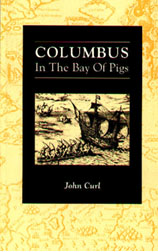
COLUMBUS IN THE BAY OF PIGS

By JOHN CURL

WITH ILLUSTRATIONS FROM THE EARLIEST SOURCES

AN AFTERWORD AS AN INTRODUCTION

& THE AMAZING SURVIVAL AND RENEWAL OF THE TAINO NATION

I

Yaní tainó, yaní tainó.

Let the Taíno language be heard.

·

Yaní tainó, yaní tainó. Dayaní.

Goeíz nitaynó guajirós guacá!

·

Imagine the sand of the beach called

Girón, fine and white, the big bend

that turns the corner of the Bay of Pigs,

Cuba.

·

Imagina la arena de Playa Girón,

fina y blanca, gira

en el rincón

de la Bahía de Cochinos

Cuba.

Tócala. Tómala con la punta de tus dedos.

Déjala caer.

Estás tocando la sangre del imperio.

·

Touch it. Take some in your fingertips.

Let it fall. You are touching

the blood of empire.

A cloudless midday, May twenty-sixth,

fourteen-ninety-four, two years after his first

“voyage of discovery,” the Italian Cristoforo

Columbo – Christopher Columbus – called

by the Spaniards Cristóbal Colón – approaches

the mouth of the Bay of Pigs. He is

on his second voyage to “the Indies.”

He thinks he is off the coast of China,

and carries letters of state

from the king and queen of Spain

to the Great Emperor Khan.

He stands on the quarterdeck, squinting

at the shore, wondering

if Cuba is finally the mainland he seeks.

The sun is a searing disc

directly above his head. His troubled thoughts

turn back to Isabela, his colony on Haiti,

with half his men sick, the rest angry and bitter,

little gold collected, food supplies low,

the Indians strained and wary.

Yesterday’s shore had been lined

with Indian villages, the ships

often surrounded by Taíno-Arawaks in canoes

offering songs and gifts to their visitors

from “the sky,” (not yet understanding

what it meant

to be subjects of a European king), but today

at the mouth of the Bay of Pigs

Columbus sees no village, the shore

is mangrove swamp, impenetrable.

Suddenly

glistening before them: a white

crescent of sand laced with palm groves.

Churning water: a great herd of beasts!

The Indians call them manatee,

but the seamen call them pigs.

RC

Before Columbus

Excerpted from the book:      American Holocaust    by David Stannard

Oxford University Press, 1992

Arawak is the general, post-Columbian name given to various peoples who made a long, slow series of migrations from the coast of Venezuela to Trinidad, then across open ocean perhaps first to Tobago, then Grenada, and on up the chain of islands that constitute the Antilles-St. Vincent, Barbados, St. Lucia, Martinique, Dominica, Guadeloupe, Montserrat, Antigua, Barbuda, St. Kitts, Anguilla, St. Croix, the Virgin Islands, Puerto Rico, Hispaniola, Jamaica, Cuba-then finally off to the Bahamas, leaving behind at each stop populations that grew and flourished and evolved culturally in their own distinctive ways. To use a comparison once made by Irving Rouse, the people of these islands who came to be known as Arawaks are analogous to those, in another part of the world, who came to be known as English: “The present inhabitants of southern Great Britain call themselves ‘English,’ and recognize that their ethnic group, the English people, is the product of a series of migrations from the continent of Europe into the British Isles, beginning with various prehistoric peoples and continuing with the Celts, Angles, Saxons, Vikings, and Normans of protohistoric time.”

Similarly, Arawak (sometimes “Taino,” but that is a misnomer, as it properly applies only to a particular social and cultural group) is the name now given to the melange of peoples who, over the course of many centuries, carried out those migrations across the Caribbean, probably terminating with the Saladoid people sometime around two thousand years ago. By the time of their encounter with Columbus and his crews, the islands had come to be governed by chiefs or caciques (there were at least five paramount chiefdoms on Hispaniola alone, and others throughout the region) and the people lived in numerous densely populated villages both ,’ inland and along all the coasts. The houses in most of these villages were similar to those described by the Spanish priest Bartolome de Las Casas:

The inhabitants of this island . . . and elsewhere built their houses of wood and thatch in the form of a bell. These were very high and roomy so that in each there might be ten or more households…. On the inside designs and symbols and patterns like paintings were fashioned by using wood and bark that had been dyed black along with other wood peeled so as to stay white, thus appearing as though made of some other attractive painted stuff. Others they adorned with very white stripped reeds that are a kind of thin and delicate cane. Of these they made graceful figures and designs that gave the interior of the houses the appearance of having been painted. On the outside the houses were covered with a fine and sweet-smelling grass.

These large buildings conventionally were arranged to face the great house that was inhabited by the local cacique, and all of them in turn faced an open field or court where dances and ball games and other festivities and ceremonies were held. In larger communities, several such fields were placed at strategic locations among the residential compounds.

The people of these climate-blessed islands supported themselves with a highly developed level of agriculture-especially on Cuba and Hispaniola, which are among the largest islands on earth; Cuba, after all, is larger than South Korea (which today contains more than 42,000,000 people) and Hispaniola is nearly twice the size of Switzerland. In the infrequent areas where agricultural engineering was necessary, the people of the Indies created irrigation systems that were equal in sophistication to those existing in sixteenth-century Spain. Their staple food was cassava bread, made from the manioc plant yuca, which they cultivated in great abundance. But also, through so many long generations in the same benign tropical environment, the Arawaks had devised an array of unique methods for more than satisfying their subsistence needs-such as the following technique which they used to catch green sea turtles weighing hundreds of pounds, large fish, and other marine life, including manatees:

Noting that the remora or suckerfish, Echeneis naucrates, attached itself to the body of a shark or other larger fish by means of a suction disc in its head, the Arawaks caught, fed, and tamed the remora, training it to tolerate a light cord fastened to its tail and gill frame. When a turtle was sighted the remora was released. Immediately it swam to the turtle, attaching its suction disc to the under side of the carapace. The canoe followed the turtle, the Arawak angler holding a firm line on the remora which, in turn, held tightly to its quarry until the turtle could be gaffed or tied to the canoe.

In addition to this technique, smaller fish were harvested by the use of plant derivatives that stupefied them, allowing the natives simply to scoop up large numbers as though gathering plants in a field. Water birds were taken by floating on the water’s surface large calabashes which concealed swimmers who would seize individual birds, one at a time, without disturbing the larger flock. And large aquaculture ponds were created and walled in to maintain and actually cultivate enormous stocks of fish and turtles for human consumption. A single one of these numerous reed marine corrals held as many as 1000 large sea turtles. This yielded a quantity of meat equal to that of 100 head of cattle, and a supply that was rapidly replenished: a fertile female turtle would lay about 500 eggs each season. Still, the Arawaks were careful not to disturb the natural balance of these and other creatures; the evidence for this is that for millennia they sustained in perpetuity their long-term supply of such natural foodstuffs. It was only after the coming of the Spanish-and, in particular, their release of dogs and pigs that turned feral and ran wild-that the wildlife ecology of the islands found itself in serious trouble.

In sum, as Caribbean expert Carl Sauer once put it, “the tropical idyll of the accounts of Columbus and Peter Martyr was largely true” regarding the Arawak. “The people suffered no want. They took care of their plantings, were dextrous at fishing and were bold canoeists and swimmers. They designed attractive houses and kept them clean. They found aesthetic expression in woodworking. They had leisure to enjoy diversion in ball games, dances, and music. They lived in peace and amity.”

***

AII that was to change, however, with shocking and deadly suddenness, once those first three Spanish ships bobbed into view on the rim of the Caribbean horizon. For it was then only a matter of months before there would begin the worst series of human disease disasters, combined with the most extensive and most violent programs of human eradication, this world has ever seen.

TWT

The Round Earth and Christopher Columbus

Today it is well known that the Earth is a sphere, or very close to one (its equator bulges out a bit because of the Earth’s rotation). When Christopher Columbus proposed to reach India by sailing west from Spain, he too knew that the Earth was round. India was the source of precious spices and other rare goods, but reaching it by sailing east was difficult, because Africa blocked the way. On a round globe, however, it should also be possible to reach India by sailing west, and this Columbus proposed to do (he wasn’t the first one to suggest this–see below).

Sometimes the claim is made that those who opposed Columbus thought the Earth was flat, but that wasn’t the case at all. Even in ancient times sailors knew that the Earth was round and scientists not only suspected it was a sphere, but even estimated its size.

If you stand on the seashore and watch a ship sailing away, it will gradually disappear from view. But the reason cannot be the distance: if a hill or tower are nearby, and you climb to the top after the ship has completely disappeared, it becomes visible again. Furthermore, if on the shore you watch carefully the way the ship disappears from view, you will notice that the hull vanishes first, while the masts and sails (or the bridge and smokestack) disappear last. It is as if the ship was dropping behind a hill, which in a way is exactly the case, the “hill” being the curve of the Earth’s surface.

To find out how the distance to the horizon is calculated, click here

Eratosthenes, Posidonius and El Mamun

The Greek philosopher Aristotle (384-322 BC) argued in his writings that the Earth was spherical, because of the circular shadow it cast on the Moon, during a lunar eclipse. Another reason was that some stars visible from Egypt are not seen further north The full quotation can be found here.

The Alexandria philosopher Eratosthenes went one step further and actually estimated how large the Earth was. He was told that on midsummer day (June 21) in the town of Syene in southern Egypt (today Aswan, near a huge dam on the river Nile) the noontime Sun was reflected in a deep well, meaning that it was right overhead, at zenith. Eratosthenes himself lived in Alexandria, near the river’s mouth, north of Syene, about 5000 stadia north of Syene (the stadium, the size of a sports arena, was a unit of distance used by the Greeks). In Alexandria the Sun on the corresponding date did not quite reach zenith, and vertical objects still threw a short shadow. Eratosthenes established that the direction of the noon Sun differed from the zenith by an angle that was 1/50 of the circle, that is, 7. 2 degrees, and from that he estimated the circumference of the Earth to be 250,000 stadia.

Tidbit: Eratosthenes also headed the royal library in Alexandria, the greatest and most famous library in classical antiquity. Officially it was called “temple of the muses” or “museion,” from which our modern “museum” is derived.

Other estimates of the size of the Earth followed. Some writers reported that the Greek Posidonius used the greatest height of the bright star Canopus above the horizon, as seen from Egypt and from the island of Rhodes further north (near the southwestern tip of Turkey). He obtained a similar value, a bit smaller. The Arab Khalif El Ma’mun, who ruled in Baghdad from 813 to 833, sent out two teams of surveyors to measure a north-south baseline and from it also obtained the radius of the Earth. Compared to the value known today, those estimates were pretty close to the mark.

The idea of sailing westward to India dates back to the early Romans. According to Dr. Irene Fischer, who studied this subject, the Roman writer Strabo, not long after Erathosthenes and Posidonius, reported their results and noted:

“if of the more recent measurements of the Earth, the one which makes the Earth smallest in circumference be introduced–I mean that of Posidonius who estimates its circumference at about 180,000 stadia, then. . . “

and he continues:

“Posidonius suspects that the length of the inhabited world, about 70,000 stadia, is half the entire circle on which it had been taken, so that if you sail from the west in a straight course, you will reach India within 70,000 stadia. “

Notice that Strabo–for unclear reasons–reduced the 250,000 Stadia of Eratosthenes to 180,000, and then stated that half of that distance came to just 70,000 stadia. Handling his numbers in that loose fashion, he could argue that India was not far to the west.

Columbus Again

SGN