
Category: Uncategorized
Thomas Friedman Will Have to Sell His Moustache For Food
By John Cook, 3:25 PM on Mon Apr 20 2009

New York Times columnist Thomas Friedman didn’t have a column in yesterday’s paper. Was it because the company that his wife’s fortune is invested in went bankrupt last week, and he’s too sad to type?
General Growth Properties filed for bankruptcy on Thursday, which is notable because it’s one of the nation’s largest mall operators, with 200 malls in 44 states—the Times called the company’s failure “one of the biggest commercial real estate collapses in United States history.”
It’s also notable because Friedman’s wife, Ann Bucksbaum Friedman, is an heir to the family that founded GGP, and her family still owns about a quarter of the company. Two years ago, a quarter of GGP was worth more than $4 billion. Today it’s worth less than an olive tree.
Friedman does OK—incomprehensibly so—with his books and speaking gigs, so he’s got a little breathing room. Still, it’s got to hurt when your spouse’s family loses $4 billion.
Here’s what Friedman had to say about his family’s business back in 2000:
My relatives are in the mall business, where everyone is worried about all the stories of the high-tech age, just around the corner, when you will be able to do all your shopping online from your Palm Pilot, and your refrigerator will automatically order more milk via the Web when its high-tech sensors indicate you’re low. I jokingly suggested to the shopping center folks that they run an ad that would say: “Imagine a world in which you will be able to go to just one place, walk from shop to shop, and see, touch, feel or try on anything you like, and then buy it right there and take it home with you — without worrying about your credit card number being stolen, or how U.P.S. will deliver it, or how you will ship it back if it doesn’t fit. Imagine such a world! It’s also just around the corner — right now. It’s called a mall.”
Man that guy’s a genius. GGP should have hired him as a marketing consultant. We were kind of excited to see what Friedman might have to say about his relatives’ business latest challenge, but the Times’ said he was “off” yesterday.
The Times catalogued GGP’s woes last week, but they didn’t mention Friedman’s connection.
Read More
(Submitted by reader)
[Friedman was back the next day. Ed.]
All the right steps in an 80-year marriage
The DeCaros’ grand duet began with dancing lessons.
By Kathy Boccella
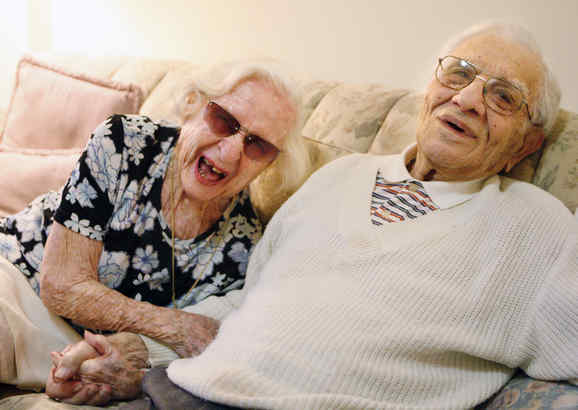
Bill DeCaro remembers his wife as a stunning young woman who could tap like Ginger Rogers. Marie DeCaro recalls her husband as a handsome hoofer who was going to make it big in show business.
It was the start of a beautiful – and enduring – romance.
Wed in a Roman Catholic church in South Philadelphia in 1929, the DeCaros will mark their 80th wedding anniversary on June 20. That’s not the only milestone the dancing duo is celebrating this year.
On March 31, Bill DeCaro turned 100. Marie becomes a centenarian on Oct. 20. Their oldest surviving “kid” is 70.
While they are not the world’s longest-married couple – that feat belongs to a man and wife from India who were married almost 85 years – they sure seem to be among the happiest.
“They’ve been beautiful, beautiful years. Who could ask for anything more?” said Bill DeCaro, fingers laced with the woman he still calls “his bride,” in their room at Harlee Manor, a senior community in Springfield, Delaware County.
The 99-and-100-year-old couple from South Philadelphia met at Madam Duvall’s Dance School when they were just 15 and 16. He knew right away that the perky blonde with the crimped hair and bow lips was for him.
She played the field a bit.
“They were fly-by-nights, but not boyfriends, if you know what I mean. He was the real deal, he was a great guy,” Marie said about her husband.
Read More
(Submitted by a reader)
A Conversation With Richard Wrangham
From Studying Chimps, a Theory on Cooking
By CLAUDIA DREIFUS
Richard Wrangham, a primatologist and anthropologist, has spent four decades observing wild chimpanzees in Africa to see what their behavior might tell us about prehistoric humans. Dr. Wrangham, 60, was born in Britain and since 1989 has been at Harvard, where he is a professor of biological anthropology. His book, “Catching Fire: How Cooking Made Us Human,” will be published in late May. He was interviewed over a vegetarian lunch at last winter’s American Association for the Advancement of Science meeting in Chicago and again later by telephone. An edited version of the two conversations follows.
Q. In your new book, you suggest that cooking was what facilitated our evolution from ape to human. Until now scientists have theorized that tool making and meat eating set the conditions for the ascent of man. Why do you argue that cooking was the main factor?
A. All that you mention were drivers of the evolution of our species. However, our large brain and the shape of our bodies are the product of a rich diet that was only available to us after we began cooking our foods. It was cooking that provided our bodies with more energy than we’d previously obtained as foraging animals eating raw food.
I have followed wild chimpanzees and studied what, and how, they eat. Modern chimps are likely to take the same kinds of foods as our early ancestors. In the wild, they’ll be lucky to find a fruit as delicious as a raspberry. More often they locate a patch of fruits as dry and strong-tasting as rose hips, which they’ll masticate for a full hour. Chimps spend most of their day finding and chewing extremely fibrous foods. Their diet is very unsatisfying to humans. But once our ancestors began eating cooked foods — approximately 1.8 million years ago — their diet became softer, safer and far more nutritious.
Mixed Feelings About Obama’s First Meeting with Hemispheric Leaders

Venezuela’s President Hugo Chavez, right, hands President Barack Obama the book titled “The Open Veins of Latin America” by Uruguayan writer Eduardo Galeano, during an UNASUR countries meeting at the Summit of the Americas on Saturday, April 18, 2009 in Port-of-Spain, Trinidad and Tobago. (AP Photo/Evan Vucci)
by Mario A. Murillo
Of all the memorable statements coming out of the Fifth Summit of the Americas in Trinidad this weekend, the one that stood out the most for me was President Barack Obama’s public expression of how he intended to approach his first major meeting with his hemispheric counterparts.
“I have a lot to learn and I’m very much looking forward to listening,” the president said in his opening address.
With those few words, Obama demonstrated, at least rhetorically, an openness that has never existed in Washington’s many dealings with the countries of the southern part of the hemisphere. Perhaps they were just words, a clever way for the smooth-talking Obama to warm up to his audience of skeptics, not only those Presidents and Prime Ministers present in Port of Spain, but their hundreds of millions of constituents back home – from the shanty towns of Rio, to the jungles of Chiapas, the highlands of Bolivia, to the dusty streets of Haiti – most of whom continue to cast a wary eye on the many decades of U.S. interventions and misdeeds, always in the name of “democracy,” “human rights,” and economic justice.
Although it is still too early to tell if his words were genuine, or if this is a true sign that U.S. policy vis a vis Latin America will undergo some necessary transformations, it is not a stretch to say that this weekend’s event was a step forward, not the usual several steps back.
In his 17-minute speech to the 34-nation gathering on Friday, President Obama promised a new agenda for the Americas, and emphasized what he described as a different way to approach the many problems facing the region.
“We have at times been disengaged, and at times we sought to dictate our terms,” Obama told an enthusiastic audience. “But I pledge to you that we seek an equal partnership. There is no senior partner and junior partner in our relations.”
His careful, almost apologetic words, and his general demeanor – did you catch that friendly, over-the-top handshake with Venezuelan President Hugo Chavez? – reflected the comfort of someone who has traveled the world with an open mind for many years, not looking for simple, textbook answers, but searching for nuance, complexity, and perspective.
Understanding that his choice of words would most likely be converted into more political fodder for right-wing talk radio hosts in the U.S. to attack the Administration’s latest “un-American” foreign policy endeavors, Obama embraced the Summit in its diversity, and seemed to welcome it as a unique opportunity for expanding his knowledge and understanding.
Furthermore, as a student of (recent) history, Obama is not unaware of the role the Bush Administration played in supporting the ill-fated coup in 2002 that temporarily pushed the democratically-elected Chavez out of office. Undoubtedly he has been briefed on the U.S. government’s ongoing financial and political support of the Venezuelan opposition, something that does not sit well with Chavez, and would be unacceptable for people in Washington if the roles were reversed. So his public greeting to Chavez was a welcome step forward, however superficial or symbolic.
Yes, the White House was forced to downplay this temporary easing of tensions later, with Obama saying the Venezuelan leader’s inflammatory rhetoric has been “a source of concern.” And evidently, Obama looked a little uncomfortable on Saturday when Chavez walked over to him and handed him a copy of the book “The Open Veins of Latin America,” by Uruguayan author Eduardo Galeano, a classic text celebrated by several generations throughout the continent as the clearest denunciation of U.S. imperialism. One could only hope that Obama actually reads the book, and in the process of learning, takes into consideration some of Galeano’s incisive critique.
…
Read More
Earth Day Facts: When It Is, How It Began, What to Do
By John Roach
From not-so-humble beginnings in 1970, when 20 million participated across the U.S., Earth Day has grown into a global tradition, with a billion expected to take part in 2009. Find out when it is, how it started, how it’s evolved, and what you can do.
When Is Earth Day?
Every day, the saying goes, is Earth Day. But it’s popularly celebrated on April 22. Why?
One persistent rumor holds that April 22 was chosen because it’s the birthday of Vladimir Lenin, the founder of the Soviet Union.
“Lenin’s goal was to destroy private property and this goal is obviously shared by environmentalists,” the Capitalism Magazine Web site noted in a 2004 article perpetuating the theory.
Kathleen Rogers, president of Washington, D.C.-based Earth Day Network, which was founded by the original organizers of Earth Day, scoffs at the rumored communist connection.
She said April 22, 1970, was chosen for the first Earth Day in part because it fell on a Wednesday, the best part of the week to encourage a large turnout for the environmental rallies held across the country.
“It worked out perfectly, because everybody was at work and they all left,” she said.
In fact, more than 20 million people across the U.S. are estimated to have participated in that first Earth Day.
(PICTURES: The First Earth Day–Bell-Bottoms and Gas Masks.)
Earth Day is now celebrated every year by more than a billion people in 180 nations around the world, according to Rogers.
Mad People and a Frustrated Politician
Earth Day’s history is rooted in 1960s activism. The environment was in visible ruins and people were mad, according to Rogers.
“It wasn’t uncommon in some cities during rush hour to be standing on a street corner and not be able to see across the street” because of pollution, she said.
Despite the anger, green issues were absent from the U.S. political agenda, which frustrated U.S. Senator Gaylord Nelson of Wisconsin, whose campaigns for the environment through much of the 1960s had fallen flat.
First Earth Day “Took off Like Gangbusters”
In 1969 Nelson hit on the idea of an environmental protest modeled after anti-Vietnam War demonstrations called teach-ins.
“It took off like gangbusters. Telegrams, letters, and telephone inquiries poured in from all across the country,” Nelson recounted in an essay shortly before he died in July 2005 at 89.
“The American people finally had a forum to express its concern about what was happening to the land, rivers, lakes, and air—and they did so with spectacular exuberance.”
Nelson recruited activist Denis Hayes to organize the April 22, 1970, teach-in, which today is sometimes credited for launching the modern environmental movement.
By the end of 1970, the U.S. Environmental Protection Agency had been born, and efforts to improve air and water quality were gaining political traction.
“It was truly amazing what happened,” Rogers said. “Blocks just tumbled.”
Earth Day Evolves
Amy Cassara is a senior associate at the World Resources Institute in Washington, D.C., who analyzes global environmental trends.
She noted that, since Earth Day started, environmentalism has moved from a fringe issue to a mainstream concern. “As many as 80 percent of Americans describe themselves as environmentalists,” Cassara said.
Environmental issues today, however, are less immediate than dirty air, toxic water, and a hole in the ozone layer, she added.
For example, the impacts of global climate change are largely abstract and difficult to explain “without coming off as a doomsday prognosticator,” Cassara said.
“As we become more industrialized and our supply chains become less transparent, it can be more difficult to understand the environmental consequences of our actions,” she noted.
Earth Day Network is pushing the Earth Day movement from single-day actions—such as park cleanups and tree-planting parties—to long-term commitments.
“Planting a tree, morally and poetically, requires taking care of it for a really long time, not just sticking it in the ground,” Earth Day Network’s Rogers said.
To help make the transition, the organization is aligned with a hundred thousand schools around the world, integrating projects with an environmental component into the year-round curriculum.
“They announce the results on Earth Day, so Earth Day becomes a moment in time,” Rogers said.
Cassara, of the World Resources Institute, said her organization uses Earth Day to convene with leaders in the movement and assess progress in their campaigns.
“[Earth Day] doesn’t raise awareness among the general public in the same way that it used to. But it still provides a benchmark for reflection among those of us in the environmental community,” she said.
What to Do on Earth Day?
For those whose inner environmentalist speaks loudest on April 22, Earth Day Network’s Rogers encourages them to make a public commitment to take an environmental action.
“We are headed for a billion commitments to do something green,” Rogers said. “And that doesn’t mean think about it—it means do something.”
Commitment ideas promoted by the Earth Day Network include pledging to educate friends and family on global warming or buy green products such as energy-saving compact fluorescent light bulbs (CFLs).
The commitments are part of a yearlong initiative called the Green Generation, which leads up to the 40th anniversary of Earth Day in 2010.
(See pictures of quirky Earth Day stunts.)
According to Rogers, everyone is part of this generation, which marks the transition from the industrial revolution to the green revolution.
“It is also about the green generation of energy and the generation of green jobs. … The name [Green Generation], whenever I say it to people, they have their own idea of what it means, which is exactly what we want.”
Brazilian squatter activist Nete Araujo talked with Rowenna Davis

Nete Araujo Photo by: Marcella Haddad
Nete Araujo is no conventional grandma. At just 34 years old, she wears sweetheart purple nail varnish and bright white trainers. And instead of spending her days making tea and handing out cake, this nana chooses to pass the time occupying abandoned buildings in São Paulo. For the last four years, Nete has been helping to establish squats for the destitute, rallying exploited tenants to take political action and campaigning for the right to secure, dignified shelter for all.
‘As citizens, we have a responsibility to guarantee that homeless families have dignity – a house, water, education and electricity,’ she explains. ‘Change has to come from the people, because when it comes from the politicians, corruption gets in the way.’
Born in rural Guariba, Nete grew up cutting sugar cane before joining the tides of people moving to São Paulo in search of a better life. She married early, giving birth to her first child when she was just 14. Then one day, when her husband asked for a pay rise, he was sacked. Nete and her children were evicted from their home and forced to live under a motorway bridge for several months, relying on hand-outs to eat.
‘Living on the streets means losing your dignity. People would look down on me, but I used to have a house just like them,’ she recalls. ‘I lost my privacy completely. There were no doors to shut or windows to close. I was cold and I couldn’t wash myself or my children. The conditions were beneath anything worthy of humanity.’
It was only when she found the charity APOIO that her life began to turn around. APOIO, which means ‘support’ in Portuguese, works with homeless communities to help them secure their right to decent housing. Once Nete found her strength, she decided to work full time for APOIO, in order to help those going through similar circumstances to her own.
Nete’s task is not a small one. Over a third of Brazil’s 180 millon citizens live in slums, the numbers fuelled largely by rural-to-urban migration. In São Paulo alone, 25 new people join the ranks of the city’s population every hour. The inadequate housing and increased homelessness that result breed social problems. Alcoholism, domestic violence and drug trafficking are rife.
Perhaps the saddest thing about this situation is that it doesn’t have to be this way. It is estimated that 17 per cent of residential units in São Paulo’s city centre are lying empty. These buildings could provide some 45,600 badly needed homes for local people, but conditions in the property market mean that it is not profitable to sell them. ‘In these spaces there are rats, insects and mice living better than human beings,’ Nete complains. ‘Animals occupy the buildings whilst the people sleep on the streets.’
This is where Nete’s work comes in. Working illegally, she breaks into São Paulo’s abandoned buildings and helps turn them into functioning homes for local people. The result is Supergran meets Robin Hood. ‘Some nights we do six or seven occupations, so you have to be really organized. Many of the houses are precarious and dangerous, and we have to work hard to get them set up,’ she explains. By moving into these buildings, the poorest people in São Paulo are literally ‘living their protest’. Their approach seems to be working. Since 1999, APOIO has helped over 1,700 families to improve their living conditions.
When you ask Nete about her proudest achievement, she answers with two words: ‘Prestes Maia.’ A 22-storey disused building in the heart of São Paulo, Prestes Maia was the site of the largest squatted high-rise building in the whole of Latin America. Between 2002 and 2007, 466 families turned this building into their own residential community, which included a school, a communal area and a library with over 7,000 books. ‘In the beginning it was just a skeleton of a building. It didn’t have any walls or lifts. But it soon came to be a home for all of us,’ Nete smiles.
Read more
Judge Hanen Orders Condemnation and Possession of Tamez Family Lands

“I am captive in my own land,” Eloisa Tamez tells audience at Western Social Sciences Association scholarly community, in Albuquerque, New Mexico, April 16, 2009.
Press Release: Eloisa Tamez’ Land condemned for Border Wall
April 16, 2009
Albuquerque, New Mexico–A federal judge in Brownsville, TX issued an order today granting the federal government’s request to condemn the ancestral land of the Tamez Family, who are Lipan Apaches. Although this land has been in the Tamez family prior to the Spanish colonization, and also designated to them through Spanish Crown law (1767, as of today, it is in the possession of the United States Department of Homeland Security.
The landowner, Eloisa Tamez, heard about Judge Hanen’s order while participating in the Western Social Sciences Association Conference in Albuquerque, where she was participating in a Three part panel: “Indigenous People’s and the U.S.-Mexico Border: Militarization, Resistance, and Rights.” She is with a group of colleagues from several bi-national Indigenous Border communities and experts on militarization and the impact of the border wall.
The Tamez family reports that this is an urgent situation which needs international attention and wide press coverage.
Read More
(Submitted by Michelle Cook)
The dark side of Dubai
Dubai was meant to be a Middle-Eastern Shangri-La, a glittering monument to Arab enterprise and western capitalism. But as hard times arrive in the city state that rose from the desert sands, an uglier story is emerging. Johann Hari reports

Getty
Construction workers in their distinctive blue overalls building the upper floors a new Dubai tower, with the distinctive Burj al-Arab hotel in the background
The wide, smiling face of Sheikh Mohammed – the absolute ruler of Dubai – beams down on his creation. His image is displayed on every other building, sandwiched between the more familiar corporate rictuses of Ronald McDonald and Colonel Sanders. This man has sold Dubai to the world as the city of One Thousand and One Arabian Lights, a Shangri-La in the Middle East insulated from the dust-storms blasting across the region. He dominates the Manhattan-manqué skyline, beaming out from row after row of glass pyramids and hotels smelted into the shape of piles of golden coins. And there he stands on the tallest building in the world – a skinny spike, jabbing farther into the sky than any other human construction in history.
But something has flickered in Sheikh Mohammed’s smile. The ubiquitous cranes have paused on the skyline, as if stuck in time. There are countless buildings half-finished, seemingly abandoned. In the swankiest new constructions – like the vast Atlantis hotel, a giant pink castle built in 1,000 days for $1.5bn on its own artificial island – where rainwater is leaking from the ceilings and the tiles are falling off the roof. This Neverland was built on the Never-Never – and now the cracks are beginning to show. Suddenly it looks less like Manhattan in the sun than Iceland in the desert.
Once the manic burst of building has stopped and the whirlwind has slowed, the secrets of Dubai are slowly seeping out. This is a city built from nothing in just a few wild decades on credit and ecocide, suppression and slavery. Dubai is a living metal metaphor for the neo-liberal globalised world that may be crashing – at last – into history.
I. An Adult Disneyland
Karen Andrews can’t speak. Every time she starts to tell her story, she puts her head down and crumples. She is slim and angular and has the faded radiance of the once-rich, even though her clothes are as creased as her forehead. I find her in the car park of one of Dubai’s finest international hotels, where she is living, in her Range Rover. She has been sleeping here for months, thanks to the kindness of the Bangladeshi car park attendants who don’t have the heart to move her on. This is not where she thought her Dubai dream would end.
Read more
(Submitted by Shahabuddin Haji)
Brain Gain – the underground world of “neuroenhancing” drugs
by Margaret Talbot

Every era has its defining drug. Neuroenhancers are perfectly suited for our efficiency-obsessed, BlackBerry-equipped office culture.
A young man I’ll call Alex recently graduated from Harvard. As a history major, Alex wrote about a dozen papers a semester. He also ran a student organization, for which he often worked more than forty hours a week; when he wasn’t on the job, he had classes.
Weeknights were devoted to all the schoolwork that he couldn’t finish during the day, and weekend nights were spent drinking with friends and going to dance parties. “Trite as it sounds,” he told me, it seemed important to “maybe appreciate my own youth.” Since, in essence, this life was impossible, Alex began taking Adderall to make it possible.
Adderall, a stimulant composed of mixed amphetamine salts, is commonly prescribed for children and adults who have been given a diagnosis of attention-deficit hyperactivity disorder. But in recent years Adderall and Ritalin, another stimulant, have been adopted as cognitive enhancers: drugs that high-functioning, overcommitted people take to become higher-functioning and more overcommitted. (Such use is “off label,” meaning that it does not have the approval of either the drug’s manufacturer or the Food and Drug Administration.)
College campuses have become laboratories for experimentation with neuroenhancement, and Alex was an ingenious experimenter. His brother had received a diagnosis of A.D.H.D., and in his freshman year Alex obtained an Adderall prescription for himself by describing to a doctor symptoms that he knew were typical of the disorder. During his college years, Alex took fifteen milligrams of Adderall most evenings, usually after dinner, guaranteeing that he would maintain intense focus while losing “any ability to sleep for approximately eight to ten hours.” In his sophomore year, he persuaded the doctor to add a thirty-milligram “extended release” capsule to his daily regimen.
Alex recalled one week during his junior year when he had four term papers due. Minutes after waking on Monday morning, around seven-thirty, he swallowed some “immediate release” Adderall. The drug, along with a steady stream of caffeine, helped him to concentrate during classes and meetings, but he noticed some odd effects; at a morning tutorial, he explained to me in an e-mail, “I alternated between speaking too quickly and thoroughly on some subjects and feeling awkwardly quiet during other points of the discussion.” Lunch was a blur: “It’s always hard to eat much when on Adderall.” That afternoon, he went to the library, where he spent “too much time researching a paper rather than actually writing it—a problem, I can assure you, that is common to all intellectually curious students on stimulants.” At eight, he attended a two-hour meeting “with a group focussed on student mental-health issues.” Alex then “took an extended-release Adderall” and worked productively on the paper all night. At eight the next morning, he attended a meeting of his organization; he felt like “a zombie,” but “was there to insure that the semester’s work didn’t go to waste.” After that, Alex explained, “I went back to my room to take advantage of my tired body.” He fell asleep until noon, waking “in time to polish my first paper and hand it in.”
Read more