Swine flu illness in the United States and Mexico – update 2

From United Nations World Health Organization
26 April 2009 — As of 26 April 2009, the United States Government has reported 20 laboratory confirmed human cases of swine influenza A/H1N1 (8 in New York, 7 in California, 2 in Texas, 2 in Kansas and 1 in Ohio). All 20 cases have had mild Influenza-Like Illness with only one requiring brief hospitalization. No deaths have been reported. All 20 viruses have the same genetic pattern based on preliminary testing. The virus is being described as a new subtype of A/H1N1 not previously detected in swine or humans.

Also as of 26 April, the Government of Mexico has reported 18 laboratory confirmed cases of swine influenza A/H1N1. Investigation is continuing to clarify the spread and severity of the disease in Mexico. Suspect clinical cases have been reported in 19 of the country’s 32 states.

WHO and the Global Alert and Response Network (GOARN) are sending experts to Mexico to work with health authorities. WHO and its partners are actively investigating reports of suspect cases in other Member States as they occur, and are supporting field epidemiology activities, laboratory diagnosis and clinical management.
On Saturday, 25 April, upon the advice of the Emergency Committee called under the rules of the International Health Regulations, the Director-General declared this event a Public Health Emergency of International Concern.

WHO is not recommending any travel or trade restrictions.

For more information
Thomas Abraham
Communications in English
Mobile: +41 79 516 3136
E-mail: abrahamt@who.int
Fadela Chaib
Communications in English and French
Mobile: +41 79 475 5556
E-mail: chaibf@who.int
Sari Setiogi
Communications in English and Bahasa
Mobile: +41 79 701 9467
E-mail: setiogis@who.int
Gregory Hartl
Communications in English, French, German and Spanish
Mobile: +41 79 203 6715
E-mail: hartlg@who.int
Aphaluck Bhatiasevi
Communications in English, Thai and Hindi
Mobile: +41 79 484 2997
E-mail: bhatiaseviap@who.int
RELATED LINKS
WHO Swine influenza website
Daily updates will we posted on this site.

Read More

After Losing Freedom, Some Immigrants Face Loss of Custody of Their Children

Encarnación Bail Romero at an Easter service in Carthage, Mo. A Guatemalan, Ms. Bail is battling to regain custody of her son, Carlos, 2.
By GINGER THOMPSON
Published: April 22, 2009

CARTHAGE, Mo. — When immigration agents raided a poultry processing plant near here two years ago, they had no idea a little American boy named Carlos would be swept up in the operation.


Ms. Bail’s son, Carlos

One of the 136 illegal immigrants detained in the raid was Carlos’s mother, Encarnación Bail Romero, a Guatemalan. A year and a half after she went to jail, a county court terminated Ms. Bail’s rights to her child on grounds of abandonment. Carlos, now 2, was adopted by a local couple.

In his decree, Judge David C. Dally of Circuit Court in Jasper County said the couple made a comfortable living, had rearranged their lives and work schedules to provide Carlos a stable home, and had support from their extended family. By contrast, Judge Dally said, Ms. Bail had little to offer.

“The only certainties in the biological mother’s future,” he wrote, “is that she will remain incarcerated until next year, and that she will be deported thereafter.”

It is unclear how many children share Carlos’s predicament. But lawyers and advocates for immigrants say that cases like his are popping up across the country as crackdowns against illegal immigrants thrust local courts into transnational custody battles and leave thousands of children in limbo.

“The struggle in these cases is there’s no winner,” said Christopher Huck, an immigration lawyer in Washington State.
He said that in many cases, what state courts want to do “conflicts with what federal immigration agencies are supposed to do.”
“Then things spiral out of control,” Mr. Huck added, “and it ends up in these real unfortunate situations.”

Next month, the Nebraska Supreme Court is scheduled to hear an appeal by Maria Luis, a Guatemalan whose rights to her American-born son and daughter were terminated after she was detained in April 2005 on charges of falsely identifying herself to a police officer. She was later deported.

And in South Carolina, a Circuit Court judge has been working with officials in Guatemala to find a way to send the baby girl of a Guatemalan couple, Martin de Leon Perez and his wife, Lucia, detained on charges of drinking in public, to relatives in their country so the couple does not lose custody before their expected deportation.
Patricia Ravenhorst, a South Carolina lawyer who handles immigration cases, said she had tried “to get our judges not to be intimidated by the notion of crossing an international border.”
“I’ve asked them, ‘What would we do if the child had relatives in New Jersey?’ ” Ms. Ravenhorst said. “We’d coordinate with the State of New Jersey. So why can’t we do the same for a child with relatives in the highlands of Guatemala?”

Dora Schriro, an adviser to Homeland Security Secretary Janet Napolitano, said the agency was looking for ways to deal with family separations as it prepared new immigration enforcement guidelines. In visits to detention centers across the country, Ms. Schriro said, she had heard accounts of parents losing contact or custody of their children.

Read More

Printing Police Lies

By George Monbiot (Published in the Guardian, 21st April 2009.)

The rightwing press has briefly turned against the police, but normal service will soon resume.

If a conservative is a liberal who has been mugged, a liberal is a conservative who has been twatted by the police. As the tabloids turn their fire onto an unfamiliar target – the unprovoked aggression of Her Majesty’s constabulary – the love affair between the cops and the rightwing press has never been more fragile.

The policing of the G20 protests at the beginning of this month was routine. Policemen hiding their identification numbers and beating up peaceful protesters is as much a part of British life as grey skies and red buses. Across 20 years of protests, I have seen policemen swapping their jackets to avoid identification, hurling people against vans and into walls and whomping old ladies over the head with batons. A friend had his head repeatedly bashed against the bonnet of a police van; he was then charged with criminal damage to the van. I have seen an entire line of police turn round to face the other way when private security guards have started beating people up. I have seen them refuse – until Amnesty International got involved – to investigate my own case when I was hospitalised by these licensed thugs (the guards had impaled my foot on a metal spike, smashing the middle bone).

But none of this featured in the conservative press. The story was always the same: we would stagger home after our peaceful protests were attacked by uniformed skinheads to discover that we were “Anarchist Thugs on the Rampage” whose attempt to destroy civilisation had been thwarted only by the calm professionalism of the police. Violent police action mutated into violent protests. The papers believed everything the police told them.

This began to change when the police foolishly attacked a Countryside Alliance march in 2004. In the spirit of impartial policing, the cops gave these reactionaries the treatment they had been doling out to generations of progressives. It was grotesque, disportionate and entirely familiar policing, but there’s a world of difference between bloodstained hemp ponchos and bloodstained tweeds. The exposure of the lies the police then told about the killing of Jean Charles de Menezes and the shooting of Mohammed Abdul Kahar made the newspapers – which had reproduced the official version – feel stung.
In other circumstances, Ian Tomlinson, the passer-by who died after being thrown to the ground by police, would have been treated by the press as a violent anarchist who had assaulted the road with his body. But video footage and disillusionment has changed that – for a few days at least. On Friday the front page of the Daily Express carried lurid pictures of the injuries sustained by a woman at the G20 protests, under the headline “Police Did This to Me: It was just like being whipped by the Taliban”.

Yesterday the Daily Mail posted up a film made by climate camp activists(1). Its columnist Melanie Phillips, who is yet to be celebrated for her support of radical causes, opined that “there are always elements in the ranks [of the police] who want to give people a good kicking.”(2) A column in the Telegraph explained that “there are individuals who join the police just because they like hitting people”(3), while the Spectator lamented the “disgraceful actions of a few Met officers”(4). Today’s Guardian poll suggests that the police are losing the wider battle for public opinion too.

The papers maintain that a few rogue officers got out of control. But as testimonies collected by Climate Camp’s legal team show, police violence at the G20 demos was organised and systematic(5). It is true that the police appear to have been carried away by testeria (a useful word which describes testosterone-fuelled male rampages). But this keeps happening, and senior officers make no attempt to prevent it.

Before the protests, the police fed stories to the media about terrorist plots hatched by G20 demonstrators(6). “We’re up for it and we’re up to it,” Commander Simon O’Brien told the press(7). Organisers from Climate Camp asked if they could attend police briefings to journalists in order to put their side of the story. They were rebuffed. The police initially refused to meet them even to discuss the protesters’ intentions. The police plan was called Operation Glencoe: it was named after the site of a notorious massacre.

Read More

Speech by His Highness the Aga Khan at the Global Philanthropy Forum

His Highness the Aga Khan meeting with The Honorable Hillary Rodham Clinton, United States Secretary of State, at the State Department.

Photo credit: AKDN / Zahur Ramji
President Jane Wales, thank you for those very generous comments.
I’d like to say how happy I am to share in this year’s Global Philanthropy Forum.

Participants,
Excellencies,
Ladies and Gentlemen,
It is a special pleasure for me to be with you tonight, for I look upon you as particularly serious and informed partners in the work of global understanding and international development.

As you may know, I recently marked my 50th anniversary in my role as Imam of the Shia Imami Ismaili Muslims. This responsibility connects me intimately with the traditions of the Islamic faith and cultures, even while my education and a host of personal and professional associations have acquainted me with the non-Islamic West. The relationship of these two worlds is a subject of considerable importance for me – a relationship which some define, regrettably, as an inevitable Clash of Civilizations. My own observation, however – and my deep conviction – is that we can more accurately describe it as a Clash of Ignorances.

It is not my purpose tonight to detail the misunderstandings which have plagued this relationship. Let me only submit that educational systems on both sides have failed mightily in this regard – and so have some religious institutions. That – at this time in human history – the Judeo Christian and Muslim societies should know so little about one another never ceases to astonish – to stun – and to pain me.
As a Muslim leader speaking in Washington this evening, it seems appropriate that I cite the words of President Obama, in his recent speech in Ankara. As he put it, pledging a “broader engagement with the Muslim world, we will listen carefully, we will bridge misunderstandings, and we will seek common ground.” I know that the vast majority of the Islamic world shares these objectives.

Among the areas where we can find common ground is our mutual effort to address the problem of persistent global poverty, especially the endemic poverty of the developing world. Surely this is an area where we can listen and learn and grow together – establishing ever-stronger bonds of understanding. One of the great principles of Islam, in all its interpretations, is the elimination of poverty in society, and philanthropy’s centrality in this duty.

When I succeeded my grandfather as Aga Khan in 1957, I was a student at Harvard – but speaking mostly French. I got extra English practice, however, from my new official routine of regular communication with Africa and Asia – and, in the bargain, was kept in great good humour by the amazing typographic errors which inevitably arose. But then computerized spell check programs came along – and all those charming idiosyncrasies disappeared!

I recently noticed, to my joy, however, that this new invention is not a fail safe protection. Consider this recent item in the publication “The Week: “Bad week for spell-check: Several Pennsylvania high school students had their last names changed in their yearbook by an automatic computer program, Alessandra Ippolito was listed as Alexandria Impolite, while Max Zupanovic was rechristened Max Supernova. And Kathy Carbaugh’s photo appeared next to the name Kathy Airbag.”

After reading this, I decided that maybe I should act prudently and spell check my own name. And I found that, while there was no “Aga Khan”, there was an “Aga” Cooker. It was defined as one of England’s oldest stoves and ovens – now somewhat outdated – but with a distinctive whistle every time it frizzled the food within!

But returning to a more serious topic let me submit this evening a few of my own reflections on the developing world that I know a central focus of my interests over fifty years. For, in coming to understand the life of widely dispersed Ismaili communities across the globe, I have also become immersed in their host societies.

The essential goal of global development has been to create and sustain effective nation states – coherent societies that are well governed, economically self-sustaining, equitable in treating their peoples, peaceful amongst themselves, and sensitive to their impact on planetary sustainability.

This is a complex objective, a moving target, and a humbling challenge. Sadly, the response in the places I know best has often been “one step forward and two steps back.“ Today, some forty percent of UN member nations are categorized as “failed democracies” – unable to meet popular aspirations for a better quality of life. The recent global economic crisis – along with the world food crisis – has sharply accentuated these problems.

Read more
(Submitted by Nizar Dhanani, Alkarim Amersi, and a reader)

Scientists make super-strong metallic spider silk

LONDON (Reuters) –- Spider silk is already tougher and lighter than steel, and now scientists have made it three times stronger by adding small amounts of metal.

The technique may be useful for manufacturing super-tough textiles and high-tech medical materials, including artificial bones and tendons.

“It could make very strong thread for surgical operations,” researcher Seung-Mo Lee of the Max Planck Institute of Microstructure Physics in Halle, Germany, said in a telephone interview.

Lee and colleagues, who published their findings in the journal Science, found that adding zinc, titanium or aluminum to a length of spider silk made it more resistant to breaking or deforming.

They used a process called atomic layer deposition, which not only coated spider dragline silks with metal but also caused some metal ions to penetrate the fibers and react with their protein structure.

Lee said he next wanted to try adding other materials, including artificial polymers like Teflon.

The idea was inspired by studies showing traces of metals in the toughest parts of some insect body parts.

The jaws of leaf-cutter ants and locusts, for example, both contain high levels of zinc, making them particularly stiff and hard.

Read more

Afghan opinion: a surprise for some

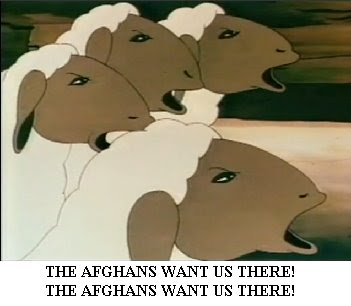
Most readers will recall from junior high school the chanting sheep from George Orwell’s Animal Farm. At the climax of the book, when the ruling pigs have taken on all the traits of the human bosses who ruled before them, the sheep block out all criticism of the new ruling class with their chant: “Four legs good, two legs better!”

It is of course rather blunt symbolism, as is the book as a whole, but it is not without considerable merit in illuminating important tendencies not only in the oppressive Soviet system but in our own society as well.

‘If Comrade Napoleon says it, it must be right.’
Consider the oft-repeated claim that Afghans welcome the foreign occupation of their country. That is the assertion of such luminaries as Defense Minister Peter MacKay (‘The Afghans want us there. ‘), Canada’s ambassador to Afghanistan Arif Lalani (‘at the end of the day Afghans want us there’) as well as NATO official Christopher Alexander (‘ keep in mind that Afghans want us there’).

But how true is this statement? We’ll get to some polling results directly, but first a word on how to interpret poll findings.

It is striking to see the enthusiasm with which the mass media trumpet poll results that indicate support for the occupation among Afghans. It seems never to have occurred to pundits and editors that the presence of foreign occupiers might lead to biased public opinion polling. Among scholars who study public opinion, however, there are few such illusions. For them, polling responses which support foreign occupiers, foreign-imposed regimes or dictatorships are basically useless – which conforms with simple common sense, one might add. Instead, only those poll respondents who voice criticism or opposition to such violently imposed regimes are taken to be sincere.

While dissident opinion is considered authentic under conditions of coercion, it is commonly thought to be under-reported. That is, expressed opinion which opposes a foreign-imposed regime is but a fraction of actual opposition. Precisely what fraction it represents is of course not known.

In light of this, let us look at some relevant polling results from Afghanistan, courtesy of Anthony Cordesman. In a recent essay, Cordesman analyzes the results of a recent poll commissioned by the BBC and ABC and ARD (Germany).
Read More

Pakistan: Outlook is Gloomier Than Ever

By B. R. Gowani


Tariq Mahmood/Agence France-Presse — Getty Images

“In Pakistan’s Buner district on Thursday, a barber looked at the “Shave is strictly forbidden” warning that the Taliban wrote on the window of his shop. The Taliban now control the region.” NY Times

“This concession represents a serious development and reflects both the growing strength of the Pakistani Taliban and the inability of the Pakistani army to conduct successful counterinsurgency operations.”
Senator Jack Reed, a Rhode Island Democrat on the Armed Services Committee, commenting after his fifth visit to Pakistan.

“Pakistan is 173 million people, 100 nuclear weapons, an army bigger than the U.S. Army, and al-Qaeda headquarters sitting right there in the two-thirds of the country that the government doesn’t control. The Pakistani military and police and intelligence service don’t follow the civilian government; they are essentially a rogue state within a state. We’re now reaching the point where within one to six months we could see the collapse of the Pakistani state, also because of the global financial crisis, which just exacerbates all these problems. . . . The collapse of Pakistan, al-Qaeda acquiring nuclear weapons, an extremist takeover — that would dwarf everything we’ve seen in the war on terror today.”
Counterinsurgency expert David Kilcullen to Carlos Lozada.

“I think that the Pakistani government is basically abdicating to the Taliban and to the extremists.”
US Secretary of State Hillary Clinton to the House Committee.

“I have absolutely no confidence in the ability of the existing Pakistani government to do one blessed thing.”
Representative David R. Obey, a Wisconsin Democrat and the leader of the House Appropriations Committee.

What is the difference between a suicide bomber and a suicidal government?

A suicide bomber is a person who thinks, or has been indoctrinated to think, that he (mostly it is men) has a higher goal to accomplish and so he does not care for his own life and, of course, for other lives. And when he embarks on a mission he destroys a particular target (place, people, or thing) and in the process gets killed.

On the other hand, a suicidal government is a body of people corrupted by the system who think only of embellishing their and their near ones’ lives and riches. And when it embarks on this mission it destroys the whole country. Unlike the suicide bombers, the leaders do not get killed—they flee to other countries.

Pakistani leaders are on one such fatal mission. Those from the elite class (the politicians, bureaucrats, defense personnel, business people, and others) who haven’t yet been influenced by the Taleban-Islam must have a plan to head off to England, the US, and the UAE. Those enamored with the Mumbai film industry and its actresses will head toward India.

Just within a span of two weeks Adm. Mike Mullen, US Joint Chiefs of Staff, has visited Islamabad twice to discuss the current crisis with Pakistan’s top military and intelligence commanders. Whether the United States — who to quite an extent is responsible for putting Pakistan in such a straitjacket situation — is serious about saving Pakistan or is simply pretending that it is concerned, but in fact is interested in seeing that country disintegrate, is really difficult to discern.

The two things United States could have done, or can do, are: End the military adventure in Afghanistan and the drone-bombing of Pakistan, and invest billions of dollars in educational, health, and social services in Pakistan. This would cause a substantial reduction in the Taliban influence there and make Pakistan a more livable place.

The latest news is that Taliban have established their control in the Banur district which is merely 70 miles from Islamabad and is strategically an important place. There are reports of Taliban being seen in two other areas near the capital.

On the other hand, Karachi, the biggest and the most cosmopolitan city in Pakistan, has also started to feel the Taliban threat more personally. Ardeshir Cowasjee reports in Dawn that the Taliban have visited the co-ed schools in Clifton, Defence, and Saddar and have issued threats against the residents there to comply with the strict ideals of the Taliban. Others have received similar threats too. (Defence and Clifton are the most posh areas in Karachi.)

Only the Pakistani government and the military can put a stop to this; and if they do not halt this immediately, it will be too late. Eventually if nothing is done by the government, a segment of the society will take up this task and there may be civil war, refugees, more problems, and more misery.

Some of the Pakistanis I talk to complain that Pakistan is always in the news and they feel uncomfortable. There is more bad news for them; Pakistan will remain in the public eye for the foreseeable future.

B. R. Gowani can be reached at brgowani@hotmail.com

Where were you, dear sisters?

By Zubeida Mustafa

Much has been said about the shameful performance of our parliament on April 13 when it approved the controversial Nizam-i-Adl Regulation without much of a murmur.
The two members who protested, MQM’s Farooq Sattar and the PML-N MNA from Chakwal, Ayaz Amir, have received much-deserved accolades — albeit given grudgingly to the MQM. But why did the others lose their voice? What happened to the women?
Why could not there be a full-fledged debate on an issue that promises to have a profound impact on the future of Pakistan? Its devastating implications for women have already started manifesting themselves, as demonstrated by reports from Karachi of men walking up to women demanding that they cover themselves ‘properly’. A woman even complained of having been threatened with a gun. These incidents vindicate the fears that have been expressed in women’s circles about the tidal wave of Talibanisation sweeping the country.
It was the failure — or helplessness — of our parliamentarians that was disturbing. It is now clear that military rule and pseudo democracy under the patronage of the army have wrought untold ravages on Pakistan’s political institutions over the years, undermining democratic structures so badly that even the restoration of democracy has not revived their working fully.
The failure of their representatives to articulate public concern on that fateful day has upset women all over the country. It has prompted an angry email from Lila Thadani of the Sindh Adyoon Tehrik, Sukkur, charging Bushra Gohar and Nafisa Shah (MNAs from the ANP and the PPP respectively) of acting for the sake of party ‘loyalty and transitory power.’

She says, ‘Remember dear sisters, your parliamentary slots will not remain for life. You will have to climb down and be with the rest of us. How will you be able to face us and the true reality after selling your soul to power? … Speak up or ship out, now. You are better outside than inside that pointless white cube of a parliament on Constitution Ave.’

It was, therefore, seen as a weak and belated rescue attempt when a female voice was raised in the house the next day. Sherry Rehman, the PPP MNA who recently bowed out as the information minister, made a spirited speech on a point of order expressing strong reservations about the implementation of the Nizam-i-Adl Regulation 2009 in Swat. Conceding that this system had been in force in the valley in the 1990s, she pointed out that circumstances were different then.

The state had executive control over the land unlike today when the writ of the ANP government doesn’t run there. She had a point when she said angrily, ‘I ask the ANP, which pressured the government to pass the regulation in the National Assembly, to tell us who will protect the rights of women in Swat now.’
Sherry also asked for a debate on the flogging incident, saying this act had been in clear violation of the laws of the land and pointed to the danger of people being subjected to Taliban vigilantism and public brutality. Yes Sherry’s fear is spot on — for this is exactly what worries people, mainly women, today, but not the parliamentarians who have yet to debate the flogging incident. Why the delay?
This question is to an extent answered by Aurat Foundation’s report, Performance of Women Parliamentarians in the 12th National Assembly, launched recently. It sheds some light on the attitudes of our lawmakers and confirms the non-role of the National Assembly in Pakistan’s system of governance. Sifting through a mountain of National Assembly records to collect data and statistics, Naeem Mirza and Wasim Wagha, the authors of the report, have made a monumental contribution to the recording of parliamentary history.

No analysis is needed to show the shoddy performance of the Assembly that functioned in 2002-2007. Figures speak louder than words. Here is some striking statistical information taken from the report: The assembly held a total of only 43 sessions in five years and met on 608 working days. It failed to fulfill the minimum requirement of 130 days in the final year when it met on 83 days.

This information does not reveal the entire truth for each day’s session on an average lasted for less than an hour in the first year and two hours in the following years. Sixty-eight times the quorum was not complete and only 50 bills were passed in five years (mostly without a debate) of which 38 became acts. The 12th assembly may have operated under the shadows of a military dictatorship but this does not exonerate parliamentarians for their indifferent performance.
The report focuses on women and their efforts to preserve the public space they have created for themselves in politics. It sheds light on the grit of a handful of women parliamentarians (60 on reserved seats and 13 on general seats) in a house of 342 who took bold initiatives and struggled against heavy odds to make their presence felt. The assessment of women parliamentarians is purely in quantitative terms.
They emerge as an active lot who spoke prolifically (3,698 interventions), questioned sensibly (2,724 questions) and took their responsibilities seriously. But who were these women? The report grades the first 25. And is it surprising that of these 22 were from the opposition parties? Now that the boot is on the other foot their parliamentary activism has been muted. The MMA women who continue to sit on the opposition benches admit that they do not believe in challenging the male public space.

What is needed is an analysis of the role of women parliamentarians in the context of the freedom allowed to them. Evidently at the root of the problem is the flawed mode of election of women legislators on reserved seats. Appointed from party lists, they are denied a constituency while their fate is in the hands of the party leadership, predominantly male. Since women parliamentarians are unwilling to join hands across party lines on issues concerning women there is no hope that their problems will be resolved through political processes.

Email: zubeidam@gmail.com
Read More