Gay couples ‘marry’ with parents’ approval, hawan and priests

MUMBAI: Last week, Durban-based sales advisor Joe Singh and his partner Wesley Nolan solemnised their relationship at a ceremony where a Hindu priest officiated. In the Singh living room, Wesley tied a necklace with a Ganesha pendant around Joe’s neck. The couple, now honeymooning in Mauritius, chose the Ganesha instead of garlands because both of them are “staunch Hindus” and wanted the Elephant God to “ward off evil and remove obstacles from their path”.

The grooms had sent out shimmering wedding invitations weeks in advance, had hand-embroidered shervanis shipped all the way from India, and took their vows before a hawan or ceremonial fire. They spent around 18 months preparing for the day and Joe’s mother Rita Govender said the larger family had been extraordinarily supportive of the plan.

A year ago, a Mumbai-based IT professional married his white boyfriend of five years in a boisterous ceremony in Seattle. They too had the shervanis and hawan. Around 450 people attended, many of them uncles and aunts from Mumbai. The boy’s parents initially had serious reservations about making their son’s sexuality public. “But by the end of it, his mother was in mother-in-law mode,” laughs one of the guests.

These warm, happy stories may sound unbelievable given the stream of stories of social hostility against gay people, but the fact is that same-sex marriage ceremonies have been performed in Indian households, rich and poor, and in cities and small towns alike. While the hawan nuptials may not have legal standing, the ritual is remarkable in a country where homosexuality is still considered a criminal act punishable by up to ten years’ in the clink. Ironically, the police cannot bust a same-sex marriage because a ceremony cannot prove homosexuality as defined by Section 377.

A Mumbai activist from Gay Bombay confirms that there are reports of marriages every week, whether it is a lesbian couple in Punjab or Kerala or gay men in Gujarat or Delhi. Ashok Row Kavi, who pioneered the opening of the closet in India, says he knows several couples who have tied the knot. “There’s one big plus-point about Hindu priests,” says Kavi with a straight face. “They’ll forget about everything if you show them a few bucks.”

Same-sex marriage ceremonies are not an entirely new phenomenon, although they’ve largely stayed under the radar. Sixteen years ago, when Aditya Advani told his parents he was gay, his mum first hugged him and then suggested that he put in a matrimonial ad in a leading Indian newspaper, for a suitable boy. Two years later, in 1993, he brought Michael Tarr home to meet the family. It was on this visit that Aditya complained about having to attend yet another family wedding. “I don’t know these people, why do I have to go to the wedding? They would never come for mine,” he griped. To which, his mother, a lawyer who, in Aditya’s words, “tends to shake the premise of things”, said half-jokingly, “Why not? Let’s have a ceremony for Michael and you.” And so there was one.

Read more

Male cleansers for hire

By Angela Robson

The dangerous practice of ‘widow cleansing’ is starting to come out into the open


Healthy conversation: a group of men discuss the taboo of widow cleansing and (left)former cleanser Esban Ochanga. Photo: Frederic Courbet

The men sitting in the shade of a large thorn tree on the outskirts of Kano-Angola village, 10 miles inland from the shores of Lake Victoria in Kenya’s Nyanza province, are in buoyant spirits today. There is bravado, there are lewd jokes, but there are also long periods of silence.

One man in particular commands attention. As soon as he begins to talk, the rest of the group listen deferentially. Esban Ochanga is tall and slender with a far-away look in his eyes. He has called the men together to talk about the practice of widow cleansing, whereby Luo women, after the death of their spouse, are pressurized into having unprotected sex; ostensibly to allow their husband’s spirit to roam free in the afterlife. It is a tradition rarely spoken about in public. ‘I knew my brother had died and they told me it was AIDS, but I thought a Luo could not die because of that virus,’ says Ochanga. ‘So I cleansed his widow and I contracted HIV. That is what killed my first wife.’

With the spiralling rates of HIV, men have become reluctant to inherit or cleanse widows. About 15 per cent of the population in Nyanza have HIV; 63 per cent live below the poverty line. In Kano-Angola, two-thirds of people who have tested for HIV have turned out positive.

Increasingly, ‘male cleansers for hire’ – who go from village to village to perform the service – are being brought in. Ochanga tells the group that a cleanser operating in Kano-Angola is even having sex with recently deceased women, at the behest of their families. None of the men look surprised. ‘The commercial part of widow cleansing, I also did,’ admits Ochanga to the group. ‘It was for the money and it seemed easy.’

Though most of the men gathered are HIV positive, Ochanga is the only one to have come out openly to his wives and community, not only about his status but also about his work as a cleanser. Working as a volunteer peer educator with the Movement of Men Against AIDS in Kenya, a charity which encourages men to play a more prominent role in Africa’s response to HIV, Ochanga and other members of the community are supporting people to have HIV tests and to use condoms. Ochanga says he takes antiretroviral drugs (ARVs) and practises safer sex with all his wives. Two are HIV positive, the other is negative.

Mother-to-child HIV transmission rates are dropping and Ochanga says that – as a result of discussion groups like this – attitudes are beginning to change. ‘How much were you paid to cleanse?’ asks a man in his thirties, laughing nervously. ‘The price of a cow. Just one night and you’ve got a cow,’ replies Ochanga, shrugging his shoulders. ‘My grandfather did it, my father did it, so I was not afraid of doing it. But the sons of this village will cease to do it.’

Read more

The Talibanisation of minds Thursday, May 07, 2009

By Kamila Hyat

There are two dimensions to the challenge of defeating the Taliban. One of course is the issue of re-gaining control over the territories they have wrested away from the state. The military successes in Dir and Buner, as the army moves into a new phase of aggression, are of course encouraging. The mysteries of how tactics in this respect are decided remain rather obscure though. In the past the civilian governments have implied that the military is unwilling to take on the Taliban. In an unusually strong set of comments the US has meanwhile slammed the government while praising the military.

What wheels are moving behind the scenes we don’t quite know – but we have learnt from the past to be wary in such situations. And meanwhile, despite the increasingly nonsensical statements of Sufi Mohammad, who now says democracy is un-Islamic and Sharia must extend across Pakistan, the ANP government seems determined to cling to its myth of a peace accord that seems increasingly fragile by the day, if not the hour.

There is, however, another aspect to battling the Taliban. That is the question of control over minds. The Zia years taught us how difficult it can be to fight off notions of morality used to brainwash and blind people. The dance with orthodoxy that began during the 1980s – when TV actresses rose from their beds with dupattas miraculously intact – lingers on. It has taken nearly two decades to reclaim some of the space Zia stole away from us, and re-discover music, classical dance and the simple liberty to dress as we choose.

Now the Taliban have launched a new threat to these basic freedoms. In Lahore’s Liberty Market shopping centre – women have been ordered over loudspeakers to cover their heads. The more relaxed dress codes that had become the norm, echoing back to a happier time in the 1960s and the 1970s have begun once more to retreat. Many women admit they are more careful than ever before about how they dress in public. In both Karachi and Lahore stories echo of threats being made to women shoppers in the streets. These may be inaccurate, but they add to the fear we all feel almost constantly.

The threat to schools – especially those that are co-educational or which take in just girls – is also terrifying. No one could perhaps have imagined a situation where security cameras appear at school gates, visitors face elaborate searches and pupils live in fear of bomb attacks. This could be the work of the handful of elements on the lunatic fringe who have in the past placed explosives at juice shops frequented by young couples and attacked the venue of a performing arts festival. It could also be the doing of individual ‘pranksters’. But the effect it has had is very real – altering the city scene forever.

Absurdly, even an up-market ‘Islamic’ school, where girls and boys are taught to memorise the Holy Quran alongside other lessons, and whose tiny pupils, some little more than toddlers, step out of their cars wearing headscarves and caps, has been threatened. But then again the fact that such schools have mushroomed in all our cities – educating the children of the elite in air-conditioned classrooms – reflects a change in mindset.

Read more

The AIPAC Spy Case

Where’s the Justice at the Justice Department?

By JAMES G. ABOUREZK

The big news last week was the defection of Republican Senator Arlen Specter to the Democrats; the bankruptcy filing of the Chrysler Corporation, and finally, the retirement of Justice David Souter from the U.S. Supreme Court.

A much smaller news item competing with these sensational stories was that the U.S. Justice Department announced that it is dropping the espionage charges against two former AIPAC agents. The story was so small that it barely was a blip on the media’s radar, bringing absolutely no comment on the network news and talk shows.
That’s known as clever public relations. Announce the bad news on a day when it won’t be noticed.

Steven Rosen and Keith Weissman had been charged in 2005 with the crime of espionage; specifically, handing over to Israel secret information they had retrieved from Larry Franklin, who was then a policy analyst in the U.S. Defense Department, working for Douglas Feith and for Paul Wolfowitz.

Franklin pleaded guilty to relaying top secret information on Iran to Rosen and Weissman, and was sentenced to 12 years and 7 months in prison, a term he is currently serving.

In the New York Times story detailing the Justice Department’s decision to drop the charges against Rosen and Weissman, the prosecutors claimed that the presiding federal judge, T.S. Ellis III, had raised the bar for the prosecution to prove its case against the two to a level they did not believe they could meet. The Judge said that the prosecutors could only prevail if they could prove that Rosen and Weissman “knew that their distribution of the information would harm U.S. National Security.” That was enough to make them dismiss the charges.

No one in the headquarters of the Justice Department took part in the announcement, but it was made by the prosecutors themselves, presumably the U.S. Attorney in charge of prosecution.
I’ve had some experience in court with U.S. Attorneys. What I know about how they operate is that if they don’t have a case, they will bring so many charges that forces the unlucky Defendant to plead guilty to at least one or two of them.

I would like to turn now the case of Sami Al-Arian, who was a college professor in Florida. Sami is a Palestinian, born in Kuwait. And why wasn’t he born in Palestine like a good Palestinian should be? Because, most likely, his parents were chased out of Palestine when Israel undertook its ethnic cleansing of that land in order to create an exclusive Jewish state.

Al Arian was charged in 2003 in a 50 count indictment, essentially with a plethora of terrorism charges. He waited 28 months in solitary in harsh conditions, before being tried in 2005. The trial lasted six months, with some 80 witnesses and 400 transcripts of intercepted phone conversations and faxes.

At the end of the prosecution’s case, Al Arian’s lawyers rested without offering any evidence or witnesses in his defense. After 13 days of deliberation, the jury acquitted Al Arian on 8 of 17 counts, and deadlocked on the other with 10 to 2 favoring acquittal. Two of the co-defendants charged along with Al Arian were totally acquitted.
Undaunted, the Justice Department prosecutors said they were considering re-trying Al Arian on the deadlocked jury charges, one of which carried a life sentence.

Read more

A Statement by the Asian Human Rights Commission

PAKISTAN: The dubious role of Pakistan army in dealing with Taliban thereby legitimizing the massacre

After the failure of the peace initiatives with the Taliban and Tehreek-e- Nifaz-e-Shariah Mohammadi (TNSM), the government of Pakistan has started an operation with the help of the Pakistan army in the northern parts of country, bordering Afghanistan, on the request of provincial government of North West Frontier Province (NWFP), resulting in the killings of innocent persons and the migration of several hundred thousand people from homes. According to information received from the affected areas, people find themselves trapped between the deep sea and the devil.

Caught in the cross-firing from the Taliban on one side and the Pakistan Army on the other, people have not been able to even collect the dead bodies of their loved ones. The military operation against the militants is carried out by gunship helicopters, mortar and jets but the entire land mass and vast mountainous areas are covered by militants armed with rockets, rocket launchers and other sophisticated arms which they captured from the NATO and allied forces as well as from the Pakistan army during the siege of almost three districts since six years. Media reports claim that the arms were allegedly supplied by the ISI – the intelligence agency of Pakistan.
The army is reluctant to either directly target the militants or disarm them, but instead is just retaliating to the gun fires from the Taliban militants in the mountains and blindly firing on the civilian population. The Inter Service Public Relation (ISPR) of the armed forces claim that more than 90 Taliban are killed in the military operation but local media sources claim that ISPR are providing wrong information as the most killings are from civilian population. More than two hundred security personnel including, army persons, are captured by the militants and about half a dozen army men were slaughtered by the militants since the last week of April. Civilians have to walk several miles to take refuge while both the governments – the NWFP and federal, have become mere spectators. The inland migrants have dispersed in different directions and are settling under the open skies.
The NWFP government has acted very arrogantly by pressurizing the federal government to implement the NAR and have an agreement with TNSM so that peace can be established in the northern parts. But when militants, particularly Taliban refused to abide by the agreement, the NWFP government has left people of the area at the mercy of the militants. More than half of the cabinet of the provincial government of NWFP is out of the province and are running their government from Dubai and Islamabad, the capital of Pakistan. Media access to the areas is not allowed and local journalists are under surveillance of state intelligence agencies. The notorious intelligence agency – the Inter Services Intelligence (ISI) are consistently asking local journalists to give them their stories before they are published or aired. The ISI has made it mandatory for local journalists to disclose the source of their news reports.

Read more
(Submitted by Abdul Hamid Bashani Khan)

Chimpanzees exchange meat for sex

By Victoria Gill


Share and share alike: a male chimp will give up his hard-earned catch for sex

Chimpanzees enter into “deals” whereby they exchange meat for sex, according to researchers.
Male chimps that are willing to share the proceeds of their hunting expeditions mate twice as often as their more selfish counterparts.
This is a long-term exchange, so males continue to share their catch with females when they are not fertile, copulating with them when they are.

The team describe their findings in the journal PLoS One.
Cristina Gomes and her colleagues, from the Max Planck Institute for Evolutionary Anthropology in Germany, studied chimps in the Tai Forest reserve in Ivory Coast.

She and her team observed the animals as they hunted, and monitored the number of times they copulated.

“By sharing, the males increase the number of times they mate, and the females increase their intake of calories,” said Dr Gomes.
“What’s amazing is that if a male shares with a particular female, he doubles the number of times he copulates with her, which is likely to increase the probability of fertilising that female.”

High value

Meat is important for the animals’ diet because it is so high in protein. Since female chimps do not usually hunt, “they have a hard time getting it on their own,” explained Dr Gomes.
The “meat for sex hypothesis” had already been proposed to explain why male chimps might share with females.

But previous attempts to record the phenomenon failed, because researchers looked for direct exchanges, where a male shared meat with a fertile female and copulated with her right away.
Dr Gomes’ team took a new approach. In a previous study, she had found that grooming exchange – where the animals take it in turns to groom each other – happens over long periods, she related. “So we thought, why not meat and sex?

“We looked at chimps when they were not in oestrus, this means they don’t have sexual swellings and aren’t copulating.”
“The males still share with them – they might share meat with a female one day, and only copulate with her a day or two later.”
She suggests this study could lay the foundations for human studies exploring the link between “good hunting skills and reproductive success”.

Read More

Teardrop: Now an Ocean of Tears

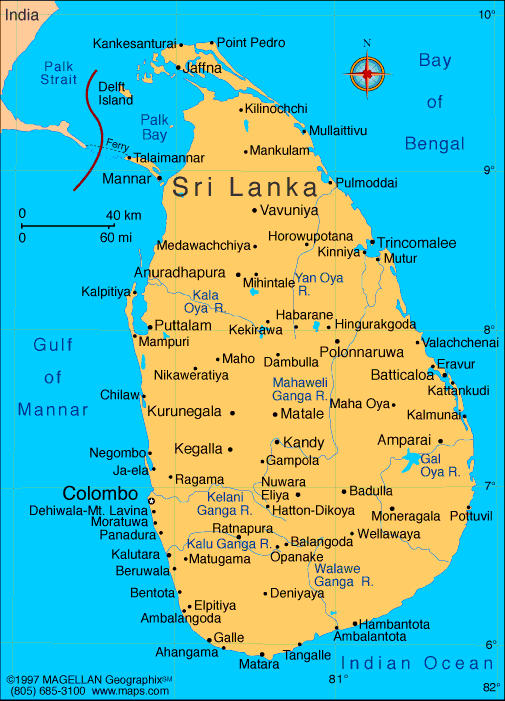
http://www.infoplease.com/atlas/country/srilanka.html

See enlargeable map

By B. R. Gowani

Sri Lanka’s geographic shape
Resembles a teardrop

A teardrop on a beloved’s cheek
Is frequently compared to a pearl
Poets and lovers see beauty in it
And advise not to let it drop

Alas! Sri Lanka is no more a pearl
Now that teardrop has in its lap
State and LTTE terror
Rapes and assaults
Refugees and ration-queues
Blood and corpses
Grief and lament
Orphans and widows

Once, long ago
Sri Lanka gave the World’s first hospital
Today, the state wounds and kills

Buddha’s enlightenment: not to desire anything
The State’s greed: not to grant a bit-autonomy

This pearl, Nature-created
But now, human-crushed
Is on a path to peace?
That’s what the rulers think
Naïve? they are not
Narcissist, they sure are
Afghans, Kashmiris, Palestinians, …
They did not disappear
And so some LTTE version will reappear

Meanwhile, the state will proclaim VICTORY
Whereas in fact
The teardrop has turned into
An ocean of tears

B. R. Gowani can be reached at brgowani@hotmail.com

Tamil People’s Rights

by A Sivanandan

There will be neither victory nor peace in Sri Lanka till the rights of the Tamil people are enshrined in a federal constitution that devolves power to the Tamil areas in the north and east – as was envisaged by the Norwegian peace process of 2002-05.
First, because the cause for which the LTTE has fought, if not its methods, is the cause of Tamil peoples everywhere, and cannot be suppressed. Second, because the present government, even more than all the governments before it, has, through the Aryanisation of race, the perversion of Buddhism into a violent, communal creed, and the exaltation of the Sinhala language as the language of office, achieved the successful symbiosis of the fascist elements that keeps it in power. In the process, it has killed off civil society with its blanket censorship, judicious murders and the suppression of the intelligentsia till there is no one left to oppose it. Instead, it has bred a culture of hate among the Sinhala masses that sees babies kitted out in army fatigues, accepts torture as a fact of war, and calls for the complete subjugation, if not the ethnic cleansing, of the Tamil people – which, in turn, ensures the perpetuation of an authoritarian government. Alas, my country.
A. Sivanandan is the Director of London-based Institute of Race Relations. The above letter appeared in London’s Guardian newspaper of February 5, 2009.
Guardian