A talk by Ayesha Jalal

Partisans of Allah: Jihad in South Asia

Ayesha Jalal, the author of the recently published book of the same title, will be speaking about the origins and meaning of the word ‘jihad’ in Islamic literature, its historical practice in South Asia and on the roots, ideology and aims of present day jihadis such as the Taliban, Lashkar-e-Taiba, Jaish-e-Mohammad and the like.

She is one of the most prominent American academics writing on Pakistan. Her talk is bound to be informative and thought provoking and will be helpful in providing a better understanding of this term – gripping some with hope, many with horror – and of the groups and forces practicing it currently.

Dr. Jalal is professor of History at Tufts University in Boston and a member of the editorial boards of Contemporary South Asian Studies Series and Third World Quarterly. Her books include `The Muslim League and the Demand for Pakistan’; `The State of Martial Rule: the Origins of Pakistan’s Political Economy of Defence’ and `Democracy and Authoritarianism in South Asia,’ amongst others.

7 p.m., Friday, May 15
Room 2-214, 252 Bloor St West (OISE)
St. George Subway, (paid parking underground)
Admission: $10. Info: 416-536-6771, 416-284-4893

Ms. Jalal obtained her B.A. from Wellesley College majoring In History and Political Science and her Ph.D. in History from Cambridge University.

The niece of the famous Urdu writer Manto, she first came to the United States in 1970 when her father Hamid Jalal was posted to the United Nations.

Sponsors: Canadian Muslim Union, Committee of Progressive Pakistani-Canadians, Left Institute, South Asian People’s Forum.

(Submitted by Abdul Hamid Bashani Khan)

Pakistan war fuels international tensions

By Peter Symonds

Comments by China’s ambassador in Islamabad last Thursday highlight the reckless character of the Obama administration’s escalating intervention in Pakistan. By pressuring Islamabad to wage an all-out military offensive against Islamic insurgents in the Swat Valley and neighbouring districts, Washington is not only destabilising Pakistan but raising tensions in a highly volatile area.

Speaking to Pakistani business leaders, Chinese ambassador Luo Zhaohui pointedly voiced concern about the growth of “outside influence” in the region. He singled out the US in particular, saying that China was worried about US policies and the presence of a large number of foreign troops in neighbouring Afghanistan. While reiterating China’s support for “the fight against terror,” Luo declared that US strategies needed some “corrective measures”. He added, “These are issues of serious concern for China.”

Luo’s unusually blunt remarks came just one day after US President Obama spoke to his Chinese counterpart, President Hu Jintao. While a number of issues were discussed, the escalating war in Pakistan was clearly high on the agenda. This first publicised phone call between the two men came as Obama met with the Afghan and Pakistani presidents over US strategy in the two countries. While Hu reportedly offered his cooperation, Luo’s comments express China’s underlying fears over growing US influence in South Asia.

Last week’s tripartite summit in Washington signalled a major upsurge in military violence in both Afghanistan and Pakistan. Under intense pressure from the US, the Pakistani army has launched a large-scale offensive against militants in the Swat Valley in which hundreds have already died and hundreds of thousands of civilians have been forced to flee. The summit, however, involved more than discussions on military cooperation, outlining comprehensive plans for the closer economic and strategic integration of the two countries into an American sphere of influence.

China, which has longstanding ties with Pakistan, is obviously disturbed by these developments. As Ambassador Luo told his business audience, more than 60 Chinese companies are involved in 122 projects in Pakistan. He noted the “close liaison” with Pakistan over the security of over 10,000 Chinese engineers and technical experts in the country. In fact, Beijing has previously insisted on reprisals over the abduction and killing of Chinese citizens by Pakistani militants as well as military action against Islamic Uighur separatists from western China taking refuge in Pakistan.

More fundamentally, Beijing regards Islamabad as a crucial partner in its own regional strategy. China devoted considerable resources to building up Pakistan as a counterweight to India after the 1962 Sino-Indian border war. Pakistan is the largest purchaser of Chinese arms and, according to the Pentagon, accounted for 36 percent of China’s military exports between 2003 and 2007. Chinese technical assistance was critical to Pakistan’s nuclear weapon and ballistic missile programs.

In return, China received the green light to build a major naval/commercial port facility at Gwadar, a coastal town in Baluchistan. The port is the linchpin of Beijing’s “string of pearls” strategy to establish access for its expanding navy to a series of ports along key sea routes across the Indian Ocean—above all, to protect oil and gas supplies from the Middle East and Africa. For its part, the US, which regards China as a rising economic and strategic rival, is determined to maintain its military, including naval, predominance.

World Socialist Web Site for more

Rumours of God’s return are greatly exaggerated

Religion is on the rise, religion makes you happy. It may seem bad manners for we atheists to say it, but so do pets

By David Aaronovitch

On a desk in my school, long ago, some past sixth-former had written four words: “God is dead – Nietzsche”, followed by four more: “Nietzsche is dead – God.” Even as a juvenile atheist I could see that the idea of the mad German getting his comeuppance from the unbelieved Almighty was funny.

And some readers today might similarly be enjoying the contents of a new book, God is Back: How the Global Rise of Faith is Changing the World, written by the Editor-in-Chief of The Economist, John Micklethwait, and his colleague Adrian Wooldridge. “You thought God had gone,” they seem to chant in the direction of the national grandstand where sits the secular elite, “you were wrong, you were wrong.”

Not surprisingly the geist that gibbers in this straitened zeit is a pessimist. Articulated by a small army of declinists, the dominant sentiment is that it’s all gone to the dogs in the West: community, spirituality, morality – and left us in a state of alienation, of anomie, eating apart in front of American Idol, obesely exercising on our Wiis, leading unsatisfactory lives of consumption and envy.

At least a couple more new books this week have suggested that our etiolated and weakened sense of higher self is consequently no match for rampant, self-confident Islam. We are the new late Romans and the Muslims are the new equivalent of Gibbon’s destroying religious army. “Man is a theotropic beast,” argue the authors of God is Back: we will have Jehovah – or Allah – one way or another.

This is an enjoyable thesis, and well argued, even if a more accurate title would be “Oh Look, God Hasn’t Gone Away as Quickly as Some Folk Expected”. In this country, for example, the British Social Attitudes Survey showed that 74 per cent of Britons belonged to a religion and attended services in 1964, but only 31per cent did so in 2005.

Times for more

Pakistan in Crisis

By Deepak Tripathi

President Asif Ali Zardari of Pakistan is this week on his first visit to the United States since coming to office. It comes at a critical time for Pakistan and for America’s relations with that nuclear-armed, but failing, country in South Asia. President Hamid Karzai of Afghanistan, Pakistan’s failed neighbor, is also in Washington for trilateral meetings with President Obama and other leading figures in the administration.
Recent escalation of violence in Pakistan has brought grim warnings from senior American officials in Washington about the viability of the Pakistani state. A month ago, General David Petraeus, the top military commander in the region, testified in the Senate Armed Services Committee that ‘militant extremists could literally take down the Pakistani state’ if left unchallenged. On the same day, a senior Pentagon official, Michele Flournoy, warned of higher US casualties in Afghanistan in the coming year. And Admiral Eric Olson, chief of America’s special operations commandos, described the situation in Afghanistan and Pakistan as ‘increasingly dire’. According to one report, General Petraeus has privately told the White House that the administration has as little time as two weeks to determine its future course of action in Pakistan as the civilian government of President Asif Ali Zardari struggles against an insurgency that is growing alarmingly.

For eight years under the Bush-Cheney presidency, the United States and its European allies were consumed in the fortification of the Western world following September 11, 2001. A vital part of this overwhelmingly militaristic approach was to remake West Asia, resulting in war and occupation in the region during the rest of the decade.

Amid all the media coverage of the threat to the West, what has often been missed is the eastward proliferation of terrorism, throughout Pakistan and to India and beyond. The Council for Foreign Relations, a New York-based research institution, while acknowledging the existence of ‘local terrorist groups’ in the Indian part of the disputed region of Kashmir, goes on to say that ‘most of the recent terrorism has been conducted by Islamist outsiders who seek to claim Kashmir for Pakistan’.[1] According to the organization, many militants involved in attacks across the border in India received training in the same madrasahs where Taliban and al-Qa‘ida fighters have studied since the 1980s. Some received training in Afghanistan when the Taliban ruled the country. Many more represent an indigenous phenomenon in Pakistani society. How did things reach such a point?

Tripathi for more

Criminalizing Criticism of Israel

By Paul Craig Roberts

On October 16, 2004, President George W. Bush signed the Israel Lobby’s bill, the Global Anti-Semitism Review Act. This legislation requires the US Department of State to monitor anti-semitism world wide.

To monitor anti-semitism, it has to be defined. What is the definition? Basically, as defined by the Israel Lobby and Abe Foxman, it boils down to any criticism of Israel or Jews.

Rahm Israel Emanuel hasn’t been mopping floors at the White House.
As soon as he gets the Hate Crimes Prevention Act of 2009 passed, it will become a crime for any American to tell the truth about Israel’s treatment of Palestinians and theft of their lands.

It will be a crime for Christians to acknowledge the New Testament’s account of Jews demanding the crucifixion of Jesus.

It will be a crime to report the extraordinary influence of the Israel Lobby on the White House and Congress, such as the AIPAC-written resolutions praising Israel for its war crimes against the Palestinians in Gaza that were endorsed by 100 per cent of the US Senate and 99 per cent of the House of Representatives, while the rest of the world condemned Israel for its barbarity.

It will be a crime to doubt the Holocaust.

It will become a crime to note the disproportionate representation of Jews in the media, finance, and foreign policy.

In other words, it means the end of free speech, free inquiry, and the First Amendment to the Constitution. Any facts or truths that cast aspersion upon Israel will simply be banned.

Given the hubris of the US government, which leads Washington to apply US law to every country and organization, what will happen to the International Red Cross, the United Nations Commission on Human Rights, and the various human rights organizations that have demanded investigations of Israel’s military assault on Gaza’s civilian population? Will they all be arrested for the hate crime of “excessive” criticism of Israel?

This is a serious question.

A recent UN report, which is yet to be released in its entirety, blames Israel for the deaths and injuries that occurred within the United Nations premises in Gaza. The Israeli government has responded by charging that the UN report is “tendentious, patently biased,” which puts the UN report into the State Department’s category of excessive criticism and strong anti-Israel sentiment.

Israel is getting away with its blatant use of the American government to silence its critics despite the fact that the Israeli press and Israeli soldiers have exposed the Israeli atrocities in Gaza and the premeditated murder of women and children urged upon the Israeli invaders by rabbis. These acts are clearly war crimes.

It was the Israeli press that published the pictures of the Israeli soldiers’ T-shirts that indicate that the willful murder of women and children is now the culture of the Israeli army. The T-shirts are horrific expressions of barbarity. For example, one shows a pregnant Palestinian woman with a crosshairs over her stomach and the slogan, “One shot, two kills.” These T-shirts are an indication that Israel’s policy toward the Palestinians is one of extermination.

It has been true for years that the most potent criticism of Israel’s mistreatment of the Palestinians comes from the Israeli press and Israeli peace groups. For example, the Israeli newspaper Haaretz and Jeff Halper of ICAHD have shown a moral conscience that apparently does not exist in the Western democracies where Israel’s crimes are covered up and even praised.

Will the American hate crime bill be applied to Haaretz and Jeff Halper? Will American commentators who say nothing themselves but simply report what Haaretz and Halper have said be arrested for “spreading hatred of Israel, an anti-semitic act”?

Many Americans have been brainwashed by the propaganda that Palestinians are terrorists who threaten innocent Israel. These Americans will see the censorship as merely part of the necessary war on terror. They will accept the demonization of fellow citizens who report unpalatable facts about Israel and agree that such people should be punished for aiding and abetting terrorists.

A massive push is underway to criminalize criticism of Israel. American university professors have fallen victim to the well organized attempt to eliminate all criticism of Israel. Norman Finkelstein was denied tenure at a Catholic university because of the power of the Israel Lobby. Now the Israel Lobby is after University of California (at Santa Barbara,) professor Wiliam Robinson. Robinson’s crime: his course on global affairs included some reading assignments critical of Israel’s invasion of Gaza.

The Israel Lobby apparently succeeded in convincing the Obama Justice (sic) Department that it is anti-semitic to accuse two Jewish AIPAC officials, Steven Rosen and Keith Weissman, of spying. The Israel Lobby succeeded in getting their trial delayed for four years, and now Attorney General Eric Holder has dropped charges. Yet, Larry Franklin, the DOD official accused of giving secret material to Rosen and Weissman, is serving 12 years and 7 months in prison.
The absurdity is extraordinary. The two Israeli agents are not guilty of receiving secrets, but the American official is guilty of giving secrets to them! If there is no spy in the story, how was Franklin convicted of giving secrets to a spy?

Criminalizing criticism of Israel destroys any hope of America having an independent foreign policy in the Middle East that serves American rather than Israeli interests. It eliminates any prospect of Americans escaping from their enculturation with Israeli propaganda.

Counterpunch for more
(Submitted by Ingrid B. Mork)

Plaintiff Wail: Ricci v. DeStefano and the Myth of White Victimhood

By Tim Wise

As a general rule, one should regard with a mountain of salt anything to be found on the editorial page of the Wall Street Journal. Committed to the promotion of right-wing economics and social policy, and unburdened by such mundane requirements as fact checking, the writers of the Journal’s daily screeds have long taken liberty with supposedly sacrosanct journalistic principles like truth. To wit, their utterly fallacious hit job on the Community Reinvestment Act back in September, in which they blamed the subprime mortgage meltdown–and virtually the entire economic crisis–on black and brown poor folks who received loans for which they were unqualified thanks to liberal reforms. A few months later, the generally splendid and fair-minded news reporters at the Journal utterly debunked the claims that the CRA had been the cause of the problem, but this mattered not to the editorial staff. They never printed a retraction for their wrong-headedness. Dishonesty in the pursuit of Austrian economics is no vice, apparently.

This week, the Journal was at it again, taking their reactionary mendacity to new heights, as they weighed in on the “reverse discrimination” case being considered by the Supreme Court. To hear the editors tell it–and this is a position advanced by conservative radio and even some mainstream journalists–Frank Ricci and his seventeen co-plaintiffs were the victims of unfair “racial preferences” for blacks in the New Haven, Connecticut fire department. Although they had scored highly enough on their supervisor exams to be promoted to one of several open positions for lieutenant or captain, the test was ultimately tossed out, supposedly because no black test-takers had earned a score that would have qualified them for such a promotion. Decrying the blatant racial balancing that such an action is interpreted to signify, the right has been portraying Ricci, et al. as the latest poster children for white victimization. As the Journal explained it on April 22 (the day the Court heard oral arguments in the case) “the plaintiffs deserve to have the law applied equally-whatever the color of their skin.”

Not only was the decision by New Haven authorities unfair generally, according to this narrative, but it was especially injurious to Mr. Ricci, who, the New York Times informs us gave up a second job so he could study “up to thirteen hours a day,” and who, because of his dyslexia, “paid an acquaintance to read textbooks onto tapes” for him, and who practiced day and night, using flashcards to help him remember the minutiae that would no doubt find its way onto the test. Ricci scored sixth out of seventy-seven firefighters who took the exam, and would have stood a good chance of obtaining one of the leadership positions had the test been certified by officials in New Haven.

Although one is free to disagree with the decision to throw out the test, before reaching such a conclusion it would help to know the facts–all of them–behind the case. Sadly, one will not glean such information from the snippets provided thus far in the news, or from the blatantly inaccurate account in the Journal editorial. Though they suggest, “the facts of Ricci are not in dispute,” nothing could be further from the truth. They are, and the facts as articulated by the Wall Street Journal couldn’t be more incorrect.

Facts of the Case: What Ricci is and Isn’t About

Red Room for more

Kenya women stage ‘sex strike’

Women’s groups in Kenya have started a week-long “sex strike”, in an attempt to press the country’s leaders to resolve rifts and work together. Ten non-governmental organizations urged women across the nation to boycott sex with their husbands and partners along with a statement calling for reforms in government and action on promoting women’s rights.

Rukia Subow, chairwoman of the Women’s Development Organization, said the group believed the boycott would persuade men to press the government to make peace. Ida Odinga, the wife of the Prime Minister, Raila Odinga, said on Thursday that she would join the strike to protest against divisions between her husband and the country’s president.

It was not clear whether the wife of Mwai Kibaki, the president, would join the strike. The east African country has been in political turmoil since a presidential election in December 2007 which Odinga accused Kibaki of stealing. Protests led to violence that killed more than 1,000 people and left more than 600,000 homeless.

Lanka Truth

US Bases and Empire: Global Perspectives on the Asia Pacific

by Catherine Lutz

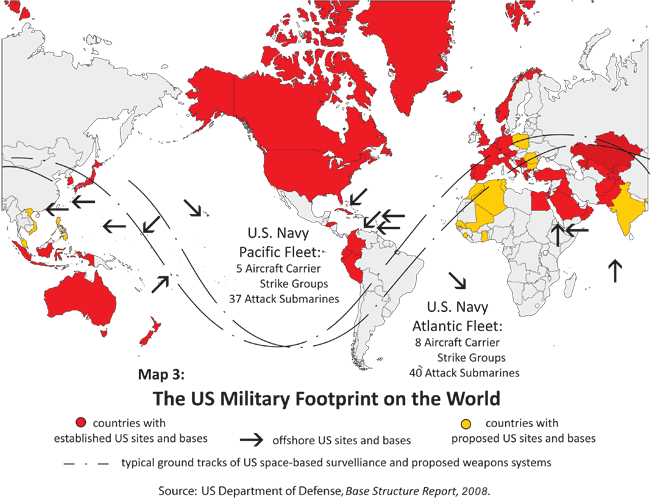
Much about our current world is unparalleled: holes in the ozone layer, the commercial patenting of life forms, degrading poverty on a massive scale, and, more hopefully, the rise of concepts of global citizenship and universal human rights. Less visible but equally unprecedented is the global omnipresence and unparalleled lethality of the U.S. military, and the ambition with which it is being deployed around the world. These bases bristle with an inventory of weapons whose worth is measured in the trillions and whose killing power could wipe out all life on earth several times over. Their presence is meant to signal, and at times demonstrate, that the US is able and willing to attempt to control events in other regions militarily. The start of a new administration in Washington, and the possibility that world economic depression will give rise to new tensions and challenges, provides an important occasion to review the global structures of American power.

Officially, over 190,000 troops and 115,000 civilian employees are massed in 909 military facilities in 46 countries and territories.[1] There, the US military owns or rents 795,000 acres of land, and 26,000 buildings and structures valued at $146 billion. These official numbers are quite misleading as to the scale of US overseas military basing, however, excluding as they do the massive buildup of new bases and troop presence in Iraq and Afghanistan, as well as secret or unacknowledged facilities in Israel, Kuwait, the Philippines and many other places. $2 billion in military construction money has been expended in only three years of the Iraq and Afghanistan wars. Just one facility in Iraq, Balad Air Base, houses 30,000 troops and 10,000 contractors, and extends across 16 square miles with an additional 12 square mile “security perimeter.”

Deployed from those battle zones in Afghanistan and Iraq to the quiet corners of Curacao, Korea, and England, the US military domain consists of sprawling Army bases, small listening posts, missile and artillery testing ranges, and berthed aircraft carriers.[2] While the bases are literally barracks and weapons depots and staging areas for war making and ship repair facilities and golf courses and basketball courts, they are also political claims, spoils of war, arms sales showrooms, toxic industrial sites, laboratories for cultural (mis)communication, and collections of customers for local bars, shops, and prostitution.

The environmental, political, and economic impact of these bases is enormous and, despite Pentagon claims that the bases simply provide security to the regions they are in, most of the world’s people feel anything but reassured by this global reach. Some communities pay the highest price: their farm land taken for bases, their children neurologically damaged by military jet fuel in their water supply, their neighbors imprisoned, tortured and disappeared by the autocratic regimes that survive on US military and political support given as a form of tacit rent for the bases. Global opposition to U.S. basing has been widespread and growing, however, and this essay provides an overview of both the worldwide network of U.S. military bases and the vigorous campaigns to hold the U.S. accountable for that damage and to reorient their countries’ security policies in other, more human, and truly secure directions.

Japan Focus for more

Progressive Nepali Forum in Americas

Progressive Nepali Forum in Americas (PNEFA) is deeply concerned over the unfortunate political developments arising out of the civilian coup staged by President Dr. Ram Baran Yadav in connivance with the Nepal Army General
Rukmangad Katwal, who was fired by the Maoist?led government for his insubordination to civilian authority.

PNEFA believes President Yadav’s move has not only violated the constitution but also seriously undermined the legitimate mandate of a democratically elected civilian government. While reinstating the fired Chief of the Army Staff the President has overstepped the boundary of the constitution. He has acted in a regressive and reactionary way, a move reminiscent of Ganendra Shah’s assumption
of executive power through dismissal of the elected government in February, 2005.

We further believe that the President has become a pawn at the hand of conniving military generals, foreign stooges, and anti?national elements positioned inside different political parties. As a result, President Yadav has lost the moral as well as constitutional ground to lead the office of highly respected institution of Presidency.
We urge all Nepalis who believe in democracy, rule of law, and civilian government to condemn this unconstitutional act and demand immediate withdrawal of his illegal move.

We also strongly condemn the act of certain foreign powers, whose interference in Nepal’s internal political dynamics encourages the regressive forces to turn the country back to the sad condition that existed before the last elections.

We also condemn United Marxist Leninist (UML), Nepali Congress (NC) and other forces who sought foreign help and made themselves available to be played at the hand of foreign power. This tactic might have served these opportunist parties’ political expediency but it has hurt the patriotic sentiment of the people of Nepal.

PNEFA welcomes the decision of Prime minister Pushpa Kamal Dahal to resign and congratulates for his bold action. We urge CPN Maoist to act proactively and to carry forward the agenda of writing the new constitution. The peace process must be allowed to work to its logical end of full democracy.

We urge the Supreme Court to nullify the President Yadav’s unconstitutional action and restore civilian supremacy. Failing to do so, we urge the members of Constitution Assembly to impeach the President, safeguard national independence by saying NO to foreign meddling in internal affairs of Nepal. We believe in the unflinching unity among patriotic and republican democrats to safeguard national
unity and independence.

Advisers
Chitra Tiwari
Gopi Upreti
Shailesh Shrestha

Executive Board
Abi Sharma, President
Santosh Thapalia, Vice President
Chandra Rai, General Secretary
Bhanu Poudyal, Secretary

Members
Bikash Jaisi
Karsang Lama
Subas B K
Shambhu Kattel

2779 Commercial Drive, Vancouver, BC, V5N 4C5
Tel: (604) 506 9259, Email: pnefacc@gmail.com

(Submitted by SANSAD