What do you get if you divide science by God?

A prize-winning quantum physicist says a spiritual reality is veiled from us, and science offers a glimpse behind that veil. So how do scientists investigating the fundamental nature of the universe assess any role of God, asks Mark Vernon.

The Templeton Prize, awarded for contributions to “affirming life’s spiritual dimension”, has been won by French physicist Bernard d’Espagnat, who has worked on quantum physics with some of the most famous names in modern science.

Quantum physics is a hugely successful theory: the predictions it makes about the behaviour of subatomic particles are extraordinarily accurate. And yet, it raises profound puzzles about reality that remain as yet to be understood.

The bizarre nature of quantum physics has attracted some speculations that are wacky but the theory suggests to some serious scientists that reality, at its most basic, is perfectly compatible with what might be called a spiritual view of things.

Some suggest that observers play a key part in determining the nature of things. Legendary physicist John Wheeler said the cosmos “has not really happened, it is not a phenomenon, until it has been observed to happen.”

D’Espagnat worked with Wheeler, though he himself reckons quantum theory suggests something different. For him, quantum physics shows us that reality is ultimately “veiled” from us.

The equations and predictions of the science, super-accurate though they are, offer us only a glimpse behind that veil. Moreover, that hidden reality is, in some sense, divine. Along with some philosophers, he has called it “Being”.

In an effort to seek the answers to the “meaning of physics”, I spoke to five leading scientists.

1. THE ATHEIST

2. THE SCEPTIC

3. THE PLATONIST

4. THE BELIEVER

5. THE PANTHEIST

BBC for more

Khoda Hafez versus Allah Hafez: A critical inquiry

By Mahfuzur Rahman (Daily Star)

[Khuda or Khoda means God in many South Asian languages, including Bengali, Hindi, and Urdu; and is of Persian origin. Whereas it has the same meaning as Khuda, the word “Allah” is of pre-Islamic Arabic origin.

The Arabic-speaking world that is mostly Sunni predominantly uses Allah; whereas, the Persian-speaking Shias in Iran commonly use Khoda. The Sunnis try to impose their influence on the Muslims at large since they make up about 85% of the world’s Muslims, with the Shias making up the remaining approximately 15%, and each of them have many sub-branches. Since the mid-1970s, a wave of religious idiocy has swept the Muslim countries that has resulted in tragic consequences.

South Asia is not immune from this undesirable influence.
We are citing two articles from South Asia: an older article from 2003 from Bangladesh’s Daily Star and a recent one from Pakistan’s Dawn published a few days ago. Ed.]

On a trip from Dhaka to north Bangladesh during my recent visit to the country, I was struck by two phenomena. First, there was something unusual about some of the mileposts along the highway. In many places, as we headed for the Jamuna, they would often have a painted-over strip, a blank. The name of a particular destination has been systematically erased. You guessed right. The blank space, staring ever so briefly as you sped past it, once spelled out Bangabandhu Setu. The sign was gone, moved and painted over, almost certainly at state expense. How amazing, though, that a dumb, blank milepost could still speak volumes!

It is, however, a second phenomenon that I have chosen as the theme of the following paragraphs: many signboards, especially those at the boundaries of local administrative districts, that not so long ago wished Khoda Hafez to the exiting travellers, now say Allah Hafez instead. I, of course, never doubted the sincerity of those who put up the slogans invoking God’s protection on roads infested with unsafe automobiles and marauding drivers. I am also sure the Supreme Being now being called upon, in fresh paint, to protect the lives of the users of those thoroughfares is the same One whose name used to be invoked on the old signs. Why then the change? Is there something of significance in the changeover, also made at considerable cost, from Khoda Hafez to Allah Hafez, just as there is meaning, albeit of a different nature, to the erased milepost sings? Or is this another exercise in triviality in which we as a nation seem to excel? I am not sure, but let us explore.

A great wave of Allah Hafez is sweeping Khoda Hafez not merely off roadside signs and hoardings but from its niches of every description. Say Khoda Hafez as a parting wish to a friend whom you may have met in the course of normal business of life, and you can now be sure to receive an Allah Hafez in return. My brother, cousins, brothers-in-law, sisters-in-law, almost one and all, reel off an Allah Hafez hot on the heel of my Khoda Hafez. If my departure after the meeting is somehow delayed by a few moments — that is, after I have already said Khoda Hafez, and they Allah Hafez — they are likely to take the opportunity to say Allah Hafez for a second time. This, I suspect, is to nullify my Khoda Hafez. But wait. There is more to come. A close relative of mine, fully grown though still a bit short of my advanced years, glared at me the other day and solemnly proclaimed: “to say Khoda Hafez is act of gunah”. Five- year olds have returned my Khoda Hafez with a defiant Allah Hafez.

And, yes, television newscasters now end their news bulletin with Allah Hafez, invariably on the state-owned TV channel but also on other channels. So do radio broadcasters. Ministers in the present government of the country, as well as other political leaders, never fail to end their speeches with Allah Hafez. (This, by the way, does not mean my endorsement of Khoda Hafez either in the public domain.)
Inquisitive as ever, I asked all and sundry how did such a sweeping change come about. This was met, for the most part, with a shrug and a strange I-don’t-know-but- this-is-the-proper-thing-to-do reply. A senior friend of mine told me that this was entirely a political matter. And he was not joking. Astonished, I asked for an elaboration. “Arey bhai”, he proceeded to explain, “the Awami Leagers say Khoda Hafez; the BNP- wallas say Allah Hafez. Satisfied?”

Of course I was not satisfied with the answer, even though the politics of the situation did seem to ring a bell. But surely the matter cannot be entirely as trivial as that. I soon promised myself, as well as a few others, that I would go to the bottom of it all. I now proceed to redeem my pledge.

I believe even the most ardent exponent of Allah Hafez will concede that whether a Muslim says Allah or utter Khoda, he or she means one and the same Supreme Being. This concession is, in fact, not a matter of magnanimity on the part of the Allah Hafezites. It has the force of logic behind it: if by uttering Khoda Hafez one can lose his Faith, then all the countless millions who must have uttered it in the historical past would have to be considered non-Muslim. A dreadful thought indeed! My ancestors, bless their souls, many of them devout Muslims, were all attuned to Khoda Hafez. They certainly did not belong to aiyyam-e jahelia. There can be little doubt therefore that Muslims mean the same Supreme Being — I shall be using the term quite often for the sake of neutrality between “Allah” and “Khoda” in the present context — no matter what name is used for Him. There must therefore be some compelling reason for the rush to abandon Khoda Hafez in favour of Allah Hafez. What is it? To start with, is the latter expression more Islamic?

“Allah” is certainly the preeminent name of the Supreme Being to Muslims. But this may come as a surprise to many that the word Allah has pre-Islamic roots. Some defenders of Allah Hafez are cagey about the pre-Islamic roots of the word even though Allah’s greatness certainly does not depend on considerations of etymology of words used to describe or address Him. There is some recognition in the Allah Hafez camp of the historic connection. Take the following sentences, for example: ” The word “Allah” was not unknown to the Arabs before Muhammad (Sa) (13: 16, 29: 61-63 etc.) They also had knowledge that man was a servant of Allah: this is seen in the name Abd Allah.” [Shankhipta Islami Biswakosh, Brief Islamic Encylopaedia, (in Bengali). Islamic Foundation Bangladesh. 1982. Vol. I. p.67. The translation is mine. The numbers in parentheses are those of Qur’ânic suras and verses, respectively.] The Biswakosh also acknowledges that, “According to some linguists the word Allah was derived by adding alif and laam to the word ilah.”

Daily Star for more

Allah Hafiz to Khuda Hafiz

By Nadeem F. Paracha (Dawn)

The first time Allah Hafiz was used in public was in 1985 when a famous TV host, a frequent sight on PTV during the Zia era, signed off her otherwise secular show with a firm ‘Allah Hafiz.’

As most Pakistanis over the ages of six and seven would remember, before the now ubiquitous ‘Allah Hafiz’ came ‘Khuda Hafiz’.

The immediate history of the demise of Khuda Hafiz can be traced back to a mere six to seven years in the past. It was in Karachi some time in 2002 when a series of banners started appearing across Sharea Faisal. Each banner had two messages. The first one advised Pakistani Muslims to stop addressing God by the informal ‘Tu’ and instead address him as ‘Aap’ (the respectful way of saying ‘you’ in Urdu). The second message advised Pakistanis to replace the term Khuda Hafiz with Allah Hafiz.

The banners were produced and installed by Islamic organisations associated with a famous mosque in Karachi. Ever since the 1980s, this institution had been a bastion of leading puritanical doctrines of Islam. Many of the institution’s scholars were, in one way or the other, also related to the Islamic intelligentsia sympathetic to the Taliban version of political Islam and of other similar fundamentalist outfits.

However, one just cannot study the Allah Hafiz phenomenon through what happened in 2002. This phenomenon has a direct link with the disastrous history of cultural casualties Pakistan has steadily been suffering for over thirty years now. Beyond the 2002 banner incident, whose two messages were then duly taken up by a series of Tableeghi Jamaat personnel and as well as trendsetting living room Islamic evangelists, a lot of groundwork had already taken place to culturally convert the largely pluralistic and religiously tolerant milieu of Pakistan into a singular concentration of Muslims following the “correct” version of Islam.

The overriding reasons for this were foremost political, as General Ziaul Haq and his politico-religious cohorts went about setting up madressahs in an attempt to harden the otherwise softer strain of faith that a majority of Pakistanis followed so they could be prepared for the grand ‘Afghan jihad’ against the atheistic Soviet Union with a somewhat literalist and highly politicised version of Islam. The above process not only politically radicalised sections of Pakistani society, its impact was apparent on culture at large as well.

For example, as bars and cinemas started closing down, young men and women, who had found space in these places to simply meet up, were forced to move to shady cafes, restaurants and parks which, by the mid-1980s, too started to be visited by cops and fanatical moral squads called the ‘Allah Tigers’, who ran around harassing couples in these spaces, scolding them for going against Islam, or, on most occasions, simply extorting money from the shaken couples through blackmail.

Then, getting a blanket ideological and judicial cover by the Zia dictatorship, the cops started to harass almost any couple riding a motorbike, a car or simply sitting at the beach. Without even asking whether the woman was the guy’s sister or mother (on many occasions they were!), the cops asked for the couples’ marriage certificate! Failing to produce one (which in most cases they couldn’t), hefty sums of money were extorted as the couples were threatened to be sent to jail under the dreadful Hudood Ordinances. The same one the Musharraf government eventually scrapped.

Some of these horrendous practices were duly stopped during the Benazir Bhutto and Nawaz Sharif governments in the 1990s, but the cat had long been set among the pigeons. Encouraged by their initial successes in the 1980s, Islamist culture-evangelists became a lot more aggressive in the 1990s. Drawing room and TV evangelists went about attempting to construct a “true” Islamic society, and at least one of their prescriptions was to replace the commonly used Khuda Hafiz with Allah Hafiz.

This was done because these crusading men and women believed that once they had convinced numerous Pakistanis to follow the faith by adorning a long beard and hijab, the words Khuda Hafiz would not seem appropriate coming out from the mouths of such Islamic-looking folks. They believed that Khuda can mean any God, whereas the Muslims’ God was Allah. Some observers suggest that since many non-Muslims residing in Pakistan too had started to use Khuda Hafiz, this incensed the crusaders who thought that non-Muslim Pakistanis were trying to adopt Islamic gestures only to pollute them. The first time Allah Hafiz was used in public was in 1985 when a famous TV host, a frequent sight on PTV during the Zia era, signed off her otherwise secular show with a firm ‘Allah Hafiz.’ However, even though some Islamic preachers continued the trend in the 1990s, it did not trickle down to the mainstream until the early 2000s. As society continued to collapse inwards — especially the urban middle class — the term Allah Hafiz started being used as if Pakistanis had always said Allah Hafiz.

So much so that today, if you are to bid farewell by saying Khuda Hafiz, you will either generate curious facial responses, or worse, get a short lecture on why you should always say Allah Hafiz instead — a clear case of glorified cultural isolationism to ‘protect’ one’s comfort zone of myopia from the influential and uncontrollable trends of universal pluralism?

Dawn for more

Vitamin D deficiency linked to vaginal infection in pregnant women

(Andhra News)

Expectant women with low levels of vitamin D are at an increased risk of developing a common v*nal infection that raises the risk of preterm delivery, finds a new study.

Washington, May 23 : Expectant women with low levels of vitamin D are at an increased risk of developing a common v*nal infection that raises the risk of preterm delivery, finds a new study.

University of Pittsburgh researchers have revealed that pregnant women with vitamin D deficiency may suffer from bacterial vaginosis (BV), a common v*nal infection.

“Bacterial vaginosis affects nearly one in three reproductive-aged women, so there is great need to understand how it can be prevented,” said Dr Lisa M. Bodnar, assistant professor of epidemiology, obstetrics and gynecology, University of Pittsburgh.
“It is not only associated with a number of gynecologic conditions, but also may contribute to premature delivery – the leading cause of neonatal mortality – making it of particular concern to pregnant women,” she added.

During the study, the researchers looked at 469 pregnant women, sought to determine whether poor vitamin D status played a role in predisposing women to BV.

They also found that the prevalence of BV decreased as vitamin D levels rose.

Vitamin D may play a role in BV by regulating the production and function of antimicrobial molecules, which in turn may help the immune system prevent and control bacterial infection.

“Although this is a preliminary study, it points out an interesting connection between vitamin D and BV,” said Dr. Bodnar.

“We don’t recommend pregnant women take mega-doses of vitamin D based on these findings, but they should talk with their doctor if they have concerns about their vitamin D status.

“All women should be encouraged to eat a healthy diet and take a prenatal vitamin before they become pregnant or as soon as they find out they are pregnant,” she added.

Andhra News for more

Mango Buttermilk Smoothie

By Martha Rose Shulman (New York Times)

This smoothie has a tropical flavor and a beautiful pale orange color. Mangos have such a rich character that you may be surprised to find that they are not a particularly high-calorie fruit (one medium mango has about 135 calories, according to Johnny Bowden’s “The 150 Healthiest Foods on Earth”). That’s because they have a relatively high percentage of water, which is why they’re so juicy when they’re ripe. They’re a good source of potassium, vitamin A and beta-carotene.
This is inspired by wonderful Indian buttermilk drinks, called lassi.
1 heaped cup fresh or frozen ripe mango
1 cup buttermilk
1 teaspoon honey
1/2 medium size ripe banana
4 frozen strawberries
2 or 3 ice cubes
1. Combine all of the ingredients in a blender, and blend at high speed until smooth.
Yield: One 16-ounce or two 8-ounce servings.
Advance preparation: Smoothies should be made and drunk right away. This will thicken and lose flavor if it sits.
Martha Rose Shulman can be reached at martha-rose-shulman.com.
NewYorkTimes

The PPP’s Long History With Nepotism, And Its Effects On Pakistan’s National Interests

By Ahsan (Five Rupees)

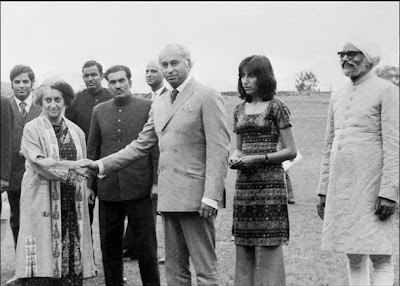
Take a good, long look at the picture below. It is from the signing of the Simla agreement between the goverments of India and Pakistan in 1972. There are four people in the foreground. The two leaders shaking hands are easy enough to identify — perhaps the subcontinent’s two most iconic leaders ever: Indira Gandhi and Zulfiqar Ali Bhutto. The bearded man on the extreme right is Swaran Singh, then Indian foreign minister. And just who do you suppose is the timid-looking young lady between Messrs Bhutto and Singh?

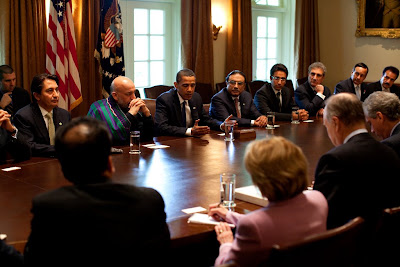
I bring this up because for the life of me, I can’t get over Bilawal Bhutto accompanying his father to a high-level meeting with Barack Obama and Hamid Karzai. I know there are more important crises in Pakistan right now (the refugees, the economy, the Taliban), but I can’t let this go, even though I probably should. I mean, just look at this picture, sent to me by reader Nabeel from the White House page on Flickr.


I just have one question: WHY IS BILAWAL SITTING THERE? Actually, I have one more question: what does it say about Zardari’s priorities that Bilawal is sitting closer to his father and Barack Obama than either Pakistan’s foreign minister (Shah Mahmood Qureshi, on Bilawal’s left) or Husain Haqqani, Pakistan’s ambassador to the U.S. (to Qureshi’s left)?

Five Rupees for more
(Submitted by a reader)

The Hour Of The Untamed Cosmopolitan

Bred on radical diversity and an epic culture, the voter makes a reckoning of Narendra Modi, Prakash Karat, Mayawati and the politics of excess

By Ashis Nandy, Social Scientist (Tehelka)

AFTER ALMOST two decades, in many ways, the election of 2009 was a normal election. No overriding consideration drove the voting across the country. Diverse configurations in diverse places determined the fate of different candidates and parties. Different regions had different logic even within a given state. Still, underlying the diversity there were some common themes.

First, I think people were looking for ways to lower the temperature of politics. High-pitched politics has reigned in our polity for nearly 15 years now. My suspicion is people were a bit tired of this. For example, the past two elections showed that in Uttar Pradesh, only one percent of the electorate was interested in Ram Janmabhoomi. The BJP probably played down the issue this year because their internal assessment showed the same thing. Except in West Bengal, nowhere did the election involve an emotional arousal of the kind we have come to routinely expect.

There are reasons for this. In our society, we live with radical diversities — diversity that is not based on tamed forms of difference. The US is a perfect example of tamed diversity. You get every kind of food and dress and cultural activity in America. You think you are very cosmopolitan if you can distinguish Huaiyang food from Schezwan food, or South Korean ballet from Beijing opera, or Ming dynasty china from Han dynasty china in a museum. This is diversity that is permissible, legitimate, tamed.

Radical diversity is when you tolerate and live with people who challenge some of the very basic axioms of your political life. Like most of South Asia, Indians have an old capacity to live with such diversity. A powerful example is Sajjad Lone contesting the election this year. Nobody objected that a secessionist wants to take an oath of allegiance to the Constitution. Everyone spoke of it glowingly. I consider that a tolerance for radical diversity. In such a society, all excesses are ultimately checkmated.

In India, we live in a country where the gods are imperfect and the demons are never fully demonic. I call this an ‘epic culture’ because an epic is not complete without either the gods or the demons. They make the story together. This is a part of our consciousness, and ultimately, I think it influences our public life. People go up to a point with their grievance, then get tired of it. They realise that to go further is a dangerous thing because it destroys the basic algorithm of your life. They say, enough is enough, let us go back to a normal life. This election represents something of that consciousness. We probably need this kind of interregnum in politics. They have a soothing effect on our public life. This is what most Indians feel.

The second underlying theme is that people were searching for a sort of minimum decency. Negative campaigns, excessively personal attacks, hostile slogans — all of this seemed to upset the voter. When the BJP and the Left targeted Manmohan Singh, making him the butt of jokes and accusations, Singh became a hero for the very qualities people joked about. His weakness, his absence of a political base, his susceptibility to pressures of the Congress high command — instead of looking like liabilities, these things suddenly began to look like a marker of a genteel type of politics. I think that paid dividends. Contrasted with their shrill opponents, Sonia and Rahul Gandhi’s conduct too paid dividends.

(I asked a waiter at the India International Centre in Delhi what he felt about the election results. “It’s been very good,” he said. Was he a Congress supporter, I asked him. “It’s not that, sahib,” he replied. “That Sardarji is a good man. He is educated, he is not a thief, and he is a newcomer to politics. Still, they got after him, calling him weak and scared. Who can enjoy watching that? I am just happy that this election result has shown there is a god watching above.” I quote the waiter verbatim because I think the idea of “a god above” might have been a consideration with many other people as well.)

THE THIRD and interlinked theme this election was the voter’s desire to bring down the arrogant. The way Mayawati has lost, in what was once thought an inelastic support base, points to something very significant. Many people did not like the way she threw her weight around; her ostentation; the dozens of statues she is erecting in her likeness, her assumption that even if she did nothing to serve it further, history was waiting for her. Others did not like Narendra Modi. Yet others, Prakash Karat. Arrogance of style. Arrogance of ambition. The arrogance of neglecting the people. All of this was punished by the voter.

Narendra Modi has marginalised all possible opposition within the BJP, and sidelined the RSS, Bajrang Dal and VHP. They cannot really muddy things for him easily anymore. He is a man looking for power and he has used and discarded them. He has a solid support base in West Gujarat and among middle-class Gujaratis, so there is no question of him fading away, but this election doubts have been planted about his capacity to emerge as a pan-Indian leader. He was billed as a star campaigner for the BJP, but the Indian voter has sent back a strong message scaling him down.

Tehelka for more

Ecuador: Firmly Left

By John Cherian (Frontline)

Rodrigo Buendia/AFP

President Rafael Correa after his re-election, on April 26.

The leftward swing in Latin America is being further consolidated. The avowedly socialist President Rafael Correa of Ecuador again won an emphatic victory at the polls in the last week of April. The other Latin American countries to have elected leftist governments are El Salvador, Venezuela, Bolivia, Nicaragua, Argentina, Honduras, Guatemala and Brazil. It is the first time in many decades that a President has been re-elected for a second consecutive term in office in Ecuador.

Before Correa came on the scene, the tumultuous politics of the country had witnessed as many as seven Presidents come and go in the past decade. Correa became the first President to win re-election since 1972. “We have made history in a country where from 1996 to 2006 no democratic government completed its term,” Correa told his cheering supporters after the election results were out. The squandering of the country’s bountiful natural resources by a greedy elite had alienated the masses from the political system. Correa, a vociferous critic of neoliberalism, refused in his short first term in office to repay part of the country’s huge debt owed to international financial institutions. Ecuador has defaulted on 32 per cent of its $10.1 billion debt.

Correa severed Ecuador’s relations with the International Monetary Fund (IMF) in 2007, describing the organisation as “exploitative”. In November last year, Correa decided to stop the payment of $4 billion in foreign debt after the country’s independent public debt audit commission concluded that the debt was illegally contracted when authoritarian governments were in control.

The Ecuadorian President said at the time that the IMF imposed conditions on developing countries while giving loans that benefited bankers and private businessmen at the expense of the poor. Correa has offered to buy Ecuador’s debt back at 30 cents to a dollar. He also imposed tough protectionist measures to safeguard the country’s economy, which was reeling because of the drastic fall in petroleum prices in the global market. At the same time, he tripled state spending on education and health care and doubled the monthly payment for single mothers. In his two years as President, half the budget has been devoted to the social sector.

In September last year, Correa got the country’s Constitution amended to give the government more powers to implement its socialist projects and to ensure that the proceeds from the sale of hydrocarbon deposits go to the exchequer. The government gets 40 per cent of its budget from the petroleum industry. Correa once said that the oil multinationals took four out of five barrels they produced and left only one for the country. The new Constitution gives the President control over the central bank, and allows a President to serve two consecutive four-year terms.

The 2008 Constitution guarantees free education through university. The document is considered one of the most progressive of its kind in the world. It guarantees the rights of the indigenous people, legalises the rights of gay people to a civil union and has strong provisions to protect the environment.

Rodrigo Buendia/AFP

Voters outside a polling station in Cangahua. The 2008 Constitution guarantees the rights of the indigenous people.


Ecuador expelled two U.S. diplomats from the country earlier in the year for their “unacceptable meddling” in the internal affairs of the country. Ecuador has established cordial diplomatic and trade links with countries such as Iran. Ecuador signed a big defence deal with Iran after the raid by Colombian forces into its territory last year. It has begun to diversify its sourcing of defence hardware. Now it buys hardware from countries such as Russia, China and also India. It has placed orders for Indian-made Advanced Light Helicopters.

Correa has been viewed with increasing suspicion after he announced late last year that the lease on the U.S. military base in Manta was not being extended. At the beginning of his first term, he said that the U.S. could retain the Manta base if the Ecuadorian military was given a base in the U.S. State of Florida. Washington thought that Correa was only posturing. But the U.S. has been ordered to vacate the Manta base by the end of the year.

Manta is considered the most important American military base in the region, but Ecuadorians consider the presence of American troops on their soil a threat to their sovereignty and security. Correa had pledged to close the base after he first took office in 2007. Last year, Correa dismissed his Defence Minister along with the commanders of the air force and the army. He said at the time that the country’s defence establishment was “totally infiltrated and subjugated to the CIA [Central Intelligence Agency]”.

Frontline for more

A Conversation with Richard Sennett

(Economic Sociology)

Richard Sennett is one of the world’s most prominent critical sociological thinkers.

At the beginning of the interview I ask Richard Sennett to tell me more about how he got interested and involved in the study of sociology, and in particular the study of forms of new capitalism and its social and political consequences.

Richard Sennett: Well, I’d say two things. One was that I grew up in a rather unusual family, because all members of my family worked for the communist party in the 1930s. So, they were resolutely on the left. I just swam in this as a child. And even though my mother and my father and my uncle left the party – in 1939 my mother left, and my uncle left in 1956 – this was always there; this was social reality for me. When I started in sociology, I reacted quite strongly against some of the more doctrinaire aspects of it. This happened to many people in my generation from the extreme left, which was very tiny in the United States, a sect more than a political group. So when I was in graduate school, I was very attracted to in-depth interviewing and to ethnographic work, because it seemed so corrective on the ground that a lot of the ideological nostrums that the American communist party was able to say were the least intelligent and the most rigid of all the modern communist parties. You know, I reacted very much against that.

I suppose what’s happened in my career is that I re-turned to the left, but from a different kind of data, and that has produced a different kind of social analysis. I have studied two things in my career: work and cities – work and place. These are the two things I am interested in. And [in the late 1960s, early 1970s] I started doing research on the sociology of work for a book called the The Hidden Injuries of Class, which is just about to be published again in Britain, after thirty years of being out of print. It was a book that looked rather sceptically at a proposition about the United States, and at a proposi-tion about class. The proposition about the United States was that American workers had very low levels of class consciousness. And the proposition about class itself was about its bourgeoisification, a thesis that was in the 1970s quite dominant. The book used intensive interview data from a hundred people to combat that idea. And then in the nineties when the current phase of globalised capitalism started to become apparent, I got really interested in the subject of work. And the last four of the books I’ve written have taken up that interest. I still use a lot of ethnographic and intensive interview material, but I also tried to introduce more of a historical frame into the study of capitalism. But again, I focused on the labour process – that’s what these last four books have all been about. And I have to say that the more I’ve studied the effect of modern capitalism on ordinary workers the more I feel I return to the radical roots of my childhood. This system is obscene. And I think it’s really hard on ordinary workers, culturally and socially, not just in terms of familiar things like inequality gaps or wages, but also in terms of conducting a family life, relations to other people in the community, sense of life merit. It’s a culturally destructive system.

Economic Sociology pp.27-32 for more