North Korea: “Sanity” at the Brink

by Michael Parenti

Nations that chart a self-defining course, seeking to use their land, labor, natural resources, and markets as they see fit, free from the smothering embrace of the US corporate global order, frequently become a target of defamation. Their leaders often have their moral sanity called into question by US officials and US media, as has been the case at one time or another with Castro, Noriega, Ortega, Qaddafi, Aristide, Milosevic, Saddam Hussein, Hugo Chavez, and others.

So it comes as no surprise that the rulers of the Democratic People’s Republic of Korea (DPRK or North Korea) have been routinely described as mentally unbalanced by our policymakers and pundits. Senior Defense Department officials refer to the DPRK as a country “not of this planet,” led by “dysfunctional” autocrats. One government official, quoted in the New York Times, wondered aloud “if they are really totally crazy.” The New Yorker magazine called them “balmy,” and late-night TV host David Letterman got into the act by labeling Kim Jong-il a “madman maniac.”

To be sure, there are things about the DPRK that one might wonder about, including its dynastic leadership system, its highly dictatorial one-party rule, and the chaos that seems implanted in the heart of its “planned” economy.

But in its much advertised effort to become a nuclear power, North Korea is actually displaying more sanity than first meets the eye. The Pyongyang leadership seems to know something about US global policy that our own policymakers and pundits have overlooked. In a word, the United States has never attacked or invaded any nation that has a nuclear arsenal.

MRZine for more

Creator Vanished, Creation Survives!

By B. R. Gowani

Many years have passed
Since you bade farewell
With an unwritten/unspoken promise
To never come back …
Even if you wanted to
Nature would not let you

Painful, the separation was
And it will it seems
Persist to the end
Other pains have cropped up too
As if the heart is not
A life spewing instrument any more
But has instead turned into
a collection of sorrowful parts
With varying degrees of anguish and woe

You were the creator …

The creator vanished
The creation survives!

The only difference
That divides you and me
Is intense grief
I feel it; you don’t

B. R. Gowani can be reached at brgowani@hotmail.com

Preventing a Taliban victory

By Pervez Hoodbhoy

A few thousand mountain barbarians, even if trained by Al Qaeda’s best, cannot possibly seize power from a modern, well-armed state with 600,000 soldiers. The spectre of Pakistan collapsing in six months — a fear expressed by a senior US military adviser in March — has evaporated.

But there is little cause for elation. Daily terror attacks across the country give abundant proof that religious extremism has streamed down the mountains into the plains. Through abductions, beheadings and suicide bombings, Taliban insurgents are destabilising Pakistan, damaging its economy and spreading despondency.

Look at Islamabad, a city of fear. Machine-gun bunkers are ubiquitous while traffic barely trickles past concrete blocks placed across its super-wide roads. Upscale restaurants, fearing suicide bombers, have removed their signs although they still hope clients will remember. Who will be the next target? Girls’ schools, Internet cafes, bookshops, or western clothing stores with mannequins? Or perhaps shops selling toilet paper, underwear, and other un-Islamic goods?

The impact on Pakistan’s women is enormous. Throwing acid, or threatening to do so, has been spectacularly successful in making women embrace modesty. Today there is scarcely a female face visible anywhere in the Frontier province. Men are also changing dress — anxious private employers, government departments and NGOs have advised their male employees in Peshawar and other cities to wear shalwar-kameez rather than trousers. Video shops are being bombed out of business, and many barbers have put ‘no-shave’ notices outside their shops.
WorldAnalysis for more

Conservatives Use “Racism” to Confuse and Exploit

June, 19 2009By Daniels, Ron Ron Daniels’s ZSpace Page

When rabid right wing radio talk show host Rush Limbaugh and conservative guru Newt Gingrich initially attacked Supreme Court nominee Judge Sonia Sotomayor as a “racist,” they were using a time-tested strategy to appeal to Whites who believe their “rights” are being threatened by Blacks and people of color.

Historically, racism has frequently been used by elements of the White power structure as a wedge to persuade working class and poor Whites to disassociate with or fight against Blacks who should have been seen as their class allies. Deeply ingrained attitudes of White superiority and Black inferiority which underpin structural/institutional racism in this society have made White working class and poor people particularly susceptible to this strategy of confuse and exploit. Thus the slogan “Black and White Unite and Fight” has generally failed to bear fruit because too often Whites have been convinced that people of African descent are their enemies.


Z Space
for more

Running scared

No reprieve for gay community living with 30 years of sharia law


Living in fear: a gay transvestite in Iran. JeROeN OeRLeMANS / PANOS

On 1 April Iran marked the 30th anniversary of becoming an Islamic Republic and adopting sharia law. For the country’s gay community, the occasion was a stark reminder of their decades-long persecution. Homosexuality was already taboo under the Shah, but the birth of the Republic in 1979 led to its criminalization. In 2007, despite a penal code stipulating homosexuality as a crime, President Ahmadinejad declared that ‘in Iran we do not have homosexuals’. Following international pressure and derision, he later conceded that there ‘might be a few gay people in Iran’ but denied that they faced execution.
New Internationalist for more

15 sentenced for ‘ritual’ killing

By Phuntsho Choden & Rinzin Wangchuk (Kuensel)
The four main perpetrators of the chilling crime were all minors below 18 years old

20 June, 2009 – The Dorokha dungkhag court in Samtse dzongkhag has sentenced 15 people, involved in the beating up of a 46-year-old mother to death, after local Christian pastors said she was possessed with “evil”, to 1-18 years in prison.

On March 13 this year, victim Kal Maya Rai and her husband had gathered with a group of Christian converts for prayers at Jasbir and Tula Maya Rai’s house in Dumtoe village in Dorokha.

Court officials said that two pastors – Sangeeta Rai and Dil Maya Rai – had asked the gathering to confess their sins. When none did so, the two pastors accused Kal Maya Rai (the victim) of murdering their god in her past life and concluded that she should be killed.

Sangeeta, Dil Maya and two others – Bijay Kumar and Subhash Rai – (all minors, below 18 years) then caught the victim by her hair and started to kick and slap her. They assaulted her first with brooms and then with the handle of a spade, while others, including her husband, watched. Subhash Rai, then, trampled her chest and she started bleeding profusely from her mouth, court officials said.

Four of them then tied the victim’s hands and dragged her outside the house with a rope around her waist, while the victim’s two 13-year-old daughters pleaded with them to spare their mother. The unconscious victim was then tied to an orange tree 15 m away from the house. A mother of five, Kal Maya, was discovered dead by the Dumtoe gup.

The court found the four people to be the main perpetrators and so they should have been sentenced to life imprisonment for their crime, say court officials, but since they were all minors the group was sentenced to 18 years in prison, added the official.

Kuensel for more

World People’s Resistance Movement (Britain) Launches New Website!

Submitted by a reader in UK:

To visit our website Click on: www.wprmbritain.org

World People’s Resistance Movement (Britain) has launched a new website to promote and unite people’s struggle against the British ruling class and the imperialist system in general. This political website supports all anti-imperialist and revolutionary forces and individuals, regardless of their ideology, and informs the people about their statements, articles, leaflets and practical activities. All visitors to the site will have the opportunity to leave comments and join a lively public debate.

WPRM ( Britain ) is a democratic organisation, which supports resistance to imperialism and the revolutionary struggles (e.g. Nepal, India, Bhutan, Peru, Philippines etc.) of the peoples of the world. Its existence is a response to a world where imperialism is on the rampage, bringing nation after nation to ruin, from Afghanistan and Iraq to Somalia and Palestine .

WPRM ( Britain ) supports the right of oppressed nations to self-determination, which includes defending themselves when the imperialist ruling class and their client states wage wars of aggression against them. The oppressed peoples of the world (workers, peasants, women, national minorities, etc.) have the right to rebel against oppression and its root cause – the imperialist system.

In Britain , we need to unite with all those who always support the people’s struggle against the imperialist ruling class. We believe that active participation of the British people in the global struggle against imperialism will pave the way for their liberation.

Join us to develop and promote the website to serve the people.

World People’s Reistance Movement (Britain)
BM Box 7970 , London.
WC1N 3XX
E-mail: wprm_britain@yahoo.co.uk
Website: www.wprmbritain.org

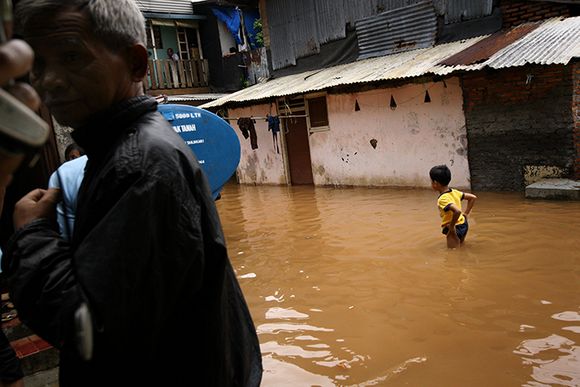
Private sector participation in Jakarta’s water supply has left many citizens high and dry

Access to clean water is difficult. With seasonal flooding, both the Ciliwung river and groundwater from the many hand-pumps become increasingly contaminated.
Henri Ismail

In Cipinang Muara, East Jakarta, there lies a cemetery complex known as ‘Kuburan Cina’. It is not, unfortunately, solely a resting place for the deceased. It is also home to over 80 families living in a slum inside the complex where water is a precious commodity. The people here earn their income from selling goods in a nearby flea market, making just Rp20,000 (US$2.60) a day. Buying clean water from private vendors is clearly not an option for them. Likewise, piped water is too expensive, and the city’s private water operators do not offer their services to what they consider illegitimate houses. In the past, the slum residents obtained water for cooking, drinking and sanitary purposes by collecting rainwater from the roofs of the buildings in their neighbourhood. Two years ago they collaborated to install four shallow wells. Given the quality of water they use however, water borne diseases such as diarrhoea and typhoid are not uncommon.

The story from Kuburan Cina is a stark reminder of the water service predicament in Jakarta and particularly its impact on the city’s urban poor. When a new system of Private Sector Participation, or PSP as it is sometimes known, opened up the city’s water supply sector to private companies in February 1998, it was hoped that Jakarta would finally be relieved of its clean water shortage woes. However, eight years later a UNDP report found that over 75 per cent of Jakartans – most of whom are of the poorer segment of the population – were still without improved access to clean water, relying instead on multiple sources, including rivers, lakes and private vendors.

Jakarta is in dire need of a functioning water supply system that can allow the city’s burgeoning population to stop relying on contaminated underground water

In the same year, however, Jakarta’s environmental body reported that approximately 85 per cent of the shallow underground water in the city had been contaminated by faecal coli bacterium resulting from human waste, causing those who consume it to be infected by water borne diseases. In light of these statistics, there is little doubt that Jakarta is in dire need of a functioning water supply system that can allow the city’s bourgeoning population to stop relying on the contaminated underground water. Unfortunately, to date the participation of private companies in the distribution and maintenance of Jakarta’s water supply seems to have done more harm than good.

Inside Indonesia for more