How Old Do You Feel? It Depends on Your Age

By SARAH ARNQUIST

The older people become, the younger they feel and the more likely they are to see “old age” as a time occurring later in life, according to a national survey on aging released on Monday.

“There’s a saying that you’re never too old to feel young, and boy, have older Americans today taken that one to heart,” said Paul Taylor, executive vice president with the Pew Research Center and the survey’s principal author. He said this is the broadest survey the nonpartisan research center has ever done to gauge Americans’ views on aging.

Currently, about 40 million Americans, or one in eight, are 65 and older. By 2050, one in five American will be in that age group. The center surveyed about 3,000 adults 18 and older via land and cellular telephone lines in February and March of this year.
The survey found not just a gap between actual age and the age people say they feel, but also that the gap between reality and perception increases with age.

NY Times for more

Study turns pigeons into “art critics”

World Science staff

You can have an eye for art. Or, you can have a bird’s eye view of something.

But both at the same time?

A Japanese researcher is reporting that he has trained pigeons to tell apart “good” and “bad” children’s paintings, in the process making judgments that largely agree with those of human viewers.

Can animals make artistic judgments? A researcher claims to have trained pigeons to tell apart “good” and “bad” children’s paintings
Whether the birds are weighing the works based on artistic merit, or on some other characteristic or cue, may not be fully ascertainable. But somehow, the avians could distinguish between pictures previously rated as good or bad by adults, according to psychologist Shigeru Watanabe of Keio University in Tokyo.

Perhaps pigeons can “learn the concept of ‘beauty’ as defined by humans,” wrote Watanabe in the study, published in the June 16 issue of the research journal Animal Cognition.

Watanabe first asked a group of adults to judge several children’s paintings. Sophisticated evaluations weren’t requested: the viewers were simply asked to rate the works as “good” or “bad”—that is, beautiful or ugly.

Later, pigeons were trained, through dispensation of treats, to peck at “good” paintings. Pecking at “bad” ones would net them no reward.


World Science
for more

From the highlands of Papua to exile in England, Benny Wenda is a leader of his people

A man on a mission
By Jennifer Robinson

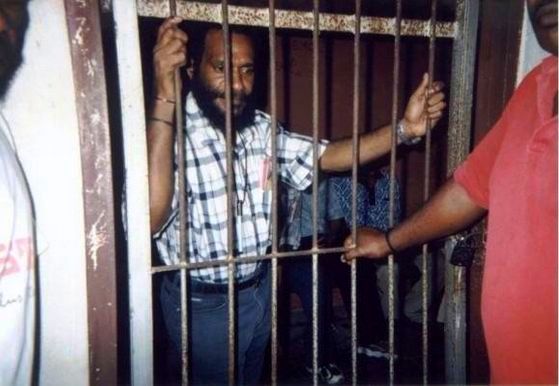
Benny was detained in Abepura prison during his trial in 2002

As a young child in the 1970s, Benny Wenda’s world was his village in the remote highlands of West Papua. Life consisted of tending gardens with his mother among the Lani people who, he says, ‘lived at peace with nature in the mountains’. In 1977 that life changed dramatically.

That year, the military appeared in his village. Now, every morning on the way to their gardens, Benny and his mother and aunties would be stopped and checked by Indonesian soldiers. Often the soldiers would force the women to wash themselves in the river before brutally raping them in front of their children. Many young women, including three of Benny’s aunties, died in the jungle from the trauma and injuries inflicted during these attacks, which often involved genital mutilation. Every day Papuan women had to report to the military post to provide food from their gardens, and to clean and cook for the soldiers. Violence, racism and enforced subservience became part of daily routine.

‘I asked myself ‘why?’ Who are these people? And why do they do this to us? Why do they kill my people? Why do they rape my aunties?’

Later that year, and in response to military violence towards Papuans, 15,000 Lani people rebelled. In retaliation, Indonesian military aircraft bombed many Lani villages in the highlands, including Benny’s village. Benny remembers an attack where their huts and crops were burned and many of his family were killed or injured. Benny too suffered in the attack: his leg was badly injured and left untreated because his family was forced to flee into hiding in the jungle, leaving him with one leg significantly shorter than the other and an awkward limp. More than twenty years later the scars, the pain and the difficulty in walking remain.

Childhood in the jungle

Benny and Maria Wenda with their young children regularly organise
and take part in protests at the Indonesian Embassy in London. Here at a protest in 2008 Dominic Brown

Between 1977 and 1983 Benny and his family, along with thousands of other highlanders, lived in hiding in the jungle. Life was hard. Food and shelter were scarce, and the weak struggled to survive the harsh conditions.

Inside Indonesia for more

U.S. Considers Curbs on Speculative Trading of Oil

Tim Sloan/AFP-Getty Images
“My firm belief is that we must aggressively use all existing authorities to ensure market integrity,” Gary Gensler, the chairman of the Commodity Futures Trading Commission, said in a statement.

By EDMUND L. ANDREWS

WASHINGTON — Reacting to swings in oil prices in recent months, federal regulators announced on Tuesday that they were considering trading restrictions on hedge funds and other “speculative” traders in markets for oil, natural gas and other energy products.

In a big departure from the hands-off approach to market regulation of the last two decades, the chairman of the Commodity Futures Trading Commission, Gary Gensler, said his agency would consider limits on the volume of energy futures contracts that purely financial investors would be allowed to hold.

The announcement also highlights a broader shift toward tougher government oversight under President Obama. Since Mr. Obama took office, the Justice Department has stepped up its antitrust enforcement activities, reversing many of doctrines adopted by the Bush administration. The Securities and Exchange Commission is ramping up as well, having been sorely embarrassed by its failure to heed warnings about Ponzi scheme run by the money manager Bernard L. Madoff.

The Obama administration is also proposing a broad overhaul of financial regulation that would include tougher rules in the free-wheeling market for arcane financial instruments called derivatives.
When it comes to supervising oil and gas trading, regulators made it clear they were willing to move ahead on the basis of their existing authority, without waiting for Congress to act on Mr. Obama’s broader overhaul.

“My firm belief is that we must aggressively use all existing authorities to ensure market integrity,” Mr. Gensler said in a written statement.

NY Times for more

Lessons from Israel’s water sector

By Orton Kiishweko

Filtering machines at the IDE Technologies first and world’s largest desalination plant at Ashkelon city near Tel Aviv whose 100 million m3 per year capacity makes it the world’s largest plant using the RO technology.

Water and environmental technologies are increasingly gaining attention in the world’s development strategies and economy.

Water, apart from being a human consumption, is a resource on which Agriculture significantly depends through state of the art irrigation in countries like Israel.

Agriculture in Israel is advanced, with all sorts of opportunities and possibilities, inspite of its desert status.

For example, the country’s agriculture sector is an intensive system of production, starching from the need to overcome the scarcity in natural resources, especially water and arable land, particularly south of the country.

Just outside Telviv, the capital of Israel, a one and a half hour drive from Ashdod city to Dimona, is one big and wonderful irony,-with the desert stretch having significant distances of successful farms, all green under irrigation technology.

There is a sense of possibility with the kind of water technologies being developed at the centre of dry lands to get high productivity.

The Israel NEWTech project manager Gilad Peled told this reporter in Tel Aviv that the constant growth in agricultural production is due to the close cooperation between researchers and farmers.

The Citizen for more

17th Amendment, 58(2b) to go as per CoD: Gilani

* PM says Benazir was also committed to restoring constitution to its original form
* Says he believes in a strong federation

By Irfan Ghauri

ISLAMABAD: The 17th Amendment and 58(2b) will also be abolished in accordance with the Charter of Democracy (CoD), Prime Minister Yousuf Raza Gilani said on Tuesday.

Talking to reporters at the Prime Minister’s House, Gilani said, “I want to restore the constitution to its original form. There should be no ambiguity in this regard when the PPP Central Executive Committee has unanimously supported the abolition of 58(2b) and the 17th Amendment.” In his two addresses to the joint sittings of parliament, President Asif Zardari had not only asked the government to amend the constitution, but had also written him a letter to expedite the process, the premier said.

Committed: He said, “The chair I am sitting in is the chair of PPP founder Zulfikar Ali Bhutto. It is in the manifesto of the PPP and Benazir Bhutto was also committed to restoring the constitution to its original form.”

Daily Times
for more

Russia bans all gambling and shuts casinos

By Mikhail Antonov and Vladimir Bomko

MOSCOW (Reuters) – Russia closed down its casinos overnight as gambling was banned nationwide, a move the industry says could throw a third of a million people out of work.

The July 1 ban shut gaming halls, from gaudy casinos crowned by extravagant neon structures to dingy dwellings containing a handful of slot machines.

“I feel terrible. We just let 1,000 people go,” said Yuri Boyev, general director at Metelitsa, an upmarket casino where billionaires rolled the dice and Russia’s gas giant Gazprom held a lavish Christmas party.
Vladimir Putin, now prime minister, came up with the idea in 2006 when he was president after the Interior Ministry linked several gaming operations in Moscow to Georgian organised crime.

The Kremlin plans to restrict gambling to Las Vegas-style gaming zones in four rarely visited regions deemed to need investment, including one near the North Korea border, but nothing has been built and critics say the zones will fail.

Though gaming establishments knew the shutdown date for at least a year, few thought the government would go through with it, but officials moved in overnight to close them down.

The industry says the ban will axe at least 300,000 jobs but officials in Moscow put the national figure at only 11,500.

Rows of slot machines, usually blinking around the clock in smoky, crowded halls, lay dormant and wrapped in cellophane.

Moscow deputy mayor Sergei Baidakov, watching men dismantle poker tables and lay roulette wheels on the floor, said the state was ready to thwart any big to move gambling underground.
“We are confident we will control the situation,” he said.

He said the ban was to protect the health of society. Many critics in the gambling industry say it has more to do with Russia’s poor ties with Georgia. Georgians are thought to run many Russian gaming halls.
City police stood on guard in case of protests by disgruntled former workers in the popular gaming halls that have sprouted since the Soviet Union collapsed in 1991 and now pepper Russia’s cities.
A hotline was set up on Wednesday to report on those suspected of operating illegal gambling, Itar-Tass reported.

Moscow had around 550 gambling places, including 30 casinos in prime spots, symbolising the capital’s love of excess.

Midnight on Novy Arbat street, the heart of the gambling scene, was muted as its flashing lights and loud music were turned off for the first time in over a decade.

“I’m upset but I guess I’ll have a little rest and re-visit my job situation in August,” said Elena, a slot machine operator who has worked in the gaming business for five years.


Public Broadcasting
for more

Bring terrorists to US? Better than leaving Gitmo open, panel says

In a letter to Congress Tuesday, 17 terrorism experts said America’s super-maximum security prisons can handle detainees from Guantánamo.

By Alexandra Marks | Staff writer
New York

With the deadline to close the Guantánamo Bay prison just six months away, Obama administration lawyers told Congress Tuesday they are still unsure about how they will deal with the remaining detainees there.

But a bipartisan group of leading homeland-security experts criticized congressional efforts to block to the administration from moving the Guantanamo detainees to the US as “unnecessary and harmful to our national security.”

Currently, more than 200 detainees remain at the naval prison camp in Cuba. Congress and administration officials are currently debating whether they should be prosecuted in civilian or military courts, as well as where such trials should take place. Some in Congress object to bringing the detainees back to this country to stand trial and have blocked the administration from doing so during the 2009 fiscal year, which ends Sept. 30.

The homeland-security experts sought to undercut this objection, saying in a letter to Congress Tuesday that closing Guantánamo would be a “net benefit to our counterterrorism efforts,” and that doing so will require bringing some terrorists here for “trial, detention, or, if appropriate, resettlement.”

“Guantánamo is so onerous to us from a foreign-policy standpoint that we’ve got to get rid of it,” says Ronald Marks, a former senior CIA official and senior vice president of Oxford Analytica, an international consulting firm in Washington. He was one of 17 terrorism experts who signed the letter to Congress.

“The logical answer is to bring some of these guys to super-maximum security prisons here and keep them here for the rest of their lives,” he says.

Christian Science Monitor for more

Turkey balances on shaky ground

By Reza Akhlaghi

This month, the Turkish parliament approved a bill to clear more than 600,000 landmines along the Turkish-Syrian border that were planted in the 1950s to keep Kurdish separatists harbored by Syria from infiltrating into Turkish territory.

The bill was harshly criticized by Turkey’s opposition parties, which said it undermined Turkey’s national security. The cleaning project, which could also be opened to bidding from foreign companies, could cost as much as half a billion US dollars. Turkey claims that it is mandated to clear them by its signing of the 2003 Ottawa Treaty, which calls for a ban on anti-personnel landmines, but the reality is that the move is part of a strategic overhaul of the country’s standing in the Muslim world.

Turkey’s openness to Syria does not end with landmine cleanups. In late April, for the first time, Turkish and Syrian forces conducted joint military operations along the same mine-laden borders. Israel, unsurprisingly, frowned on the joint exercise and thought it might be a harbinger of things to come, especially given Tel Aviv’s close relations with Turkey, its only ally in the Muslim world. But the Turkish leadership is not naive enough to take sides in the Arab-Israeli conflict to the detriment of its strategic standing in a region that is being shaped by two wars and a rising Iran.

Turkey’s gradual about-face regarding its strategic position vis-a-vis the Muslim world can be seen as part of a soul-searching exercise that began with the rise of Islamists in the government in the early 1990s and the United States invasion of Iraq in 2003. This soul-searching was born partly out of frustration with the country’s fiercely secular elite, who for decades tried to integrate Turkey into the European family of nations and change the country’s demography and cultural attitudes toward religion and its role in politics.

Asia Times for more

Women In Art

by Philip Scott Johnson

500 Years of Female Portraits in Western Art

Music: Bach’s Sarabande from Suite for Solo Cello No. 1 in G Major, BWV 1007 performed by Yo-Yo Ma
Nominated as Most Creative Video
2nd Annual YouTube Awards