Allergy drugs may fight diabetes, obesity

Khaleej Times Online > HEALTH (Reuters)
27 July 2009

Over-the-counter allergy and asthma drugs helped obese, diabetic mice lose weight and control their blood sugar, researchers reported on Monday.

Three other studies strongly linked obesity and type-2 diabetes to a dysfunctional immune system, and researchers said these findings could lead to better drugs or perhaps even vaccines to treat the effects of both conditions.

Rates of obesity and type 2 diabetes are surging around the world as people eat more and exercise less. The four studies published in the journal Nature Medicine help explain how obesity might cause diabetes and how the two together can cause organ damage, heart disease and death.

Guo-Ping Shi at Brigham and Women’s Hospital and Harvard Medical School in the United States and colleagues found that mast cells—the immune cells that get out of control in allergy and asthma—were abundant in fat tissues of obese and diabetic people and mice.

They created obese and diabetic mice by overfeeding them. Then they gave some of the mice two antihistamines, one called ketotifen fumarate, sold by Novartis AG under the brand name Zaditor and generically available cromolyn.

Both help stabilize mast cells in people with allergy or asthma, Shi said in a statement.

Mice fed a healthy diet improved moderately, while those given either cromolyn or Zaditor showed dramatic improvements. But mice given the drug and switched to a healthy diet showed nearly 100 percent recovery in all areas.

“The best thing about these drugs is that we know it’s safe for people,” Shi said. “The remaining question now is: Will this also work for people?”
Shi will test both in monkeys.

Immune Response
Type 1 diabetes is an autoimmune disease—one in which the immune system mistakenly attacks healthy tissue. The studies in Nature Medicine suggest that type 2 diabetes and obesity also involve the immune system.

Satoshi Nishimura of the University of Tokyo and colleagues found a surge in immune cells or lymphocytes called CD8 T-cells in obese mice fed a high-fat diet.

Mice engineered to be deficient in CD8 T-cells had markedly less inflammation, even when fed a high-fat diet.

“So if we can find the molecule that triggers (the production of) CD8 T-cells, we can block or inhibit it (the molecule) using drugs,” Nishimura said in a telephone interview.

Khaleej Times for more

Why We Can’t See the Trees or the Forest

The Torture Memos and Historical Amnesia

By Noam Chomsky

The torture memos released by the White House elicited shock, indignation, and surprise. The shock and indignation are understandable. The surprise, less so.

For one thing, even without inquiry, it was reasonable to suppose that Guantanamo was a torture chamber. Why else send prisoners where they would be beyond the reach of the law — a place, incidentally, that Washington is using in violation of a treaty forced on Cuba at the point of a gun? Security reasons were, of course, alleged, but they remain hard to take seriously. The same expectations held for the Bush administration’s “black sites,” or secret prisons, and for extraordinary rendition, and they were fulfilled.

More importantly, torture has been routinely practiced from the early days of the conquest of the national territory, and continued to be used as the imperial ventures of the “infant empire” — as George Washington called the new republic — extended to the Philippines, Haiti, and elsewhere. Keep in mind as well that torture was the least of the many crimes of aggression, terror, subversion, and economic strangulation that have darkened U.S. history, much as in the case of other great powers.

Accordingly, what’s surprising is to see the reactions to the release of those Justice Department memos, even by some of the most eloquent and forthright critics of Bush malfeasance: Paul Krugman, for example, writing that we used to be “a nation of moral ideals” and never before Bush “have our leaders so utterly betrayed everything our nation stands for.” To say the least, that common view reflects a rather slanted version of American history.

Occasionally the conflict between “what we stand for” and “what we do” has been forthrightly addressed. One distinguished scholar who undertook the task at hand was Hans Morgenthau, a founder of realist international relations theory. In a classic study published in 1964 in the glow of Camelot, Morgenthau developed the standard view that the U.S. has a “transcendent purpose”: establishing peace and freedom at home and indeed everywhere, since “the arena within which the United States must defend and promote its purpose has become world-wide.” But as a scrupulous scholar, he also recognized that the historical record was radically inconsistent with that “transcendent purpose.”

We should not be misled by that discrepancy, advised Morgenthau; we should not “confound the abuse of reality with reality itself.” Reality is the unachieved “national purpose” revealed by “the evidence of history as our minds reflect it.” What actually happened was merely the “abuse of reality.”

The release of the torture memos led others to recognize the problem. In the New York Times, columnist Roger Cohen reviewed a new book, The Myth of American Exceptionalism, by British journalist Geoffrey Hodgson, who concludes that the U.S. is “just one great, but imperfect, country among others.” Cohen agrees that the evidence supports Hodgson’s judgment, but nonetheless regards as fundamentally mistaken Hodgson’s failure to understand that “America was born as an idea, and so it has to carry that idea forward.” The American idea is revealed in the country’s birth as a “city on a hill,” an “inspirational notion” that resides “deep in the American psyche,” and by “the distinctive spirit of American individualism and enterprise” demonstrated in the Western expansion. Hodgson’s error, it seems, is that he is keeping to “the distortions of the American idea,” “the abuse of reality.”

Let us then turn to “reality itself”: the “idea” of America from its earliest days.

Tom Dispatch for more

Ophelia Benson talks to George Eaton

The co-author of the new book Does God Hate Women? discusses patriarchy, the burka and capitalism

What inspired you to write your new book Does God Hate Women?

My co-author, Jeremy Stangroom! It was his idea. More broadly though, I’ve been following women’s rights issues at Butterflies and Wheels for about six years, and I’ve published many articles by women who are right at the coal face on issues of religion (Maryam Namazie, Azar Majedi, Homa Arjomand, and Gina Khan to name a few). It interests both of us strongly, and once Jeremy thought of it it seemed inevitable.

Do you believe that religion represents the primary threat to women’s rights today? Many socialist feminists would argue that capitalism remains the greater foe.
I think religion represents the primary threat at least in some places – in places where religion is strong and has not been liberalised. Religious beliefs about female subordination are more all-pervading and intimate than capitalism is. Unfettered capitalism is of course a giant threat to workers’ rights, and women are workers – so the picture is complex. But capitalism doesn’t shape people’s lives from birth in quite the searching way that religion can.

Religion also gets a particular kind of respect that even capitalism can’t match. Saying ‘God says women are complementary rather than equal’ has a kind of force that saying ‘What’s good for General Motors is good for the nation’ did not, even before the recent unhappy events. Capitalism lacks the God or Jesus or Prophet Mohammed or Blessed Virgin that believers love, so that particular emotional charge is missing. The acolytes of Ayn Rand might be an exception to that – but that’s a subject for Alan Greenspan, not for me.

What was your reaction to President Sarkozy’s support for legislation banning the burka? And how do you respond to Muslim women who argue they have reappropriated the garment as a feminist symbol?
Very, very ambivalent. All over the place. I hate the idea of making special new laws on dress, and all the more so when the laws can’t help targeting immigrants or any other vulnerable minority. I also realise that Sarkozy’s motives may be very suspect, or at least a mixture of suspect and defensible. And yet, I could not help (and that’s what it was like, I had a lot of inner resistance) being pleased that he said “The burka is not a sign of religion, it is a sign of subservience.” I would much rather hear it from someone else, but I certainly do want to hear it, because it’s true. That doesn’t mean I flat-out approve of the idea of a ban – but I don’t flat-out oppose it either. I’m torn. I’m glad it’s not up to me to decide.

One reason I don’t flat-out oppose it is because community pressure can force other women and girls to wear the hijab or the burqa, and from that point of view a ban is like any other law that creates a level playing field. If no one can wear the burqa on the street, then no one will be forced to wear it on the street. This is hard on women and girls who want to wear it but good for women and girls who don’t want to. If I have to choose which should be helped, I choose the latter.

I respond with great weariness to Muslim women who claim they have reappropriated the garment. Given the reality of what happens to women who try not to wear it in Afghanistan, I think it’s simply grotesque to think it can be any kind of feminist symbol. I get the point about freedom from the male gaze, and believe me, I wish women around here would stop reappropriating stiletto heels and plunging necklines as ‘feminist symbols,’ but a stifling face-covering tent is not a feminist symbol.

New Statesman for more

Are Our Markets Being Manipulated By “Rogues” Or Firms?

By Danny Schechter

There’s New Evidence to Suggest that Crime In The Financial Markets is Rife

New York, New York: Everyone has heard of the Wikipedia but not everyone knows about the Investopedia, a Forbes website, that monitors finance for market players. One of the issues it is concerned about is market manipulation, actions by rogue and not so rogue players who, working alone or together, unduly influence the way our supposed “free” markets function.

It is a fascinating source of information for the uninitiated who hear the daily reports on the ups and downs of the Dow and believe that somehow it is all part of the natural order of the universe.

It isn’t

Thanks to an even more informative web site, Gamingthemarket.com, we learn that in fact markets are subject to, prone to, and characterized by all sorts of manipulative practices. Here’s one you may not have heard of.

“Ghosting: An illegal practice whereby two or more market makers collectively attempt to influence and change the price of a stock. Ghosting is used by corrupt companies to affect stock prices so they can profit from the price movement.

This practice is illegal because market makers are required by law to act in competition with each other. It is known as “ghosting” because, like a spectral image or a ghost, this collusion among market makers is difficult to detect. In developed markets, the consequences of ghosting can be severe.” -Investopedia

It looks like we have gone from the age of the trustbuster to the era of the ghost buster as fiction once again turns into “faction.”

Last week, the price of oil mysteriously shot up. There were reports of yet another “rogue” trader. The New York Times later reported:

“Reacting to recent swings in oil prices, federal regulators said they were considering limits on “speculative” traders in markets for oil and other energy products.” Of course, the big banks and Wall Street firms are expected to zealously oppose more oversight.

Some things don’t change. Anyone remember Nicholas Leeson, a one man engine of speculation who lost over a billion dollars and brought down his own bank before going to jail? He later gloated on his website; “How could one trader bring down the banking empire that had funded the Napoleonic Wars?”

On July 4th, Bloomberg News reported:

“Sergey Aleynikov, an ex-Goldman Sachs computer programmer, was arrested July 3 after arriving at Liberty International Airport in Newark, New Jersey, U.S. officials said. Aleynikov, 39, who has dual American and Russian citizenship, is charged in a criminal complaint with stealing the trading software. At a court appearance July 4 in Manhattan, Assistant U.S. Attorney Joseph Facciponti told a federal judge that Aleynikov’s alleged theft poses a risk to U.S. markets.

Aleynikov transferred the code, which is worth millions of dollars, to a computer server in Germany, and others may have had access to it, Facciponti said, adding that New York-based Goldman Sachs may be harmed if the software is disseminated.”

The next sentence is particularly eye-opening: “The bank has raised the possibility that there is a danger that somebody who knew how to use this program could use it to manipulate markets in unfair ways,” Facciponti said.”

J.S. Kim who runs an independent investment research and wealth consultancy firm commented on the financial site, Seeking Alpha:

“It’s curious to note that Goldman Sachs has admitted that it has developed trading software that could be used to, in their own words, “manipulate markets in unfair ways”, yet nobody in the mainstream media has questioned whether Goldman Sachs was / and is using its proprietary trading platform to manipulate markets in unfair ways. Only extremely naive investors with zero understanding of how global stock markets operate would deny that there has been continual and excessive intervention into US stock markets to prop them up over the past several months.”
.
I spoke with Christian Angelich, the founder or Gaming the Market.com, a former airline pilot turned trader, who told me that in recent years efforts to manipulate markets have become pervasive and, yet, are mostly illegal.

He too cited Goldman when I asked how it often works.

Without prodding, he came up with one possible scenario involving a firm like Goldman Sachs that had 00 millions of shares of Intel it wanted to offload. So they issue a report predicting it will sell for $50 a share. As a major player at the New York exchange where they do l out of ever ten shares, and have become even more powerful now that competitors like Bear, Lehman and others are out of business, their recommendations are given lots of weight even though in this case they really want to just dump the shares.

“None of this is new,” he told me, “its been going on for years. Even the founding Fathers warned about it, but is more egregious today in part because of all the technology these firms have.” He says it is illegal and has been winked at, citing one example: former Senator Phil Gramm attaching a plan to kill the Glass Steagall act as an amendment to a bill that then sailed through the Congress while his wife was on the Commodity Futures Trading Commission.”

ZCommunications for more

Which is Worse? Germs in Our Food or the Antibiotics That Kill Them?

Keeping Big Meat Happy

By MARTHA ROSENBERG

If you want to lose weight the late comic Gilda Radner used to say, eat your lunch next to a car wreck. But this summer all you have to do is eat the food the FDA approves.

Recent recalls of pathogen tainted milk, meat, chicken and cheese make you wonder if E.coli, campylobacter, salmonella and listeria are the new four food groups.

Of course just because our food harbors harmful microbes doesn’t mean it’s not also full of antibiotics. Especially since dosing farm animals with antibiotics is why so many resistant microbes are in the food.

Seventy percent of all US antibiotics are fed to farm animals according to the Preservation of Antibiotics for Medical Treatment Act of 2009 (PAMTA) introduced by Louise Slaughter (D-NY) this spring. Over 80 percent of pig and sheep farms and cattle feedlots put antibiotics in the feed or water to produce growth with less feed and compensate, “for crowded, unsanitary and stressful farming and transportation conditions,” says the bill.

Forty-eight percent of our national streams are tainted with antibiotics says the bill and meat and poultry bought in US grocery stores shows, “disturbingly high levels of Campylobacter and Salmonella bacteria.”

Nor are the antibiotics only in the stream.

In April the FDA wrote Nappanee, IN dairy farmer Lyle J. Borkholder that a cow he sold “for slaughter as food” had excessive sulfadimethoxine–an antibiotic which affects the thyroid–hypothalamus axis– in its liver and muscle. In May, it wrote dairy farmers Alva Carter Jr. and Allen Carter in Portales, NM that their cow, also sold as human food, had excessive flunixin in its liver and desfuroylceftiofur in its kidneys, two other antibiotics.

Both farmers were told, “you hold animals under conditions that are so inadequate that medicated animals bearing potentially harmful drug residues are likely to enter the food supply.”

Worse, veterinarians who condemn the use of gentamicin in food animals, a tenacious antibiotic that destroys kidneys and hearing in humans, revealed in a survey in the current issue of Journal of Dairy Science that they believe Ohio farmers routinely and illegally use the drug in the cows they market.

Nor is mad cow or bovine spongiform encephalopathy a distant fear after the largest meat recall in US history last year, much of it destined for school lunch programs. In its final report on Chino, CA-based Hallmark Meat Company in November, the USDA found disease-spreading tissue called Specified Risk Material (SRM) is routinely left on edible carcasses–hello–and Food Safety and Inspection Services staff believe hand sanitizers kill prions. Not even radiation, Formaldehyde or 18 minutes in an autoclave kills prions, the agent that spreads mad cow disease.

The American Medical Association, Union of Concerned Scientists, Pew Charitable Trusts, most of the antibiotic-taking public and even Chipotle Gourmet Burritos and Tacos support PAMTA. But the pharmaceutical industry, which call itself the American Meat Institute when it is selling animal drugs, does not.

Not only would the legislation ban its current gravy train of penicillins, tetracyclines, macrolides, lincosamides, streptograminds, aminoglycosides and sulfonamides–the pharmaceutical industry wants to replace human drug profits with animal now that insurers are saying YOU WANT US TO SPEND WHAT? about new blockbuster drugs.

Nor is Big Meat happy. When the FDA announced a ban of just one type of antibiotic last year–cephalosporins–shills from the egg, chicken, turkey, dairy, pork and cattle industries stormed the Hill complaining that a ban would threaten their ability to keep animals “healthy.” But what do they mean by healthy?

Veal calves described in a government slaughter manual as “unable to rise from a recumbent position and walk because they are tired or cold”? (And refused by the wife of Prime Minister Gordon Brown, Sarah, this month during her G8 visit to Italy?)

Tyson chickens, 11 percent of which “die of respiratory insufficiency; their bodies not found until six weeks later–or on slaughterhouse day,” according to Yanna Smith in Namibia’s SPACE Magazine? Suffering from “chicken madness” from ammonia fumes?

Antibiotic-enabled animal “health” was manifest when officials raiding an egg farm in Turner, Maine in December–on a tip from Mercy For Animals–had to be treated by doctors for breathing distress after entering the egg barns.

Counterpunch for more

Violent neighbourhood (Editorial)

Hinduism is said to be a non-violent religion, Buddhism is supposed to be synonymous with ahimsa and Islam, they say, means peace. Yet the followers of these faiths inhabiting the countries of South Asia have been perpetrators and victims of violence as perhaps no other region of the world in the last two decades.

In the early ’80s we thought that, like others in the world, it was time we too came together as good neighbours and worked out a pact of mutual cooperation and collective welfare. Thus in 1983 the Declaration on South Asian Regional Cooperation was adopted by the foreign ministers of seven countries – Bangladesh, Bhutan, India, Maldives, Nepal, Pakistan and Sri Lanka – in New Delhi. Two years later the South Asian Association for Regional Cooperation (SAARC) was formally established. On India’s initiative, Afghanistan was welcomed to the SAARC club in 2005 as its eighth member.

The objectives of SAARC as defined in its Charter are noble:
• to promote the welfare of the peoples of South Asia and to improve their quality of life;
• to accelerate economic growth, social progress and cultural development in the region and to provide all individuals the opportunity to live in dignity and to realise their full potential;
• to promote and strengthen collective self-reliance among the countries of South Asia;
• to contribute to mutual trust, understanding and appreciation of one another’s problems;
• to promote active collaboration and mutual assistance in the economic, social, cultural, technical and scientific fields;
• to strengthen cooperation with other developing countries;
• to strengthen cooperation among themselves in international forums on matters of common interest; and
• to cooperate with international and regional organisations with similar aims and purposes.

But the experience of the past quarter century shows that the reality on the ground has been the exact opposite of declared intent, with the region plagued by mutual suspicion, hostility, hatred and bloody violence between and/or within the member countries.

During this period we in India have had more than our share of ethnic, ideological and communal strife, massacres, genocidal killings, extremism and terrorism. The failure of the Indian state to protect the life and property of religious minorities resulted in an impetus to Sikh terrorism in the ’80s and Muslim terrorism following the demolition of the Babri Masjid (1992), the anti-Muslim pogrom in Mumbai (1992-93) and the genocidal killings in Gujarat (2002). It is a matter of common knowledge now that in what some might call a ‘retaliation’ against ‘retaliation’ strategy, ‘Hindu terror’ was born in 2003, if not earlier, in several parts of the country. The Indian turmoil was exploited to the hilt by Pakistan which did all it could to train, equip, finance and export terrorism to India, fuelling extremism in Punjab, Kashmir and the rest of the country. The two nuclear-armed neighbours even fought the Kargil war in 1999.

For now however we in India are entitled to a big sigh of relief. In the recently concluded Lok Sabha polls the Indian voter said an emphatic yes to inclusive politics and dealt a severe blow to the BJP, the electoral wing of Hindu majoritarianism. In the camp of those whose full-time occupation it was to promote divisive politics, the knives are out and internal bickering is intense. Political pundits say that Hindutva has reached the limits of hate politics, that there is no future for the BJP except as a right-of-centre party. Let’s say amen to that and cast a glance at the situation in our neighbourhood.

The people of Bangladesh gave themselves a wonderful New Year’s gift this January. As fanatical religious outfits were routed at the polls, Sheikh Hasina, with a landslide victory, pledged her party’s commitment to uproot extremism from her country. But in next-door Nepal, the situation is worrisome. Not so long ago the Maoists had bid goodbye to extremism and turned to parliamentary politics. Of late however there have been fresh signs of turbulence and it is only to be hoped that the country is not pushed into a violent trajectory once again.

Sabrang for more

The Washington Post’s David Ignatius Pens Another Exculpatory Brief for CIA

By Melvin Goodman

The Public Record
July 23, 2009
A week ago, Ignatius argued that it was “just plain nuts” to have an investigation and that CIA operatives would refuse assignments in counterterrorism in the wake of any investigation. What Ignatius doesn’t do is discuss the legal and moral implications of a secret assassination program or the CIA’s tortured history in this field.

The CIA is no stranger to the field of assassination where they have contributed to numerous disasters. Revelations of assassination plots in Cuba, the Congo, the Dominican Republic, and Vietnam in the early 1960–at the direction of the Eisenhower and Kennedy administrations–led to a ban on CIA political assassinations in the mid-1970s. None of these assassination attempts helped U.S. national security interests, and all of them led to increased violence, even terrorism.

An assassination plot against Patrice Lumumba in the Congo led to the emergence of Mobutu Sese Seku, the most evil tyrant in modern African history. CIA’s covert actions against the democratically elected Salvador Allende led to the emergence of Augusto Pinochet.

Ignatius discusses CIA training of a Lebanese assassination team after the 1983 bombings of the U.S. embassy and the Marine barracks, but fails to mention the team’s only operation. In 1985, the CIA-trained team set off a car bomb that killed 80 innocent people in Beirut and wounded 200. The devastation, fires, and collapsed buildings from the bomb killed, hurt, or terrorized anyone who happened to be in the immediate neighborhood.

The target of the bomb, Sheikh Mohammed Hussein Fadlallah, escaped without injury, and his supporters placed a “Made in the USA” banner in front of a building that had been blown out. In that same year, despite the ban on political assassination, the CIA demonstrated its contempt for the ban and produced a manual for the Contras that discussed “neutralizing” officials in Nicaragua.

Ignatius does not discuss the Phoenix operation in Vietnam, where the CIA ran a paramilitary campaign of arrest, interrogation, torture, and assassination that targeted many innocent victims. William Colby ran this program from 1968 to 1971 and, when he became CIA director in the mid-1970s, he decided to share sensitive intelligence on the assassination plots with the Church Commission because of his regrets over the Phoenix program.

Nor does Ignatius mention the CIA training of death squads in Central America, including Guatemala, Nicaragua, Honduras, and El Salvador. The CIA misled the congress about most of these actions, and we still lack complete information on CIA support for the repressive regime in Guatemala over a forty-year period. All of these activities raised serious questions about the judgment and objectivity of high-ranking CIA officials and demonstrated that these illegal covert activities are addictive to some operational officers.

It is noteworthy that Ignatius relies on his information from retired and active clandestine operatives who seem to have no difficulty in passing sensitive information, including operational code names, to a sympathetic journalist like Ignatius. Three years ago, however, an officer in the Office of the Inspector General was fired and frog-marched out of CIA headquarters for having unauthorized conversations with journalists.

Her name was Mary McCarthy, and she accused senior Agency officials of lying to congress about detentions and interrogations, the very abuses that cause Ignatius no concern. CIA director Leon Panetta must understand that such a double standard exists at the CIA and he should wonder why it took him five months to learn about the secret assassination program. And perhaps he should make sure that a new statutory Inspector General is named at the CIA to replace the one who announced his retirement five months ago.

Ciponline for more

Talking Back to Twilight

By Carmen D. Siering

In Stephenie Meyer’s Twilight saga, a wildly popular four-book series of young adult novels, the protagonist Bella Swan—by all accounts a very average human girl—has two suitors. One is the unimaginably beautiful vampire, Edward, the other a loyal and devoted werewolf, Jacob. Fans of the books, and now a movie version, often break into “teams,” aligning themselves with the swain they hope Bella will choose in the end: Team Edward or Team Jacob.

But few young readers ask, “Why not Team Bella?” perhaps because the answer is quite clear: There can be no Team Bella. Even though Bella is ostensibly a hero, in truth she is merely an object in the Twilight world.

On the surface, the Twilight saga seems to have something to please everyone. Moms are reading the books and swooning over Edward right alongside their teen and tween daughters. Librarians and teachers are delighted to see students with their heads tucked into books, and since Twilight’s romantic sensuality is wrapped up in an abstinence message, all the kissing and groping appear to be harmless.

But while Twilight is ostensibly a love story, scratch the surface and you will find an allegorical tale about the dangers of unregulated female sexuality. From the very first kiss between Edward and Bella, she is fighting to control her awakening sexuality. Edward must restrain her, sometimes physically, to keep her from ravishing him, and he frequently chastises her when she becomes, in his opinion, too passionate. There are those who might applaud the depiction of a young man showing such self-restraint, but shouldn’t the decision about when a couple is ready to move forward sexually be one they make together?

Bella is also depicted as being in need of someone to take charge, someone to take care of her. Edward isn’t just protective, though, but often overprotective of Bella. Edward is jealous of Bella’s relationships with other boys, going so far as to disable her car to keep her at home. He is condescending, assuming that he knows what is best for her in every situation.

Maybe it’s difficult for Edward to see Bella as an equal because Bella has almost no personality. Meyer writes on her website that she “left out a detailed description of Bella in the book so that the reader could more easily step into her shoes.” But Meyer fails to give Bella much of an interior life as well; Bella is a blank slate, with few thoughts or actions that don’t center on Edward. If Meyer hopes that readers see themselves as Bella, what is it she is suggesting to them about the significance of their own lives?

Meyer also insists that she sees Bella as a feminist character, since the foundation of feminism is being able to choose. What Meyer fails to acknowledge is that all of the choices Bella makes are Meyer’s choices—choices based on her own patriarchal Mormon background.
In Breaking Dawn, the latest book in the series, Meyer finally allows Bella’s subordination to end as she takes her proper place: in the patriarchal structure. When Bella becomes a wife and mother, Meyer allows her to receive her heart’s desire—to live forever by Edward’s side, to be preternaturally beautiful and graceful, to be strong and be able to defend herself.

The Twilight saga has become something of a bonding phenomenon among mothers and daughters. But reading the books together and mutually swooning over Edward isn’t enough. As influential adults, mothers (and, by extension, teachers and librarians) have an obligation to start a conversation concerning the darker themes and anti-feminist rhetoric in these tales. There is plenty to work with, from the dangers of losing yourself in an obsessive relationship to the realities of owning one’s sexuality.

Ms Magazine for more

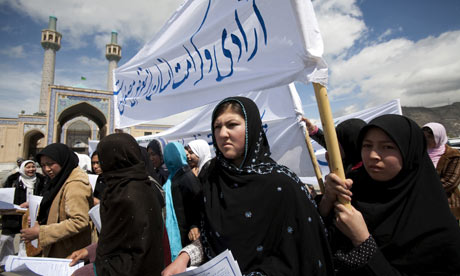
Afghanistan women outraged at proposed family planning law

By Janine di Giovanni


Afghan women protest at the proposed new family law Photograph: Robert Nickelsberg/Getty Images

A few days after the Taliban were toppled in 2001 I was in Kabul. The city was jubilant and full of hope for the future, and I remember talking to some laughing teenage girls in the street. One was excited because she could now go back to school. Another sang terrible disco songs and showed me dance steps she had been practising for five years in secret. A third debated whether to take off her burka. “Is it safe enough yet?” she asked me. “For five years, I lived inside this prison.”

Eight years later I returned, but the Afghanistan I found was far from jubilant. Despite the money poured into reconstruction and development, it is one of the five poorest countries in the world.

There is 40% unemployment – nearly 80% in some parts of the country. A third of children under five are malnourished. Life expectancy is 43 – and it is one of only three countries in the world where women die earlier than men.

I arrived to meet women before the presidential elections next month and to talk about a new law, which if brought in, could have drastic repercussions for women. The Shia Family Planning law was signed last March by President Hamid Karzai in an attempt, many believe, to appease powerful mullahs. The Afghan constitution allows Shias to have a separate family law from the Sunni majority based on traditional Shia jurisprudence, and some think the law is linked to the August elections and the Shia electorate who would have to abide by it (they could form up to 20% of the electorate).

The proposed law led to furious protests from women’s groups. It sanctioned marital rape and brought back Taliban-era restrictions on women by outlining when a woman could leave her house and the circumstances in which she has to have sex with her husband; Shia woman would be allowed to leave home alone “for a legitimate purpose” only which the law does not define, and could refuse sex with their husbands only when ill or menstruating.

Following international outrage, Karzai backtracked and said the law would be reviewed. This month it was amended and re-signed by the president, but has not yet been ratified by parliament. Human rights groups say it is unclear how much the amendments have done to improve the law. And the law has already achieved its aim – instilling fear and insecurity among an already traumatised female population.

Soraya Sobhrang, a human rights activist I meet in her Kabul office, says, “The law will affect all women if it goes through. It opens the door for other repressive laws to be passed, for Sunni Muslims as well as Shia.” A young doctor friend, Najeeb Shawal, says he is seeing more female patients who were depressed since news of the law emerged. “They have the kind of hopelessness that comes with knowing your life is incredibly repressed. And might become more so.”

On Mothers’ Day, I had sat with Seema Ghani in her home as she blew out candles on a small walnut cake. Her seven adopted children surrounded her – six girls and a boy – dancing, practising judo and lighting sparklers. “Dear Mother,” Seema read above the din from a card her children made. “We hope you are happy! Love from your children.”

Guardian for more

Calcott says Ottawa warned Prague of move

Ambassador: Restrictions are due to immigration policy, not Czech domestic affairs

By Tom Clifford

The Canadian ambassador to the Czech Republic dismissed accusations that officials in Prague had not been given adequate notice of Ottawa’s decision to reintroduce visas for Czech citizens.

“Jason Kenney, the immigration minister, came to Prague June 28. Part of the reason for the trip was to attend the Holocaust Era Assets conference,” Ambassador Michael Calcott said. “But another reason for the trip was to meet senior Czech politicians and tell them in person about Canada’s decision. He felt it was important, considering the issue, to tell them face to face.”

Czech officials expressed surprise at Canada’s reintroduction of visas July 14, stating that they were working on immigration arrangements, such as stricter airport controls, that would satisfy Canada.

There has been a sharp increase in asylum seekers from the Czech Republic since Canada scrapped visa requirements two years ago.
In 2006, five Czech Roma sought asylum in Canada while the total crossed 3,000 since the abolition of visas in 2007.

In the first half of this year, there were 1,720 refugee claims from Czechs in Canada, double the number from last year.

“This is a huge issue in Canada,” Calcott said. “The sharp rise in asylum seekers puts a huge strain on local authorities especially in Toronto and Hamilton, but in other areas as well, regarding social welfare, housing and also the taxpayers.”

Many in the Czech Republic were cynical about the timing of the announcement, coming just weeks after the Czech presidency of the EU and before a general election in October with a caretaker government currently in office.

But Calcott was quick to rebuke claims that the announcement’s timing had more to do with Czech domestic affairs than Canadian immigration concerns.

“We told them in June about our decision, and we simply could not wait until October. We are getting 200 families a week seeking asylum; we could not delay the decision any longer.”

A point of contention remains the fact that visa seekers cannot process their documents at the Prague embassy.

Instead, Czech citizens requiring visas to travel to Canada must go through the Vienna embassy.

“This is due to financial constraints and manpower. Besides, we operate a ‘hub’ system that means that one embassy will sort out visas for a number of countries. Czech citizens do not have to travel to Vienna. They can, and, if they do, their visas should be sorted out within a day. But, if they apply by post, it should only take about three working days to get the visa processed in Austria.”

Prague Post for more