Sudan protesters back woman facing indecency trial

KHARTOUM, Aug 4 ) – Dozens of protesters rallied outside a Khartoum court on Tuesday in support of a Sudanese woman facing 40 lashes for wearing trousers in public, a case that has become a public test of Sudan’s indecency laws.

Lubna Hussein, a former journalist and U.N. press officer, was arrested with 12 other women during a party at a Khartoumrestaurant in early July and charged with committing an indecent act.

Women’s groups have complained that the law gives no clear definition of indecent dress, leaving the decision of whether to arrest a women up to individual police officers.

Ululating women outside the courtroom carried banners and headbands with the message ”No return to the dark ages” and shouted slogans against laws which ban dress deemed indecent.
Speaking after the hearing, Hussein said the judge had adjourned her case until Sept. 7.

”They want to check with the U.N. whether I have immunity from prosecution. I don’t know why they are doing this because I have already resigned from the United Nations. I think they just want to delay the case,” she told Reuters.

Riot police advanced towards the crowd, beating their shields with batons, to try to disperse them. One officer fired what appeared to be blank rounds into the air, a Reuters witness said.

”We are against this law. It is against women, against Islam and against human rights,” said Zainab Badradin, one of the women in the crowd.

Indecency cases are not uncommon in Sudan, where there is a large cultural gap between the mostly Muslim and Arab-oriented north and the mainly Christian south.
Hussein has attracted attention by publicising her case, posing for photos in her loose green trousers and inviting journalists to campaign against dress codes sporadically imposed in the capital.

Her case has attracted widespread support among women’s groups in Khartoum, but there were also men among Tuesday’s protesters.
”Her main argument is that her clothes are decent and that she did not break the law,” defence lawyer Nabil Adib Abdalla told Reuters shortly before the hearing.

FT for more

(Submitted by reader)

The Land Weaver — a poignant play on farmer suicides

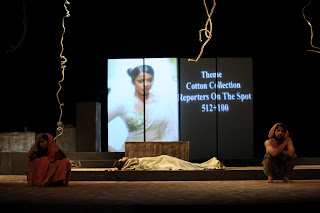
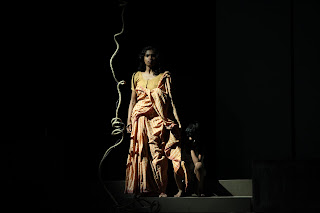
Two scenes from the play The Land Weaver, directed by Gagandeep, National School of Drama, New Delhi

A few weeks back a young girl from the National School of Drama came to meet me. Gagandeep, a 3rd year student at the NSD, seemed to be very concerned about the spate of farmer suicides and wanted to understand the reasons behind the farm tragedy. She had of course done a lot of research, and I found she had the grip over the reasons behind the terrible crisis that afflicts Indian agriculture. She told me that as part of the student’s diploma production, she was planning to stage a play on the agrarian crisis.

Yesterday, I had gone to see the play, titled: The Land Weaver. I must say that I was moved by the way Gagandeep, who has conceptualised and directed the play, had captured the essence of the crisis. Opening to a packed house, and moving from an outside location where we find a farmer perched on a tree not wanting to come down because he has no money. When a lady asks her as to why he is not coming down, he first wants to know whether she has come from a bank or from a foreign company.

I think the underlying message was very well spelled out at the very beginning.

The scene then moves into the auditorium, where we first encounter a farmer’s body hanging. The body is lowered and then begins the second part of the play that takes us through several stages of agricultural development, and also brings out clearly and loudly a whole gamut of issues that plague farming. As Gagandeep says in the brochure that was circulated: “the play is not mourning on their (farmers) death but a realization of truth; a piercing truth which we all should face to be a responsible citizen of this country.”

Sitting through the entire presentation, it looked as if I was revisiting the famer suicides issues through a maze of some of the most critical dimensions that the farmers are faced with. The presentation was also in such a manner that more than one aspect was at a time being addressed or focused on. This simultaneous approach provided the audience a unique prism to view the crisis as it is unfolding. The focus was on hybrid seeds, chemical pesticides, delayed monsoon rains, increasing indebtedness, exploitation by money-lenders and banks, sexual exploitation of the farm widows, and of course increasing rural to urban migration. I must say that I was impressed by the way Gagandeep had actually grasped the critical areas of the agrarian crisis, and presented these in a gripping and easy flowing manner.

Monsanto came in for a lot of flak. I found it very amusing the way Monsanto executives, dressed in black tie and suits, presented the annual production figures and profits (like they do in AGMs). The claims that Monsanto makes normally for the ‘success’ of Bt cotton seeds, and its forthcoming Golden Rice varieties, were all presented. And finally the audience was told, and that was amusing too, to ‘collect’ a sample of the Golden Rice seeds as they leave the hall. It was also in a way provoking to hear the sutradhar of the play tell us that farmers are so unimaginative — they only know two ways to kill themselves: drink pesticides or hang themselves from a tree. Food for thought, I think.

The media bias against farmer suicides in particular and the agrarian crisis in general also came in for a lot of drubbing, and rightly so. Over 500 journalists covering the Lakme Fashion Week, while only 4-5 turn up when cotton farmers commit suicide in the nighbourhood, did depict the realities under which the media operates and manipulates the real issues confronting the nation. And finally, we see how the land weaver is happily entrenched in his new home in the urban centres. Working as a taxi driver, he is happy that he left the village and migrated. He can now look forward to realising his dreams, and he wants his son to be better educated and certainly not be a farmer. And his wife adds in broken English, not a driver too.

Devinder Blog spot

US’s $1bn Islamabad home is its castle

By Syed Saleem Shahzad

ISLAMABAD – The ambitious US$1 billion plan of the United States to expand its presence in Pakistan’s capital city of Islamabad underscores Washington’s resolve to consolidate its presence in the region, particularly in pursuit of the endgame in the “war on terror”.

This marks the beginning of direct American handling of “war and peace” diplomacy in the region, following the forging of a seamless relationship between the Pakistani military establishment and the US military. (See Pakistan-US plan falls into place Asia Times Online, July 24, 2009.)

Standing in the way are Pakistan’s restive tribal areas and the seemingly never-ending – and escalating – Taliban-led insurgency in Afghanistan’s Pashtun provinces.
According to reports, the US will spend $405 million on the reconstruction and refurbishment of its main embassy building in the diplomatic enclave of the capital; $111 million for a new complex to accommodate 330 personnel; and $197 million to construct about 250 housing units.

For this purpose, the US Embassy has acquired about 7.2 hectares of land at what is widely considered a mark-down price of 1 billion rupees (US$12 million), courtesy of the state-run Capital Development Authority. A Turkish firm has already built a 153-room compound for the embassy.

The fortress-like embassy will eventually accommodate close to 1,000 additional personnel being sent to Islamabad as part of the US administration’s decision to significantly raise its profile in the country. The new staffers will augment the current 750-strong American contingent already based in Pakistan; this against a sanctioned strength of 350.

“What appears to be more alarming is that this staff surge will include 350 [US] marines. Additionally, the Americans are pressuring Islamabad to allow the import of hundreds of Dyncorp armored personnel carriers,” reported Pakistan’s largest English-language daily Dawn.

Asia Times for more

Chinese factory poisons hundreds

Hundreds of residents near a Chinese chemical plant have been found to have high levels of a dangerous metal in their bodies, after a series of leaks.

Thirty-three of them were admitted to hospitals in Hunan province over the weekend with cadmium poisoning, the official Xinhua news agency reported.

Production at the Changsha Xianghe plant in Liuyang stopped earlier this year, shortly before two people died.

Cadmium can damage the liver, kidneys, lungs, nervous system and brain.

Compounds containing the highly toxic metal, which is used in batteries, are also carcinogenic.

Officials suspended

Medical tests were carried out on nearly 3,000 residents of Zhentou township over the weekend following a protest on Thursday, involving about 1,000 people.

BBC for more

Israeli police evict Palestinian families from Occupied Jerusalem


Peace index puts Israel at 141 out of 144

By Sonja Karkar


Hardly a peaceful way to run a state. Zionist spin carefully avoids any mention of Israel’s slow and deliberate ethnic cleansing of the Palestinians from their own land. A man sits amongst his belongings after he was forcibly removed from his home in East Jerusalem – a cruel and devastating experience that threatens many more Palestinian families in the weeks to come.

Contrary to what Zionist spin wants us to believe, Israel is not a country in which people can live in peace. According to the peace index, Israel was even outranked by Sudan, Zimbabwe, Lebanon, North Korea and Iran. Only Iraq, Afghanistan and Somalia are worse. And what is happening in Israel right now – the forcible eviction of Palestinian families from Jerusalem – is evidence of Israel’s plummeting descent into an apartheid state. After all, how many of us could imagine the state evicting us out of our homes so
that an imported group of people can take them over? Read about the evictions and this survey on our website under Latest Palestine News http:www.australiansforpalestine.com

You will find too Dr Salim Nazzal’s reminder about the dangers of division in the struggle for Palestinian liberation which comes just as Palestinian leaders convene for the first time since 1989 in Bethlehem for the Fateh Congress.

Australian readers may be shocked to learn that Australian billionaire Joe Gutnik, a former president of the Melbourne Football Club has been pouring millions of dollars into criminal settlement expansion in the Hebron area of Palestine, land illegally occupied by Israel and run by the extremist Jewish Kach party.

Also, check out the Global Initiatives section where you will find what others are doing for Palestine around the world and how you can help.

All this and much more on our website http://www.australiansforpalestine.com

– the latest breaking news, articles, activism, educational material,
events, reports. In the weeks ahead, even more information will be added to help Palestine supporters keep abreast of all the rapid developments as the global movement for Palestine ignites people’s imaginations.

Israel evicts two Palestinian families – 2 Aug 09

(Article and video submitted by Ingrid B. Mork)

A Canadian doctor diagnoses U.S. healthcare

The caricature of ‘socialized medicine’ is used by corporate interests to confuse Americans and maintain their bottom lines instead of patients’ health.

By Michael M. Rachlis

Universal health insurance is on the American policy agenda for the fifth time since World War II. In the 1960s, the U.S. chose public coverage for only the elderly and the very poor, while Canada opted for a universal program for hospitals and physicians’ services. As a policy analyst, I know there are lessons to be learned from studying the effect of different approaches in similar jurisdictions. But, as a Canadian with lots of American friends and relatives, I am saddened that Americans seem incapable of learning them.

Our countries are joined at the hip. We peacefully share a continent, a British heritage of representative government and now ownership of GM. And, until 50 years ago, we had similar health systems, healthcare costs and vital statistics.

The U.S.’ and Canada’s different health insurance decisions make up the world’s largest health policy experiment. And the results?

On coverage, all Canadians have insurance for hospital and physician services. There are no deductibles or co-pays. Most provinces also provide coverage for programs for home care, long-term care, pharmaceuticals and durable medical equipment, although there are co-pays.

On the U.S. side, 46 million people have no insurance, millions are underinsured and healthcare bills bankrupt more than 1 million Americans every year.
Lesson No. 1: A single-payer system would eliminate most U.S. coverage problems.

On costs, Canada spends 10% of its economy on healthcare; the U.S. spends 16%. The extra 6% of GDP amounts to more than $800 billion per year. The spending gap between the two nations is almost entirely because of higher overhead. Canadians don’t need thousands of actuaries to set premiums or thousands of lawyers to deny care. Even the U.S. Medicare program has 80% to 90% lower administrative costs than private Medicare Advantage policies. And providers and suppliers can’t charge as much when they have to deal with a single payer.

Lessons No. 2 and 3: Single-payer systems reduce duplicative administrative costs and can negotiate lower prices.

Because most of the difference in spending is for non-patient care, Canadians actually get more of most services. We see the doctor more often and take more drugs. We even have more lung transplant surgery. We do get less heart surgery, but not so much less that we are any more likely to die of heart attacks. And we now live nearly three years longer, and our infant mortality is 20% lower.

LA Times for more
(Submitted by reader)

Indian Feminism and Sexual Discourse

By Sarojini Sahoo

1901
She was born into a Christian family in Bastar (now Chhatisgarh) in 1901 when her father, a doctor by profession, stayed away in Burma (now Myanmar). Later she studied medicine at Cuttack Medical School where she earned her LMP (the degree for Medical Practitioner during British Colonial times) in 1921 and started her career as the superintendent of the Cuttack Red Cross. During this time, she got involved with a fatherly person and was caught red handed by his wife. They had physical relations, but her lover cum mentor wholeheartedly wished her marriage with a suitable person.

The period between 1921 and 1927 was also a productive phase of her literary life. She wrote several volumes of poems like Anjali and Archana, and novels on social issues like Bharati and Parasmani in Oriya. Through her writing, she protested against purdah, child marriage, caste system, untouchability, discrimination against women. And she advocated women’s rights, steps towards their empowerment, and widow remarriage.

While working with Red Cross and also while in a relationship with her mentor lover, she got herself involved with a barefoot doctor and imposter who settled in Delhi. Her mentor was against her marriage with that unknown person, but she resigned from her service and became an Aryasamajis. She got married to that stranger and left for Delhi and opened a clinic in Chandinichowk.

She began to write in Hindi while continuing her writing in Oriya. She came out with a volume of Hindi poems entitled Baramala. She also became an influential editor of several Hindi periodicals such as Mahabir, Jeevan and Nari Bharati. Kuntala Kumari was invited to deliver the convocation addresses at Allahabad University and at Benaras Hindu University. That was a mark of rare recognition accorded to a woman of those days.

But her marital life was not happy and her husband exploited her as a source of income to which she wanted to resist. She died at only her 37 years of age with illness and mental trauma. Eminent Hindi novelist Jainendra Kumar’s novel Kalyani was based on her struggle and her pathetic life.

She was Kuntala Kumari Sabat, the veteran feminist poetess and writer of Oriya Literature. Though her pre- and post-marital life were not so peaceful and her life was dangling between love, sex, oppression, and harassment by the male-dominated mentality of feudal India, we never find any sexual agony or find any of her own saga of life in her poems, rather than she always tried to hide her sexual expression with a coated version of mysticism in the form of Sufi ideology. This trend was prevailed for many years and even after few decades in the beginning of post colonial. where era we can see the poetess expressed their love feelings as a form of Bhakti poems.

1914
In 1930, a Romanian young boy met a 16-year-old Indian girl and both fell in love. The boy had come to India to study Indian Philosophy and the girl was his teacher’s daughter. They couldn’t hide this affair and were soon caught by the mentor. The boy was asked to leave the mentor’s residence and never to contact the girl again.
Later, the boy became a world famous philosopher and wrote a semi-autobiographical novel first published in Romania in 1933. It was written specifically for a literary prize and sold very well in Romania, garnering both fame and money. The novel was translated into Italian in 1945, into German in 1948, into French in 1950, and into Spanish in 1952.

The girl was married at the age of twenty and had two children. She engaged herself in writing and published volumes of poetry and prose, wrote many books on Tagore, but was not famous until 1974.
However, the girl was not aware of that Romanian novel until she heard about it from her father who had visited Europe in 1938 or 1939. She also came to know that the book was also dedicated to her. But it was not until 1972, when a close Romanian friend of the author came to Kolkata, and she finally understood that the author had described a sexual relationship between them in his book. She subsequently had a friend who translated the novel for her from the French and she was shaken by his depictions. In 1973, when she went to America to attend a seminar on Tagore. She met the author again after 43 years and talked personally to him. She also warned the him that she would sue if his book ever came out in English. The author assured her that he wouldn’t publish the English version of his novel. But perhaps she didn’t believe the author and she herself couldn’t check her agony — the agony of her love being misrepresented. So she wrote a novel.

Later after her death, in 1974, the University of Chicago Press published the English translation of both the Romanian and Indian novels both as companion volumes depicting two sides of a romance. In her novel, she wanted to paint how an Indian girl fell in love with a western boy, depicting the whole thing as being more concerned with emotion rather than to physical co adherence.
The Romanian author was Mircea Eliade and the Indian girl was Maitreyi Devi. The English translation of the Romanian novel is entitled The Bengal Nights while the English translation of the Indian novel is entitled It Does Not Die.

1919
After six years of dating incidents of Maiytreyi, a young poetess of Punjab married an editor of a literary magazine to whom she was engaged in early childhood and changed her name. Later she became the author of 70 works, which included novels, short stories, and poems. She was elected a fellow of the Sahitya Akadmi, in India, as one of the 21 immortals of literature. She was honored with the Padma Vibhushan, the Jnanpith Award and the Padma Shree. She also received three D Lit degrees from Delhi, Jabalpur, and Vishva Bharti Universities.

She was born in 1919 in Gujranwala, now in Pakistan, the only child of a school teacher, a poet and an editor of a literary journal. When she was 40 years old, she got herself involved with an Urdu poet and left her husband, but that Urdu poet did not prepare to marry her as he had a new woman in his life. Later, she became involved with another painter and lived the last 40 years of her life with that artist, who also designed most of her book covers. For the rest of her life, she maintained her two lovers with equal potency of love and without any confrontation.

The author was Amrita Pritam, who died on October 31, 2005 and her two lovers were Imroz and Sahir Ludhianvi. Penguin India has published a book entitled Amrita-Imroz: A Love Story (ISBN: 0143100440) by Uma Trilok.

1934
In 1934, after four years of romance of Maitreyi-Eliade, a Keralite girl was born and spent her childhood in that city. She began writing at the age of 17 in both Malayalam and English. At the age of 15, she got married to a man 15 years elder to her and their first son was born after only one year of their marriage.

In her writing, she soon got involved in controversy as her writings were a type of confession where she did not hide her sufferings and her traumas that started from her teenage years and then went on and on. She was the first woman writer to write and discuss about her sexual desires in her writings. She did not hide in her writings either her lesbian relationships or her husband’s homosexual tendencies, nor did she hide her extra-marital relationships. But strangely enough, her husband always supported her writings.

In Chapter 27 of her most discussed and controversial autobiographical book My Story , she writes, “During my nervous breakdown, there developed between myself and my husband an intimacy which was purely physical … after bathing me in warm water and dressing me in men’s clothes, my husband bade me sit on his lap, fondling me and calling me his little darling boy….I was by nature shy… but during my illness, I shed my shyness and for the first time in my life learned to surrender totally in bed with my pride intact and blazing.”

Though in numerous interviews, she praised her husband for showing his support for her writings, in her book My Story, she told that her husband supported her writings because her writings were a source of income for him. However, her husband died after a long illness. She later tried her luck in politics and failed.

At the age of 65, she converted herself to Muslim to marry a young man. After converting herself to Islam, she argued that Purdah in Islam is the most wonderful dress for women in the world. And she had always loved to wear the purdah as it gives women a sense of security. Only Islam gives protection to women. About her conversion to Islam, she told that she had been lonely all through her life. At night, she used to sleep by embracing a pillow. But she was no longer a loner. Islam was her company. According to her, Islam is the only religion in the world that gives love and protection to women. But in 2006, she issued a statement at a book release ceremony organized by Kairali Books in Kochi that she deeply regretted converting to Islam and was disillusioned with the treacherous behavior of her Muslim friends. She claimed that all her wealth amounting to several lakhs, gold ornaments, books and other valuables had been looted by Muslims.

She was Kamala Das or Madhavikutty or Kamala Surraiyah. She had been shortlisted for the Nobel Prize for literature in 1984 along with Marguerite Yourcenar, Doris Lessing, and Nadine Gordimer. Apart from that, she received many awards for her literary contributions like the Asian Poetry Prize, Kent Award for English Writing from Asian Countries, Asian World Prize, Sahitya Academy Award and Kerala Sahitya Academy Award etc. She passed away on 31 May 2009 in Pune at the age of 75.

The Role of Sexuality From a Colonial Perspective
These four feminist writers of the last century, opposite to each other’s character, tried to raise women’s voices, which apparently may seem very contradictory, confusing and even delineating different values for feminine aspects. Following the work these feminists, anyone can argue that womanhood is, as a whole, a paradigmatic myth, which incorporates multiple myths of the woman in a mystic form. We have no way to oppose this parenthesis. But as a female (please note that I am not saying the word ‘feminist’), I can feel every situation was true for me if any day I would be either Maitreyi or Kamala or Amrita or Kuntala. It is a very vague argument why Maitreyi was not like Kamala or Amrita was not like Kuntala. Maitryi could admit her relationship with Eliade as Kamala did. Why didn’t Amrita bore all her pathos as Kuntala did? These are vague arguments.

I think the transformation of a woman’s heart from Kuntala to Kamala must be possible due to the development of feminism in India. The reason and development of feminism in India is different from that of the Western world. The pre-colonial social structure and the role of women reveal in them was theorised into feminism. It was more a social than any individual matter. Female mass was considered equal to male mass but the status of the individual female body remained as puritan as it was in feudalistic patriarchal society. In pre-colonial India, we see that plural marriage was allowed for males and even we find our male intellectuals, writers, politicians were able to get married to another woman in the case of the death of their first wife.
It is also ironically true that the female mortality rate was considerably higher in comparison with males due to lack of proper nutrition. But we never find a single instance of any woman remarrying after became a widow in those days, though the marriage of widows was legalized from the early days of British rule.

Women were taught to act as a goddess of sacrifice and as Simone told us in her The Second Sex, the women were trapped into an impossible ideal (the myth of the mother, the virgin, the motherland, nature, etc) by denying the individuality and situation of all different kinds of women. So we find when our pre-colonial feminists used to write essays, they often chose the titles like “Women’s Duty for Household” or “The Legendary Female Figures in Indian Myths,” where the patriarchal tone was still there. So an attempt to reconstruct Indian womanhood as the essence of Indian Culture through the Nationalist movement could be seen where the individual feminism was deliberately denied. Kuntala and Maitreyi were products of these pre-colonial societies.

The largest and the most mainstream women’s organisation in India at this time was the All-India Women’s Conference. A wing of Indian National Congress, it was founded in 1927, was many-layered, and always attempted to reflect the regional diversity of the movement. Within one year of Maitreyi- Elliad’s meeting at Kolkata, the Indian National Congress passed the Karachi Resolution in 1931 where ‘swaraj’ or ‘self rule’ in free India was declared, but the gender issue was still marginalised as evidenced by the fact that only one of the resolutions expressly mentions protecting women’s rights (as part of workers’ rights).

Undoubtedly, post-colonial India was different from that of pre-colonial India and women’s education was flourishing. And the age-old binaries that had characterised dominant philosophical and political thinking on gender were reconstructed with an array of oppressive patriarchal family structures: age, ordinal status, relationship to men through family of origin, marriage, and procreation, as well as patriarchal attributes: dowry, siring sons, etc., kinship, caste, community, village, market, and the state were put into questionable range. Along with these questions, ‘rights of women’s bodies’ are also seen as antithetical to these patriarchal milieus.

I have to write this article in support of Kamala Das or Amrita Pritam because some of our scholars always try to carve a separate identity for sexuality other than feminism. They define feminism in order to avoid the uncritically following as the protest for male hegemony and in their conception; sexuality has no role to protest such hegemony. If feminist writing during twentieth century colonial India was characterised by societal hierarchies and a need to demarcate an Indian identity, feminist debates in post-colonial India dealt with ways in which feminist sexualities were practiced. This is why the whole country mourns the demise of Amrita and Kamala.

Sarojini Sahoo Blog for more

Do Muslim Women Really Need Saving?

Anthropological Reflections on Cultural Relativism and Its Others

By LILA ABU-LUGHOD (American Anthropologist)

Ethics Forum: September 11 and Ethnographic Responsibility

ABSTRACT This article explores the ethics of the current “War on Terrorism, asking whether anthropology, the discipline devoted to understanding and dealing with cultural difference, can provide us with critical purchase on the justifications made for American intervention in Afghanistan in terms of liberating, or saving, Afghan women. I look first at the dangers of reifying culture, apparent in the tendencies to plaster neat cultural icons like the Muslim woman over messy historical and political dynamics. Then, calling attention to the resonances of contemporary discourses on equality, freedom, and rights with earlier colonial and missionary rhetoric on Muslim women, I argue that we need to develop, instead, a serious appreciation of differences among women in the world—as products of different histories, expressions of different circumstances, and manifestations of differently structured desires. Further, I argue that rather than seeking to “save” others (with the superiority it implies and the violences it would entail) we might better think in terms of (1) working with them in situations that we recognize as always subject to historical transformation and (2) considering our own larger responsibilities to address the forms of global injustice that are powerful shapers of the worlds in which they find themselves. I develop many of these arguments about the limits of “cultural relativism” through a consideration of the burqa and the many meanings of veiling in the Muslim world. [Keywords: cultural relativism, Muslim women, Afghanistan war, freedom, global injustice, colonialism]

WHAT ARE THE ETHICS of the current “War on Terrorism, a war that justifies itself by purporting to liberate, or save, Afghan women? Does anthropology have anything to offer in our search for a viable position to take regarding this rationale for war?

I was led to pose the question of my title in part because of the way I personally experienced the response to the U.S. war in Afghanistan. Like many colleagues whose work has focused on women and gender in the Middle East, I was deluged with invitations to speak—not just on news programs but also to various departments at colleges and universities, especially women’s studies programs. Why did this not please me, a scholar who has devoted more than 20 years of her life to this subject and who has some complicated personal connection to this identity? Here was an opportunity to spread the word, disseminate my knowledge, and correct misunderstandings. The urgent search for knowledge about our sister “women of cover” (as President George Bush so marvelously called them) is laudable and when it comes from women’s studies programs where “transnational feminism” is now being taken seriously, it has a certain integrity (see Safire 2001).

My discomfort led me to reflect on why, as feminists in or from the West, or simply as people who have concerns about women’s lives, we need to be wary of this response to the events and aftermath of September 11, 2001, 1 want to point out the minefields—a metaphor that is sadly too apt for a country like Afghanistan, with the world’s highest number of mines per capita—of this obsession with the plight of Muslim women, 1 hope to show some way through them using insights from anthropology, the discipline whose charge has been to understand and manage cultural difference. At the same time, I want to remain critical of anthropology’s complicity in the reification of cultural difference.


American Anthropologist
for more

Govt set to investigate the plight of Ugandan girls in Iraq

By Eve Masho

After weeks without the Ministry of Foreign Affairs pronouncing itself on what it was going to do for the nine Uganda girls, who were allegedly lured into slavery in Iraq, a top official has said investigations are underway.

Ambassador James Mugume told Sunday Monitor on Thursday that they are working with Uganda’s embassy in Saudi Arabia to recover the girls’ passports. “The government has decided to cooperate with the Saudi Arabian Mission to assist in carrying out all the necessary investigations concerning the alleged withdrawal of passports from the Ugandan girls who are stuck in Iraq,” said Ambassador Mugume.

The passports are still under Iraq’s authorities and it’s not clear where the passports are. This is dangerous because in the past criminals have used lost passports to carry out their fraudulent activities. A terrorist was recently arrested in the UK in connection with the same activities.

There is surprising general lack of information and interest of these people at the Immigration office in Kampala.
When contacted on Thursday, the Immigration Office publicist said their brief doesn’t include this. “Our mandate was to facilitate their travel. However the proper authority to handle this situation is the Foreign Affairs Ministry,” said Ms Eunice Kisembo.

The girls allege that a Kampala businesswoman, who owns the Uganda Veterans Development Limited, took them to Iraq to work as house helpers. A guard, who works in Iraq, and wanted to remain anonymous confirmed to Sunday Monitor last week that some girls were missing out of the forty that had arrived in Iraq.

The girls have been identified as Ms Shamim Namutebi, Ms Fatuma Ndagire, Ms Agnes Twesigye, Ms Brenda Nakanjako, Ms Amina Nakiwauka, Ms Saudah Kizito, Ms Hamidah Namatovu, Ms Razia Muhasa, Ms Zurah Nabukenya, Ms Jamila Musiime and Ms AineMbabazi.

The source, however, added: “The girls are currently detained at Siera Base in Baghdad and are under the hospice of US marines. The girls called me and told me that they have been tortured, sexually harassed and not been paid for the past six months by their Iraq bosses.”

In response to the above situation, the acting Charge d’Affaires, at the US Embassy in Kampala John Hoover, in an email to Sunday Monitor indicated that the nine women from Uganda presented themselves to the Coalition Forces in Iraq seeking temporary refuge and requesting assistance to be repatriated back to Uganda around July 4 to12.

Monitor for more

TANZANIA: Solutions to Dar’s Water Problems in the Pipeline

By George Mwita

DAR ES SALAAM, Aug 2 (IPS) – In the nine months since she moved to the Dar es Salaam neighbourhood of Kinondoni, Anna Christopher has only seen water running from her taps once.

Christopher, who works as a public servant, says finding water is a burden in this low-income area of Tanzania’s financial capital.

Like the majority of residents of Dar es Salaam, she has to buy water by the gallon from street vendors every day, paying 250 to 300 Tanzania shillings – equivalent to 18 to 22 U.S. cents – for each 20-litre container. And that’s on the days when water is available in the city at large; when there are shortages – and this happens frequently – prices shoot up to 500 Tshs per gallon.

“This has made it even harder for me, as I have to spend about 4000 Tshs ($3) a week on water only,” Christopher laments. With a gross income equivalent to 115 U.S. dollars a month and a long list of other bills to pay, she finds it a burden. Most Tanzanians must make ends meet on less than a third of here income: the United Nations Development Programme estimates average annual per capita income in the country as a whole is $390.

Unlike in rural areas, where women and girls go long distances to fetch water, here in the city it’s vendors who take it to each doorstep, either by handcarts or tankers. This indirectly provides employment for a fair number of people. Juma Jabu says he can make between 7 and 11 dollars a day selling water, depending on demand.

Upscale areas have problems of their own

In other parts of the city, like the middle-class area of Tabata Kimanga, residents usually get pipe-borne water once a week. This area is located on relatively high ground, which makes it difficult for the aging pumps to supply it with water from the Upper Ruvu treatment plant.

Many in Tabata Kimanga rely on water from shallow wells, mainly dug by independent companies, but this water is salty and unfit for consumption. There is fresh water deep below the ground, but it can only be tapped by heavy duty pumps.

Residents of this area say groundwater resources are not safe, because of the many pit latrines in the area, which may contaminate underground water and cause diseases like diarrhoea and dysentery. The concern with water quality extends to other areas of the city, since buyers don’t know where a street vendor has obtained the water being sold.

Surprisingly, there are places in the same city where water shortage is like new vocabulary in an old dictionary. Areas like Masaki, Sinza, Victoria and Mwenge, have long enjoyed running water all year round. But in recent years, water cutoffs have reached even these affluent neighbourhoods.

IPS news for more