
by LyNDIE CHIOU
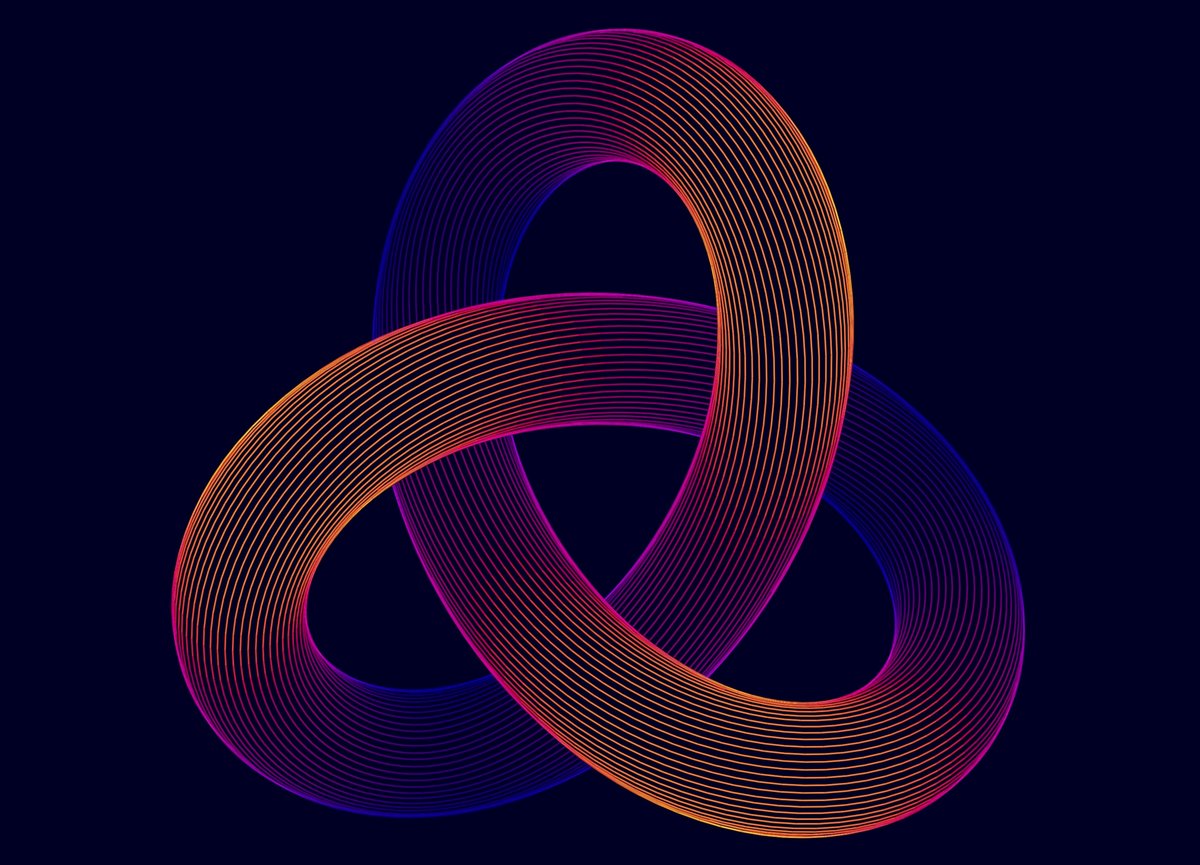
Knots show how to generate infinitely many formulas of a kind developed by the visionary genius
The legendary mathematician Srinivasa Ramanujan and Yifeng Huang, a postdoctoral researcher at Emory University, have something in common: they will not be ignored. In 1912 Ramanujan, a 24-year-old clerk at what was then the Madras Port Trust in India, began mailing pages of new, unproven formulas to mathematicians across England. One of his letters eventually reached British mathematician G. H. Hardy at the University of Cambridge, who recognized Ramanujan as a visionary, invited him to visit and helped launch his groundbreaking career.
More than a century later, Huang, while a graduate student at the University of Michigan, began e-mailing mathematicians letter after letter—more than 40 in total. He scarcely heard back.
Huang’s ideas concerned two formulas that appeared in Ramanujan’s letters and are now known as the Rogers-Ramanujan identities. In September 2026 Huang and a few collaborators uploaded a proof that the historic equations represent a single case of a much grander geometrical theory. In particular, the work showed that the Roger-Ramanujan identities correspond to a trefoil knot in a certain space. The trefoil, known as the shape of the familiar Celtic knot, is one of the simplest mathematical knots. And related knots, they found, reveal an infinite number of previously unknown identities.
“Everything about this subject, even the original discovery, is a surprise,” says George Andrews, a mathematician at Pennsylvania State University and an expert on Ramanujan’s math. Ramanujan, Hardy and their collaborators “were all unable to prove this,” he adds. “So the things that have cropped up from knot theory were a total surprise to me.”
The Roger-Ramanujan Identities
Hardy was responsible for shaping much of early 20th century number theory. Initially skeptical when he received a letter from Ramanujan, Hardy later wrote that he recognized the letter’s author as “a mathematician of the highest quality, a man of altogether exceptional originality and power.” It was a pivotal moment.
Two of Ramanujan’s formulas were startling: they represented an infinite series of sums on one side and an infinite series of products on the other, with no visible reason for the two to agree. By 1916 British mathematician Percy MacMahon had found a way to read them. These two equations were similar to ones studied two centuries earlier by mathematician Leonhard Euler. Euler had a neat trick for sidestepping such complexity: he connected the equations to a type of counting problem known as a “partition.” A partition of a number is a way of writing it as a sum. MacMahon transformed Ramanujan’s formulas into two kinds of partitions that looked nothing alike, but whose counts always came out identical.
Here’s how one side of a Ramanujan equation was partitioned: count the number of ways to sum up to a certain value using numbers that are at least two whole numbers apart. For instance, 6 can be written as 1 + 5, 2 + 4 and 6. So there are three partitions.
On the other side, sum using only numbers that end in 1, 4, 6 or 9. For 6, the answer is 1 + 1 + 1 + 1 + 1 + 1, 1 + 1 + 4 and 6, which also gives three partitions.
The formulas say these two very different counts agree for every number. Before Ramanujan could prove them, he came across an obscure proof by English mathematician Leonard James Rogers in an old math journal. Thus, the equations became known as the Rogers-Ramanujan identities.
“It was regarded, for most of the 20th century, as an isolated gem,” Andrews says. No one suspected it lay at the heart of a much larger theory.
In the early 1970s Andrews uncovered an infinite family of the identities. “I discovered them only to learn that [mathematician] Basil Gordon had done them first,” Andrews says, “which was a huge disappointment for me.”
The new family came to be known as the Andrews-Gordon identities.
Since then the identities have turned up in strange places: in representation theory, in the study of symmetric functions, even in physics via the “hard hexagon model,” which describes how gas atoms can settle onto a surface in a triangular pattern.
“Who would have thought that the Rogers-Ramanujan identities were related to how liquid helium behaves when poured onto a graphite plate?” Andrews says.
A Pinch to Build a Conjecture
Yifeng Huang had a hunch.
Matrices—little spreadsheets of numbers—can undergo operations such as flips and transpositions, which must be done in a certain order to get the correct result. But if the values of the matrices are chosen such that the order of operations doesn’t matter (meaning they “commute”), then the matrices behave like coordinates and can be used to describe curves. Take any smooth curve, such as the parabola y = x2, and replace y and x with pairs of matrices. A textbook-level problem might ask: How many pairs of matrices make the equation true? A math student can find the answer.
But what happens if you use a curve that isn’t so smooth—one that has a “pinch” in it, also known as a singularity? Now textbook theory breaks down. These matrix counts had neverbeen studied.
While he was still a Ph.D. student at the University of Michigan, Huang started counting matrices on pinched curves such as y2 = x3, which comes to a sharp tip when x and y equal 0. Before long, his counts reproduced a familiar formula: one side of the Rogers-Ramanujan identities. “Already this discovery is fascinating,” Huang says. “I’m wondering what is going on. It can’t be a coincidence.”
Scientific American for more