
by SYEDA SHAGUFE HOSSAIN
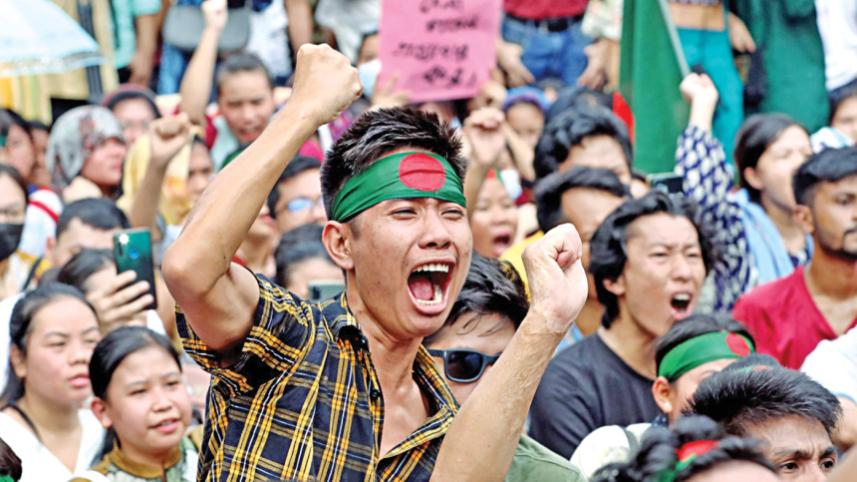
Just over a year after the historic July uprising that once again split Bangladesh into a before-and-after timeline, the country finds itself at a critical juncture where we ask ourselves, “Who are we?” This search for identity in a new Bangladesh feels urgent. Yet, in this national reimagining, another pressing question remains: whose histories will be remembered, and whose will be erased?
I was reminded of this tension while facilitating a session organised by Supporting People and Rebuilding Communities (SPaRC), where 24 youth from 16 Indigenous communities came together to explore questions of culture, belonging, and power. The experience forced me to confront the privileges of my own identity as a Bangalee Muslim woman that merits its own deeper delve, but maybe another time.
What stayed with me from that day and what I want to reflect on today is a moment that cut through the abstractions of dialogue and made the stakes of belonging painfully real—one that asks that I approach this topic with as much humility as I can muster, given the privilege I hold in relation to the identities I am about to discuss.
In one of the exercises, where participants were asked to present what culture is “ours” and what is “theirs,” a young Oraon man made the claim that nakshi kantha—the iconic embroidered quilt so often celebrated as “quintessentially Bangalee”—is indigenous to their community. Whether historically accurate or not, his assertion made me reflect on how the cultural fabric of Bangladesh is not uniform but rather stitched together from multiple threads, some of which have been systematically denied, an erasure that can be both cultural and material. Later that night, Coke Studio Bangla released its now-controversial song Baaji, further deepening my discomfort as discussions on cultural appropriation, tokenism, and the politics of representation emerged within activist communities.
The Oraon, Chakma, Marma, Santal, Garo, Mro, Bawm, and other Indigenous peoples carry histories older than this state. Their languages, rituals, and oral traditions have survived in the hills and plains, but in our national imagination, they are often rendered invisible, or reduced to a choreographed view comprising embroidery motifs, staged dances, or smiling faces in the tourism brochures. Culture becomes consumable for the masses while the real people disappear. The violence on lands and bodies is mirrored by the violence of forgetting.
According to a report published in The Daily Star, which quoted the Kapaeeng Foundation’s 2025 report, 295 individuals were impacted by 15 land-related incidents during the first seven months of this year. These incidents included a wide range of violations—from attempted land seizures and expansion of security camps to the occupation of 130 acres of Jhum and fruit plantations belonging to 39 families, and even the seizure of a Buddhist temple site following the felling of 300 trees. In the Hill Tracts, over 27 years after the Peace Accord, militarisation continues, and promises of land restitution remain unfulfilled. In 2024, the Parbatya Chattagram Jana Samhati Samiti (PCJSS) documented over 200 human rights violations in the Chittagong Hill Tracts affecting 6,055 Jumma people, including 21 deaths, 119 houses and shops burned or looted, and 2,314 acres of land forcibly occupied, confirming that dispossession and violence remain disturbingly routine.
The daily Star for more