
TRICONTINENTAL
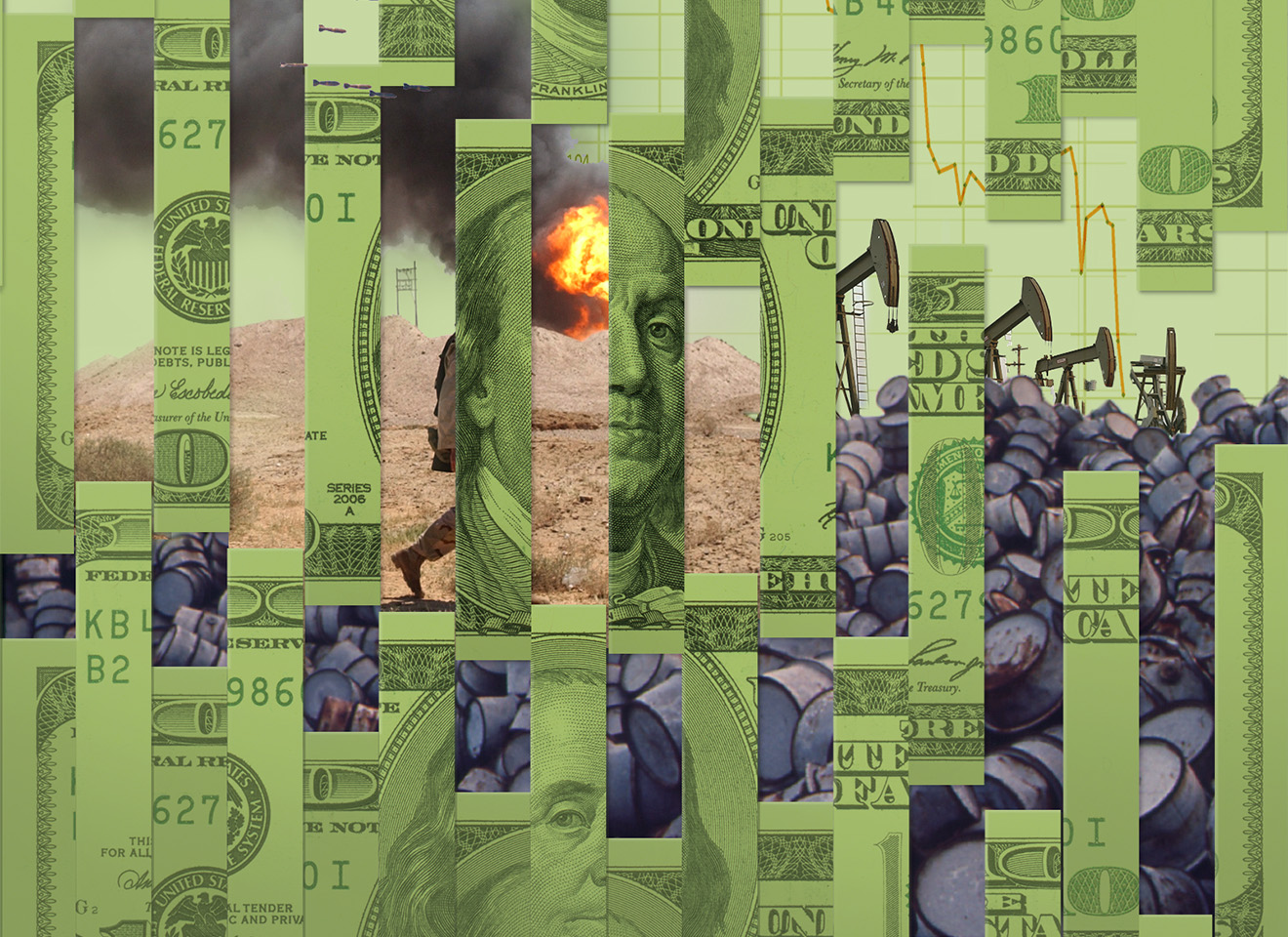
The role of the dollar as the principal currency of exchange in world trade grants the United States exorbitant power. This dossier examines the rise of this currency, the mechanisms of its domination, and the structural limits to building an alternative to the dollar.
In a capitalist society, money performs an essential function. It is the material representation of an immaterial social relation: value, which is established through the labour of millions of people across the world. Money serves as a means of exchange, a unit of account, and a way of storing that value. Yet money is never neutral. When a specific national currency transcends its borders to become a world currency, it becomes a powerful instrument of hegemony, discipline, and imperial power.
The history of the last two hundred years is the history of the rise and contestation of two such key currencies: the British pound sterling in the nineteenth century, and, far more expansively, the US dollar from the twentieth century to the present.
The current global order, underpinned by the dollar, grants the United States what has appropriately been called an ‘exorbitant privilege’: the power to issue the currency that the rest of the world needs as a store of value, means of payment, and unit of account.1 This allows the United States to finance its deficits, consume more than it produces, and project its military power simply because its public debt is treated as the safest asset on the planet. It also enables the United States to host the world’s most important financial market, shaping expectations that extend far beyond the financial sphere and influencing investment and production worldwide. In turn, these financial flows establish key conditions that determine the direction of global finance and limit the autonomy of dependent and subordinated countries.
National currencies exist within a hierarchy defined in relation to the dollar. For countries of the Global South, this architecture imposes a high cost. Their currencies are treated as volatile financial assets, and their economies are held hostage to the discipline imposed by international financial capital. The need to accumulate dollars as a defence against speculative attacks and to guarantee imports results in a perverse net transfer of wealth from the Global South to the Global North, particularly to investors and speculators in Western Europe and the United States. Given these structural features of contemporary capitalism, understanding the rise of the dollar, the mechanisms of its present domination, and the structural limits facing any alternative is therefore a central task for those who seek a more just and cooperative international order.
Money, Value, and the Need for a World Currency
In any society based on the division of labour and the exchange of commodities, money emerges as a practical necessity. When different producers specialise – one growing wheat, another making cloth, yet another extracting ore – they need to exchange their products with each other in order to meet their needs. But direct exchange, or barter, presents obvious difficulties: the farmer who wants cloth must find a weaver who at that same moment wants wheat, in the exact amount, and accepts the proposed exchange ratio.
Money solves this problem by functioning as a universal equivalent: a special commodity that everyone accepts in exchange for any other. With money, the farmer can sell wheat to any buyer, keep the value received, and later buy cloth from any seller. Money thus fulfils three basic functions: it serves as a means of circulation, facilitating exchange; a unit of account, allowing the value of different commodities to be compared; and a store of value, allowing wealth to be preserved for future use.
In Marxist analysis, money is not an arbitrary invention or a mere technical instrument. It is the material expression of a social relation called value. The value of a commodity corresponds to the socially necessary labour time required to produce it. When millions of independent producers exchange commodities on the market, they are, in practice, comparing quantities of human labour. Money is therefore the form through which that comparison becomes possible and visible. It represents social labour in condensed form.2
Within a single country, the use of money is relatively simple: there is a national currency, issued and guaranteed by the state, which all inhabitants recognise and accept. But what happens when producers in different countries want to trade with one another? Let us consider a concrete example. A Brazilian company exports coffee to Germany. The German importer has euros, while the Brazilian exporter needs reais to pay workers, suppliers, and taxes. How can these two currencies be reconciled? The problem unfolds on several levels. First, an exchange rate must be established: how many reais are equivalent to one euro? Second, there must be a mechanism to convert one currency into the other. Third, both parties must trust that the currency they receive will hold its value and be accepted by others.
When international trade was small-scale and sporadic, such problems could be resolved on a case-by-case basis, often with universally accepted precious metals such as gold and silver. But as the world market expanded, that solution became insufficient. As international trade grew, there emerged a need for an organised system to settle accounts between countries. It is not practical for each individual transaction to involve either the physical transfer of gold or the direct conversion of one currency into another. A clearing mechanism is needed. Imagine that, over a given period, Brazil exports US$100 million in coffee to Germany and imports US$80 million in machinery. Rather than making two separate transfers, the two amounts are offset against each other, and Germany only needs to transfer the net difference of US$20 million to Brazil. This is the principle of clearing.
For such a mechanism to work on a global scale, involving dozens of countries and currencies, a common reference point is required – a currency that everyone accepts as a unit of account and means of payment for settling balances. Historically, that role was first played by gold and later by the national currencies of economically dominant countries. The advantages associated with controlling the reference currency are anything but simple. They include:
- the possibility for the issuing state to expand its capacity for debt and spending disproportionately in relation to other national states;
- the use of the currency as an instrument of foreign policy and domination through control over key channels of international liquidity, as in the case of economic sanctions; and
- the advantages granted to the international operations of its banks, which, because they operate within a fractional reserve system backed by a currency that can be expanded, occupy a privileged position in the circuit of global high finance.
This gives rise to fundamental questions: who issues this reference currency? Through what mechanisms does it become dominant? What are the consequences when a country’s national currency is elevated to the status of a world currency?