
MICHAEL ALBERT interviewed by LUKE ALDEN
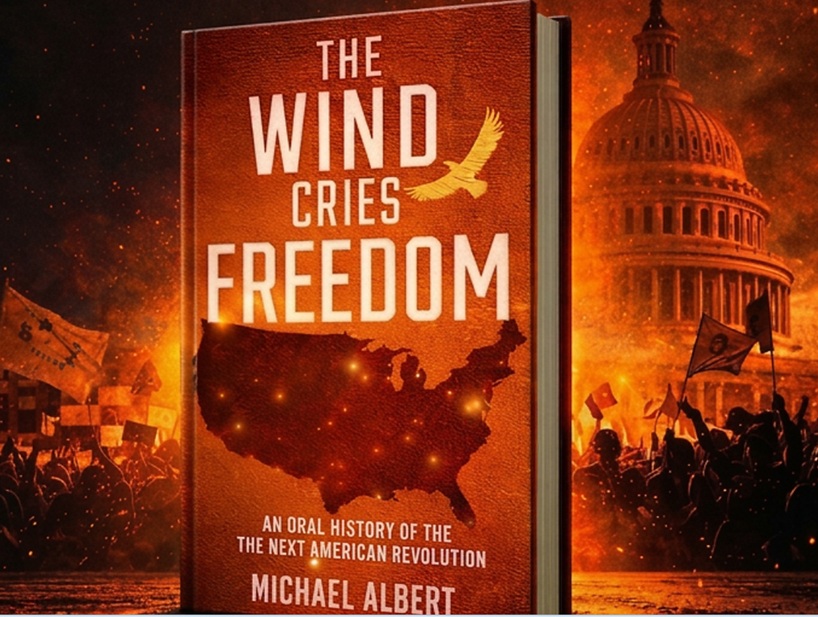
Is revolution a single event? Or is it a process? Perhaps a process made possible by the many gaining certain invaluable insights into their own conditions in relation to society’s reigning institutions, acting together on them, and staying collectively and strategically committed to positive transformation for the many.
But does it stop there? Does revolution have a final climax and termination where all is won? Should it always be, on the contrary, continuous renewal?
But is that even it? If revolution is not a quick, bloody power grab at the top of society, what does it mean for not only individuals but for core societal institutions at every level, from families, workplaces, communities, schools and universities, and the economy and governments?
How do we come to certain insights in the first place that allow us to carry out transformational progression? And how do groups of ordinary people make it happen?
Lastly, if substantial portions of populations find revolution is urgently needed at certain times, does this mean it is only appropriate at those times?
If past is a prologue of lessons, we should not at the same time allow ourselves to be bogged down by it. Past peoples’ lessons merit attention to the degree that they enable us to forge our own insights, individually and collectively. And to the extent that they appeal to a sense of our own capacity to act and our own recognition that we can radically alter not only ourselves and our communities, but also our societal institutions for the better.
Past or present lessons should be recognized as valuable when they reveal that doctrine and orthodoxy do not simply come from above but are all around us, indeed how we ourselves can become producers of it when we are not careful. And they are valuable when they evoke understanding as to why doctrine in itself is a roadblock to awareness and change.
Current writing should allow others to come to realize the need for serious change and how intrinsic features of current institutions stand in the way of that. It should also reveal that this is the case today as it was long before what we see in the news and in our own lives everyday – genocide, climate and ecological collapse, aggressive war, the threat of nuclear war, classism, fascism, authoritarianism, racism, sexism, exploitation, homophobia, transphobia, pandemics, unemployment, healthcare crisis, housing crisis, out of control cost of living, unseen levels of anxiety, crisis of time to think, pervasive absence of dignity and ubiquitous cynicism.
Michael Albert, along with Robin Hahnel, is the conceiver of participatory economics (Parecon), part of a broader participatory society vision,
and has been writing, acting and organizing on the basis of similar insights since the 1960s. With others he has developed a publishing house, alternative media networks and written over 20 books and countless articles evoking insight into vision, strategy, agency and much else. While he has previously written a screenplay and a memoir, this may be perhaps his most unique literary offering to date. A fictional oral history of the ways in which many near-future members of society see the need to come together over a period of decades in order to create revolutionary transformation. They reveal what equity, solidarity, dignity, diversity, justice and potential, among much else, could actually look like. And how difficult in the first place it would be to reveal what this looks like without certain insights making up a guiding vision, one put to practice through strategy.
As with the characters interviewed in the novel’s oral history, it is up to us to arrive at our own insights in our own way to see the need for a dramatic re-envisioning and reconfiguring of society’s institutions.
To that end, is it really fiction if insights apply not only to an imaginary future but to our own lives, potentials and visions? I interviewed Michael Albert with questions that arose for me while reading his recent book.
PROGRESS / REVOLUTION / TRANSITION TO A TRANSITION
Luke Alden: “The Wind Cries Freedom – An Oral History of the Next American Revolution” describes a near future of a vast and profound improvement in quality of life and reports its revolutionary process as it is taking place over the next few decades, subsequent to groundwork being laid today and over previous decades as well. Might we generally characterize some of the reasons to write this book now as a reaction to an analysis of our times or as an expression of the writer’s own values? Is it of any use to distinguish between the two? Or can the reasons be better characterized another way?
Michael Albert: I wrote it to try to provide reasoned hope in the possibility of movements winning massive, fundamental change starting now and extending into the future. So the book certainly reacts to our times, and indeed it begins with them. But mostly it proposes how these particular activists moved forward in their world. The distinction between their history and my own values is a little complicated. As I wrote the book, I understood myself to be conveying the views, feelings, actions, and life circumstances of the future interviewees. I was a conduit.
When a novelist writes about a character’s views, where the character might even be a serial killer, the novelist is certainly not solely presenting herself. The same holds here. The interviewer and interviewees have their own back stories and priorities sometimes different than mine. After all, there are nineteen of them, who I dreamed up while trying to simultaneously channel them. I like to think of the book as relaying a message from a possible future.
Why might a discussion around “revolution” be warranted, especially in our time? And if warranted, what does a revolution mean to you as the writer, or better, to those in the story who bring revolution into being in the future? How is revolution defined in the book that might distinguish it from conventional associations of the term?
The discussion is warranted because in our time we suffer not just some bad people or cruel choices, but horrible institutions that corrupt people and pervert choices. The word revolution doesn’t mean a big conflict, a dramatic quick transformation whether chaotic, tumultuous or whatever. The term “revolution” names any process that successfully replaces some or even all defining institutions in a society with new and fundamentally different defining institutions. And that is how the participants saw what they contributed to. The key thing wasn’t some particular tactic or clash, or even how many people participated, or how long they all struggled, or how fierce or difficult it got, but whether they did or did not successfully replace the institutions that defined one or more spheres of their social lives.
In what sense or context might “revolution” mean perpetual rebirth in the book – one “who isn’t busy being born is being dying” as Bob Dylan sang – and in what other sense or context might that definition not aptly apply?
I think the idea of being open to, welcoming, and intent on change in one’s personal beliefs as well as in society’s defining relations is perhaps the most succinct characterization of what it means to be personally revolutionary. To just do what one does, uncritically, to “let it be,” passively, and “to go along to get along,” is in some sense a kind of opposite approach. The extreme opposite is arguably to try to ward off everything that differs from past belief and practice. It is to try to reflexively defend rather than question not just society but oneself. Defensive, sectarian, are the watchword of “not busy being born.”
A revolutionary participant and economist, Andre Goldman, talked to journalist interviewer Miguel Guevara in a session with two other revolutionary activists Alexandra Hanslet and Malcom Mays, about what made him feel that change had actually occurred while considering cross-movement organizing among the myriad of ongoing campaigns, in particular a societal arms boycott, from his perspective inside universities. This took place in the context of a broader discussion on fighting to win and the collective realization that strategic and tactical choices had to focus not just on immediate gains but how these choices and gains could provide a basis for further gains. Goldman says in the book that seeing the need for and looking to attain a profoundly better world—aka “being a revolutionary”—was about “having a new attitude” beyond simply “supporting particular ideas or even having a transformative vision,” or “courage,” or even “organizational ties.” Can you talk about this?
As I channeled that sentiment it meant to me that as compared to someone going through the motions of parroting some ideology just to be loyal to his team, someone who is truly revolutionary does not just pronounce some important truths (or lies) to be loyal to some organization, or even to be courageous. There is a personality or attitude facet to it. A revolutionary sees the glass half full. A revolutionary is not a cynic. A revolutionary is critically discerning. A revolutionary communicates reasoned hope and desire. A revolutionary seeks to make revolution. That is the heart of it. Part of the reason for doing a novel with lots of different characters was that I felt the human dimensions of revolution are very difficult to believably convey other than by displaying characters that embody them.
Z Network for more