
by MARIAM SABRI
The fathers of Islamic science hold lessons for students: breadth over specialisation, and never let constraints get in the way
This semester, my students are learning about four polymaths who shaped Islamic science: al-Biruni, Alhazen, Avicenna and al-Khwarizmi. Their circumstances could hardly have been more different: one wrote his way out of scarcity; one was held under house arrest for a decade; one distilled an era’s medical knowledge into a text that ruled European universities for 500 years; and the last worked at the largest research institution of his age. But each shared the same underlying instinct: to move freely between mathematics, medicine, astronomy, philosophy and poetry, testing one discipline’s assumptions against another’s. My classroom is in Pakistan, where students arrive eager to talk about disruption and employability, but rarely about breadth. I want them to see, through these four lives, that this kind of expansiveness isn’t a luxury for stable times; it has produced some of the most enduring breakthroughs in the history of science.
After 15 years working in liberal arts education, I believe a reintegration of disciplines in a Hellenistic style can lead the way. I’m not making a superficial case for ‘interdisciplinarity’. Instead, I’m arguing for something more specific: the recovery of the penchants of polymathy that once thrived in the Muslim world. Rather than fetishising disruptive innovation through compulsory courses on entrepreneurship and applied methods, we should offer an entirely different model of how to learn and what learning is for – especially since my students already enter university with a narrowly vocational mindset.
The word polymathy itself captures the bricolage of many (poly) worlds of knowledge (mathy). Polymathy offers respite and reflection in a world fractured by war, climate catastrophe and injustice. It is sourced from indigenous idioms of the Muslim world rather than an imposition by the Global North. Today, polymathy brings different kinds of thinking to bear on political, economic and environmental problems. At a time when students are reading less of the classic canon and worrying more about employment opportunities, the expansiveness of polymathy can offer a meaningful path forward. These are the lessons of the great Islamic polymaths.
The life of our opening actor al-Biruni has much to teach students about the human dimensions of science. Born in the Central Asian city of Khwarizm around 973, he grew up with few opportunities. But that didn’t constrain him: al-Biruni sought an education. In the classic tradition of Islamic polymathy, he studied Islamic law, grammar, theology, the sciences of astronomy and mathematics, as well as history. Throughout his life, lack was not an impediment for al-Biruni. In fact, scarcity has a way of making one appreciate whatever knowledge is at their disposal – a key lesson for any liberal artist.
This resourcefulness fuelled al-Biruni to make key contributions to his fields of expertise. Early in his career, he had limited access to scientific instruments. Undeterred, he taught himself to build them from a handful of old manuals and limited resources. Al-Biruni’s ingenuity also allowed him to take on established scientific leaders. The astronomer al-Khujandi, for instance, had built a massive sextant that he used to measure the tilt of Earth’s axis relative to its orbit (its obliquity). The number he yielded, though, struck al-Biruni as too low. Because of his experience in building his own sextants, he was able to identify the issue: al-Khujandi’s sextant sagged, distorting his results. The scarcity that had compelled al-Biruni to make his own sextants made it possible to see where others with far more resources had gone wrong. Al-Biruni’s own measurements, documented in The Determination of the Coordinates of Locations for Accurately Measuring the Distances between Places,were widely accepted by his contemporaries and later scientists.
Al-Biruni’s later life and works were shaped by Mahmud Ghazni, sultan of the Ghaznavid empire from 998 to 1030. Mahmud was a terrific military leader, reputed never to have lost a battle, who dramatically extended his unstable empire. Among the lands he conquered was al-Biruni’s native Khwarizm; al-Biruni himself was soon compelled to serve in Mahmud’s court. Under Mahmud, he travelled across Central Asia, India and the Arab lands. These years played a crucial role in shaping his intellectual contributions and the fields he chose to study.
Al-Biruni’s servitude ironically gave him the opportunity to traverse mountainous and coastal terrains, as well as to learn from the astronomical traditions of India, Persia and Arabia. His groundbreaking method for measuring Earth’s radius grew out of one of these journeys: at Nandana Fort in Punjab, he climbed a hill, measured the angle of the dip of the horizon, and calculated Earth’s radius to within a remarkable degree of accuracy (modern conversions put his figure at 3,928.77 English miles).
While most of al-Biruni’s fellow astronomers subscribed to geocentricism, he actually toyed with heliocentrism, though without formally integrating the theory into the rest of his thought (some 500 years before Copernicus). And al-Biruni’s travels to coastal areas and the Arabian deserts helped him understand the formation of canyons and composition of sand. ‘With the passing of time,’ he observed, ‘the sea becomes dry land, and dry land the sea.’ Had al-Biruni never left Central Asia and been compelled to undertake his travels across South and West Asia, he would never have made this critical observation. Al-Biruni’s life teaches students today that lack and scarcity need not be impediments; they can be resources for innovation.
Creativity can come as much from unimagined possibilities as from unforeseen limitations. The life and work of our next polymath, Alhazen, is a testament to how creativity emerges under constraints, particularly in captivity. While both poverty and captivity prompt creativity, these constraints are qualitatively different. One relates to scarcity and the other to immobility. Scarcity does not foreclose travel, while captivity – an unfortunately common experience for students working under oppressive governments today – disconnects one entirely from the outside world that offers a plethora of possibilities. These circumstances distinguished al-Biruni and Alhazen.
Alhazen (also known as Ibn al-Haytham) was a major scholar of optics, born around 965 in Basra, in modern-day Iraq, where there was a thriving intellectual climate that led to significant scientific and literary production. It was where the study of Arabic grammar was founded; where al-Jahiz explored everything from zoology to theology; where the Ikhwan al-Safa – a clandestine brotherhood of scientist-philosophers – compiled a massive encyclopaedia that wove together mathematics, music and metaphysics. It was this cosmopolitan and bookish culture that shaped Alhazen.
In his early days, he became famous for his revolutionary feats in engineering. But he outdid himself when he boldly proposed the construction of a dam on the River Nile to regulate its flow. The Fatimid caliph al-Hakim, ruling from Cairo, got wind of Alhazen’s extraordinary proposal. Known to history as the ‘Mad Caliph’, al-Hakim was a deeply eccentric and vindictive ruler, who persecuted religious minorities and once ordered that all the dogs in Cairo be killed (he was evidently annoyed by their barking). When Alhazen arrived in Egypt, he found to his dismay that the Nile could not be so easily tamed; his dam was entirely unfeasible. Reasonably fearing that his failure would upset the Mad Caliph, Alhazen himself claimed insanity. The ruse worked: he escaped execution and instead remained under house arrest until al-Hakim’s death.
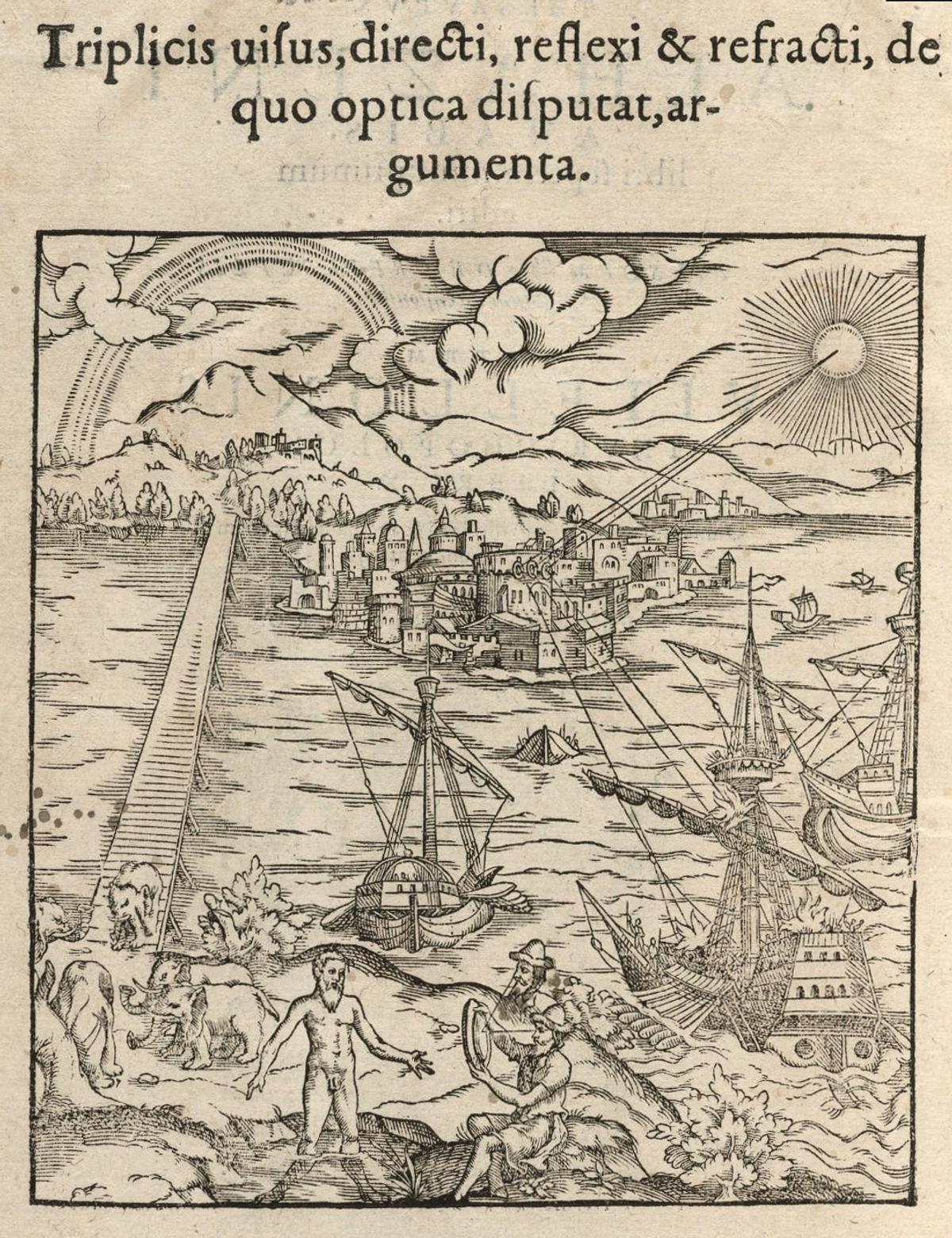
Alhazen remained under house arrest for a decade. Bound to his abode with nothing but his interests, he developed groundbreaking theories of vision in a book entitled Kitab al-Manazir (‘Book of Optics’). Given the physical limitations of his house arrest, he spent a lot of time building, tinkering and experimenting with instruments that helped him understand the behaviour of light. His vast knowledge was his sole resource during the imprisonment. As a polymath, Alhazen combined his knowledge of geometry, astronomy, optics and engineering. He developed mathematical equations to explain how light worked, studied many astronomical phenomena, especially stars, to explain theories of brightness, and used engineering principles of the camera obscura to mimic the function of the eye.
His most influential contribution remains foundational to optics. Alhazen was among the first to argue that vision results from light entering the eye, not rays emitted by it. This was his influential theory of intromission. His views put him at odds with such greats as Ptolemy, Euclid and Galen, whose emission theory of optics held that the eye projected rays onto the objects it perceived. But Alhazen countered that this couldn’t be squared with astronomy: if the eye had to send out rays before we could see anything, there’d be no way to explain how we see distant stars the instant we open our eyes.
Aeon for more